
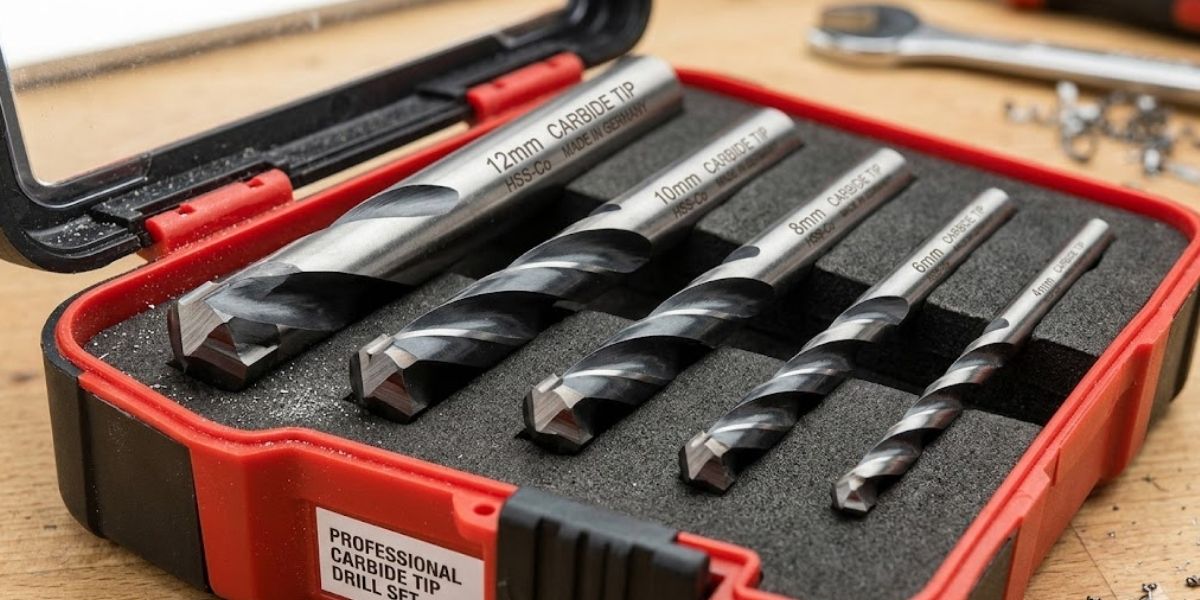
If you are pricing anchor installations, steel penetrations, or repetitive production drilling, carbide tipped drill bits are not a small tooling decision. They directly affect labor hours, hole tolerance, inspection risk, and your real cost per compliant hole. This guide breaks down the efficiency data that matters, where carbide outperforms standard steel, and how to buy for production instead of buying for shelf price.
Why Drilling Efficiency Data Matters on Commercial Jobs
On a commercial job, drilling efficiency is measured at the installed system level, not at the packaging level. A bit that saves 12 seconds per hole across 2,000 anchor holes saves 6.7 labor hours before you even count fewer changeouts, less rework, and less time clearing rough or undersized holes. That changes production planning, crew loading, and bid protection fast.
You also deal with a harder reality than a small shop or residential contractor: every bad hole creates a chain reaction. Oversized holes affect anchor performance. Rough walls trap dust. Worn bits drift out of tolerance. Crew members stop to swap tools, hunt replacements, or redrill rejected locations. None of that shows up in the unit price of a standard steel bit, but it shows up in your labor report.
For estimators and project managers, drilling data matters because it sharpens bid accuracy. For field supervisors, it matters because it protects throughput. For engineers and inspectors, it matters because hole quality is tied directly to anchor system performance and manufacturer installation requirements. If you are already tracking installed cost, you are already in the right conversation. The only question is whether your bit selection matches the production target.
Carbide Tipped Drill Bits vs Standard Steel at a Glance
Carbide tipped drill bits use a tungsten carbide cutting tip bonded to a steel body. In practice, that gives you a much harder cutting edge than standard steel, plus better wear resistance and better performance under heat. Standard steel bits, by contrast, rely on the steel body itself as the cutting edge. That works for lighter-duty drilling, softer materials, and intermittent use. It breaks down fast in production conditions.
The comparison is straightforward. Carbide tipped bits hold an edge longer, maintain hole quality longer, and keep drilling at a consistent rate deeper into the run. Standard steel bits cost less upfront, but slow down as heat builds and edges wear. In commercial work, that difference is rarely academic. It shows up in crew output by mid-shift.
That is why high-PSI concrete drilling performance and anchor prep planning need to be evaluated together. Your bit choice is part of the installation system.
What Counts as “Standard Steel” in Real-World Purchasing
In real purchasing, standard steel usually means plain carbon steel bits or basic high-speed steel, often sold as general-purpose metal drilling bits. That category does not include premium cobalt bits, advanced coated HSS, or fully solid carbide tooling. Those are separate performance classes and should be treated that way.
This distinction matters because the phrase “steel bit” gets abused in product listings. A buyer comparing carbide tipped bits against coated M35 cobalt or premium TiAlN-coated HSS is not making a true carbide-vs-standard-steel comparison. The baseline category here is uncoated or basic-purpose steel tooling used for routine drilling at a lower acquisition cost.
Once you define the baseline honestly, the efficiency gap becomes easier to evaluate. Standard steel is the economy option for limited workload, softer substrate, and low replacement concern. It is not the right benchmark for high-output anchoring or sustained drilling into hard material.
Where Carbide Tipped Bits Fit in the Performance Ladder
The performance ladder is simple. Plain carbon steel sits at the bottom for durability. Basic HSS sits above it for general shop and maintenance use. Cobalt and coated HSS improve heat resistance and wear. Carbide tipped bits step up again for hard, abrasive, or production-heavy drilling where edge retention and dimensional control matter. Solid carbide sits higher still in specialized machining and rigid setups, but with greater brittleness and cost sensitivity.
For commercial buyers, carbide tipped bits often hit the best balance. You get much of the hardness and wear benefit associated with carbide, but in a format better suited to portable tools, hammer drills, rotary hammers, and field conditions than fully solid carbide options. That is why advanced materials and coatings keep gaining ground in North American drilling markets.
The Core Efficiency Metrics You Need to Evaluate
If you want a clean buying decision, stop looking at catalog adjectives and track measurable outputs instead: time per hole, holes per bit, hole tolerance, surface condition, heat behavior, and rework rate. Those are the metrics that determine operating cost.
Time per hole tells you how fast a crew moves when the bit is fresh and, more importantly, how fast it still moves after 50, 100, or 300 holes. Holes per bit tells you replacement frequency and stocking demand. Heat buildup tells you whether performance stays stable under repetitive work. Edge retention tells you whether the hole at the end of the shift is as clean as the first one. Put together, those numbers give you total cost per hole.
For anchor-heavy scopes, also track dust clearing time, rejected holes, and compliance-related corrections. If anchor manufacturers specify hole diameter, embedment depth, and hole condition, your drilling process is no longer just a tooling issue. It is a system-quality issue. That overlaps directly with certified anchoring procurement standards.
Drilling Speed and Material Removal Rate
Carbide tipped bits maintain cutting efficiency better because the cutting edge stays sharp longer under load. That means more consistent penetration rate and less drop-off over the life of the bit. In lab data on AA 6061 aluminum, feed rate was the strongest driver of material removal rate, but tool material still affected finish and sustained performance. That lines up with field reality: setup discipline matters, but a better edge still wins.
This is where buyers get tripped up. A premium bit does not override poor feed pressure, bad alignment, weak tool platform, or wrong RPM. But once those variables are under control, carbide pulls away from standard steel because it resists wear while holding cutting geometry. You spend less time pushing a dull bit through material.
On repetitive jobs, that matters more than peak speed on the first few holes. Any cheap bit can look acceptable in a short trial. Production drilling exposes the difference.
Tool Life and Wear Rate
Tool life is not just a replacement issue. It is a downtime issue, a procurement issue, and a labor issue. When a bit wears out early, your crew stops. When a crew stops, your hole count drops. When your hole count drops, your labor cost per installed anchor rises.
Research keeps pointing in the same direction. Harder, more engineered cutting systems beat basic uncoated steel on wear. In dry drilling tests on Al7075, coated bits outperformed uncoated across 100 holes, and WC/C-coated samples showed the lowest wear rate. That is not a direct carbide tipped versus standard steel field test, but it reinforces the broader principle: wear resistance drives output.
For high-volume jobs, longer tool life also reduces inventory churn. That matters when you are trying to keep crews moving across multiple floors or phases and cannot afford shortages or emergency substitutions. If you are tightening supply continuity, the same logic applies to organizing your consumables pipeline.
Hole Quality, Surface Finish, and Dimensional Accuracy
Hole quality has direct installation consequences. Anchors, expansion fasteners, threaded inserts, and mechanical fixing systems all depend on diameter control and clean wall condition. A rough, tapered, chipped, or oversized hole is not just ugly. It changes fit, pullout behavior, torque response, and inspection confidence.
A 2026 drilling study on AA 6061 reported that carbide produced the lowest surface roughness compared with HSS. That matters beyond machine shops. Cleaner hole walls improve consistency in fastening operations, especially when you are repeating the same diameter through long runs and need predictable anchor seating.
In commercial construction, cleaner holes also reduce the temptation to “make it work” in the field. That is where compliance problems start. If the bit is drifting or tearing material, your anchor installation is already off the rails.
Heat Resistance and Performance Under Continuous Use
Heat is where standard steel starts losing the argument. As friction rises, edge sharpness drops, cutting slows, and the bit begins rubbing more than cutting. That creates a downward spiral: more heat, more wear, more force, rougher holes, more breakage.
Carbide handles sustained heat far better. That is one reason carbide drill bits are gaining popularity in the United States for demanding work requiring longer life and better cutting performance. In repetitive drilling, thermal stability is productivity stability.
The catch is brittleness. Carbide tipped bits are harder, but they demand proper use. Poor alignment, side loading, and aggressive misuse can chip the cutting edge. That does not weaken the case for carbide. It simply means you need the right operator discipline and the right tool platform to capture the efficiency gain.
What the Available Performance Data Shows
https://www.youtube.com/watch?v=dzpvsAkAJOY
The available research does not hand you a single field chart showing every substrate and every bit type. But the pattern is still clear. Harder edges, better surface engineering, and higher wear resistance produce better sustained drilling results than basic steel tooling. That shows up in finish quality, wear rate, thermal stability, and long-run efficiency.
Market data supports the same trend. Drill bit manufacturers are investing heavily in higher-performance materials because end users in construction, manufacturing, mining, and energy demand longer life and better output. One market report identifies carbide as the largest material category due to hardness and durability. That is not hype. It reflects what demanding users keep buying.
Surface Finish Data from Aluminum Drilling Studies
AA 6061 data is useful because it isolates tool-material effects in a controlled drilling comparison. Carbide bits delivered the best surface finish of the tested tools, beating HSS on surface roughness. That tells you the edge stays cleaner through the cut and produces less tearing at the hole wall.
Even if your work is not aluminum production machining, the principle carries over. A bit that creates a smoother hole in controlled testing is demonstrating sharper geometry retention and better cutting behavior. That matters in panels, fabricated components, mixed-material assemblies, and any job where repeatability counts.
Wear and Coating Research That Supports the Trend
The Al7075 dry-drilling study adds another useful layer. Coated HSS bits outperformed uncoated HSS across 100 holes, and WC/C coatings showed the lowest wear and highest hardness among the tested coatings. The message is direct: harder, lower-friction cutting systems last longer and maintain performance better than plain steel.
You should not misread that as “coated HSS equals carbide tipped in every job.” It does not. But it absolutely supports the direction of travel in drill-bit engineering. Better edge material and better surface engineering produce lower wear, lower friction, and longer useful life. Carbide tipped bits sit firmly inside that high-performance category.
What This Data Means for Field and Shop Applications
In the field, this translates into more stable drilling over long runs, less force required as the job progresses, and fewer tolerance failures from worn edges. In the shop, it means better repeatability and cleaner hole walls in metals and mixed substrates.
For commercial crews drilling structural steel, stainless, base plates, embeds, concrete anchors, or repetitive mechanical penetrations, the practical takeaway is simple: the more holes you drill, the more carbide earns its keep. Standard steel falls behind quickly once heat, wear, and tolerance control become production issues.
Material-by-Material Performance: Where Carbide Wins and Where Standard Steel Stalls
Bit selection should follow substrate, not marketing language. If your material changes, your productivity math changes with it.
Structural Steel and Stainless Steel
Hard metals punish standard steel fast. Structural steel exposes wear through slower penetration and rising heat. Stainless adds work-hardening risk, which makes a dull bit even slower and hotter. Once that cycle starts, your crew burns time and bits.
Carbide tipped bits perform better here because the cutting edge stays intact under heat and pressure. Industry guidance on hard-metal drilling consistently places carbide and cobalt above basic steel for stainless, cast iron, and other high-resistance materials. If your scope includes repetitive steel drilling, standard steel is the wrong cost-saving move.
Concrete, Masonry, and Anchoring Applications
In concrete and masonry, carbide tipped bits are already the standard because the substrate is abrasive and unforgiving. Hammer drilling and rotary hammer anchor prep demand hard cutting edges that hold diameter and resist premature wear. If your bit rounds over, hole quality goes with it.
That matters because anchoring is not just about making a hole. It is about making the right hole. Diameter consistency, embedment control, dust removal, and edge integrity affect installation quality and inspection results. If your work centers on post-installed anchoring, your drilling strategy should align with structural anchor compliance requirements and with application-specific guidance for masonry fastening in brick and block.
Aluminum, Composites, and Mixed Substrates
Aluminum rewards sharp edges and good geometry. Composites punish poor geometry by fraying, chipping, or drifting out of size. Mixed substrates expose weakness in bits that lose edge condition too fast.
Carbide performs well here because it holds geometry and produces repeatable hole quality across the run. In high-precision environments, carbide-based designs have also shown better exit quality and hole-size stability in composite drilling. That same consistency matters on commercial work involving curtain wall components, fabricated assemblies, panel systems, and mixed-material penetrations.
The Cost Equation: Price per Bit vs Cost per Hole
This is the section most buyers skip, and it is where money is actually won or lost.
A cheaper bit is only cheaper if you ignore labor. If Bit A costs $8 and drills 40 compliant holes at 40 seconds each, while Bit B costs $24 and drills 220 compliant holes at 24 seconds each, Bit B is the lower-cost option by a wide margin. Here is the math:
Bit A: 40 holes x 40 seconds = 1,600 seconds, or 26.7 minutes of drilling time per bit
Bit B: 220 holes x 24 seconds = 5,280 seconds, or 88 minutes of drilling time per bit
Now compare cost per hole. Bit A costs $0.20 per hole. Bit B costs $0.109 per hole. Already better. Now add labor. At a fully burdened labor rate of $85 per hour, drilling time costs roughly $0.94 per hole for Bit A and $0.57 per hole for Bit B. Total operating cost becomes about $1.14 per hole for Bit A versus $0.68 per hole for Bit B.
That is a 40 percent reduction in total cost per hole before you count tool changes and rework.
For high-volume commercial field operations, that is why CEP’s heavy-duty carbide tipped drill bits sit in the industry-standard category. You are not buying a premium label. You are buying fewer labor hours, fewer interruptions, and tighter output control.
Upfront Cost vs Crew Productivity
Upfront price belongs in the analysis, but it should never control it. If your crew stands around changing dull bits, waiting for replacements, or forcing slow cuts through hard material, you are paying for that with the most expensive line item on the job: labor.
A production-focused buyer calculates tooling in labor-hours saved. That is the correct lens for anchor packages, repetitive penetrations, and any scope with deadline pressure.
Downtime, Rework, and Inventory Consumption
Downtime hides everywhere. It shows up in extra trips to the gang box, emergency supply runs, broken bits, rejected holes, and extra cleaning time. Rework is worse, because it burns labor twice and raises inspection exposure.
Inventory consumption matters too. If your standard steel bits disappear twice as fast, your purchasing team spends more time replenishing low-value consumables, and your field teams face more substitution risk. That is where smarter sourcing and consolidating fastener and tool procurement starts saving real money.
When Paying More Delivers a Better Bid Position
Better drilling performance improves your bid position when the scope contains large hole counts, tight tolerances, hard substrates, or inspection sensitivity. Faster, more stable drilling gives you more confidence in crew-hour assumptions. Longer tool life reduces contingency pressure. Cleaner holes reduce punch-list exposure.
That means premium bits do not just protect execution. They protect estimating.
Key Buying Factors for Commercial Contractors and Advanced Bidders
A serious purchase decision should be built around application fit, output expectations, and compliance requirements. If a supplier cannot support that conversation, the supplier is selling boxes, not solutions.
Bit Geometry, Tip Design, and Flute Efficiency
Geometry controls how the bit enters, cuts, and clears debris. Tip angle affects centering and penetration behavior. Flute design affects chip evacuation. Poor evacuation means more friction, more heat, and slower progress. In masonry and anchoring work, debris management also affects final hole condition.
You should match geometry to the substrate and drilling method. A bit with a strong carbide tip but poor evacuation design still loses efficiency.
Coatings, Substrate Material, and Application Match
Material and coatings work together. Carbide gives hardness and edge retention. Coatings can reduce friction, improve wear, and manage heat. But neither one excuses a mismatch between bit and substrate.
If you are drilling hard metals, stainless, abrasive concrete, or mixed assemblies, buy for that exact duty cycle. If you are doing light punch-list work in soft material, do not overbuy. Application match decides value.
Shank Compatibility and Tool Platform Requirements
Bit performance collapses if the shank does not match the tool platform. SDS-Plus, SDS-Max, straight shank, and hex interfaces all serve different tools and torque profiles. A premium carbide tip on the wrong shank does not deliver premium output.
You also need to consider drill press versus handheld use, hammer mode versus rotary-only, and the rigidity of the setup. Carbide works best when the platform supports stable, controlled cutting.
Tolerance Control for Anchors and Fasteners
For anchors and fasteners, tolerance is not a side issue. Hole diameter affects holding values, installation torque, expansion behavior, and manufacturer approval. If the bit is out of size or wearing unevenly, your anchor system is compromised before installation is complete.
That is why drilling decisions should connect directly to concrete anchor sourcing strategy and to the required performance of the installed fastening system.
When Standard Steel Still Makes Sense
Standard steel still has a place. It just has a narrow one.
Low-Volume Drilling in Softer Materials
If you are drilling a small number of holes in softer metals, plastics, wood, or light-duty material, standard steel is a rational cost-control option. The lower upfront cost makes sense when cycle time, edge life, and tolerance drift are not production problems.
This is especially true for intermittent use where the bit will spend more time in storage than in service.
Maintenance, Punch-List, and One-Off Work
Maintenance crews and punch-list teams often prioritize availability over maximum productivity. If the task is one-off, non-repetitive, and low consequence, standard steel can be sufficient.
The mistake is letting a maintenance-grade buying habit bleed into a production schedule. That is where cheap bits become expensive.
Common Buying Mistakes That Kill Drilling Efficiency
Most drilling inefficiency is purchased before the job starts.
Choosing by Unit Price Alone
Unit price is the fastest way to buy the wrong bit. It ignores labor, tool changes, rework, and inspection risk. In production work, cost per hole beats shelf price every time.
Using the Wrong Bit for the Substrate
Trying to use standard steel on hard metals, abrasive surfaces, or high-volume anchor drilling is a specification failure. The bit is wrong for the workload, and the field pays for it.
Ignoring Feed, Speed, and Cooling Variables
Premium carbide tipped drill bits still require correct RPM, feed pressure, alignment, and cooling strategy where applicable. Bad operating parameters reduce output and can chip even a good bit.
Overlooking Compliance and Anchor Manufacturer Requirements
If the installed anchor system has required hole diameter and preparation standards, your drill bit choice is part of compliance. Miss that, and you create unnecessary risk for inspections and performance signoff.
Best Recommendations by Use Case
A buyer’s guide should end with a decision rule, not vague advice.
Best Choice for High-Volume Commercial Anchoring
For large anchor schedules in concrete, masonry, and structural installations, choose carbide tipped drill bits. You need hole consistency, edge retention, and fewer interruptions. That combination protects both productivity and code-compliant installation quality.
Best Choice for Hard Metals and Repetitive Production Drilling
For stainless, structural steel, cast materials, and repetitive fabrication or field penetrations, carbide-tipped solutions are the right call. Harder material and higher hole counts justify the higher acquisition cost quickly.
Best Choice for Budget-Controlled General Maintenance
For light-duty maintenance, soft materials, and low hole counts, standard steel remains acceptable. Keep it there. Do not let it migrate into production scopes where it drags labor and quality.
How to Specify Carbide Tipped Drill Bits for Procurement and Field Success
A vague tooling spec invites substitution, confusion, and field complaints. A clean spec protects output.
What to Include in a Purchase or Bid Spec
Include diameter, usable length, overall length, shank type, target substrate, drilling method, required tolerance, expected hole count, and any coating or tip requirements. Also define whether the application is anchor prep, metal penetration, or mixed-material work.
If anchor performance is tied to the drilled hole, call that out clearly. Procurement language should reflect installation requirements, not just tool dimensions.
Questions to Ask Your Supplier Before You Buy
Ask whether the bit is matched to the exact substrate and tool platform. Ask about expected life in repetitive production work. Ask about bulk availability, lead times, and domestic sourcing. Ask for technical data that supports the application instead of generic sales language.
For larger projects, also ask whether the supplier can support continuity across phases and replenishment windows. That matters just as much as the first shipment. If your project is sensitive to schedule disruptions, it helps to tighten the broader supply strategy around reducing jobsite downtime through planned bulk supply.
Frequently Asked Questions
Are carbide tipped drill bits worth the higher price?
Yes, when hole count, hard material, or tolerance control matters. The right comparison is cost per compliant hole, not price per bit. Longer life and faster sustained drilling reduce labor cost enough to justify the higher purchase price quickly.
Do carbide tipped drill bits drill faster than standard steel?
Yes, especially over repeated holes and in harder materials. The biggest advantage is not just initial speed. It is sustained speed after heat and wear start building. Standard steel slows down sooner.
What materials justify switching from standard steel to carbide tipped bits?
Structural steel, stainless steel, concrete, masonry, abrasive substrates, composites, and precision-sensitive mixed materials all justify the switch. If the job involves repetitive drilling or inspection-sensitive hole quality, carbide is the right move.
How do carbide tipped bits affect anchor hole quality?
They hold cutting geometry longer, which helps maintain diameter, cleaner walls, and better consistency across the drilling run. That supports correct anchor fit and reduces the chance of tolerance-related installation issues.
Can standard steel bits still be used on commercial projects?
Yes, for low-volume, low-consequence drilling in softer materials or maintenance tasks. Once the work becomes repetitive, abrasive, hard, or compliance-sensitive, standard steel stops being economical and starts becoming a liability.
If your drilling scope is tied to anchoring performance, steel hardness, or production throughput, treat bit selection as a cost-control decision, not a consumables purchase. That one shift in mindset changes your bids, your field output, and your margin protection.
