
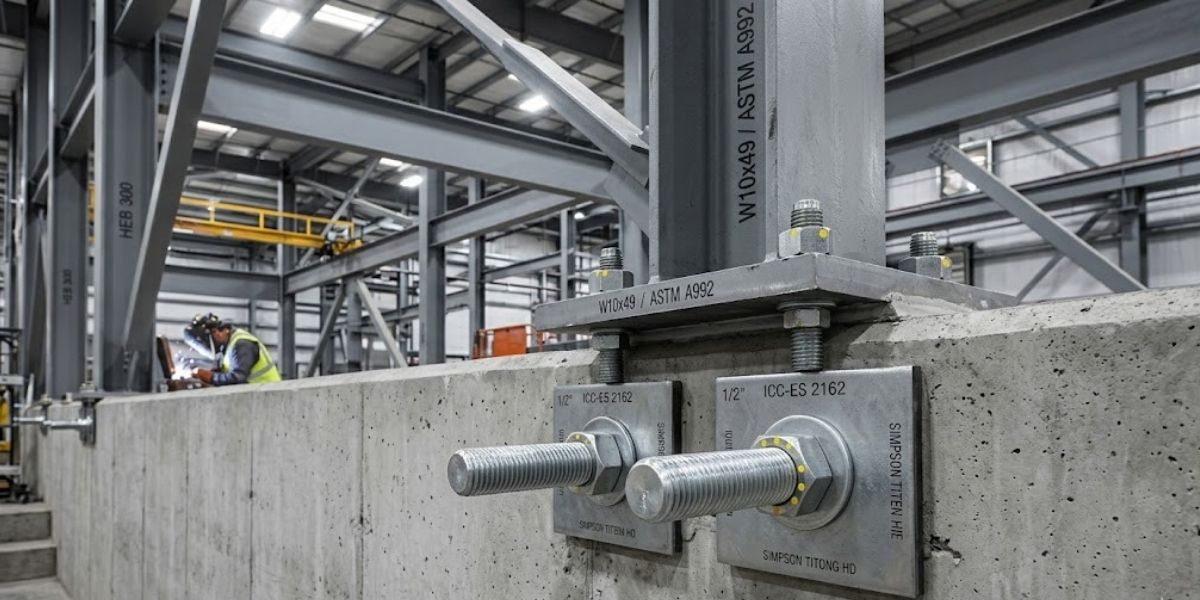
If you are still buying structural anchoring systems by pull value and unit price, you are exposing your project to rejected submittals, inspection failures, and expensive rework. Certified structural anchoring systems now define the standard on commercial work, because code enforcement, retrofit demand, and liability have moved anchorage from a commodity purchase to an engineered compliance decision.
Why Certified Structural Anchoring Systems Are Replacing Legacy Anchor Selection
Commercial anchorage has changed. Your bid package now lives or dies on documentation, tested performance, and installation control, not on a catalog claim that an anchor “holds enough.” Demand for certified systems keeps rising as building code evolution pushes safety-critical connections toward tested, third-party-approved products.
What “Certified” Means in Structural Anchoring
Certified means the anchor is part of a documented system. You need ICC-ES reports, ETA approvals where specified, UL listings when fire-rated or listed assemblies are involved, seismic approvals, corrosion data, and manufacturer instructions tied directly to tested performance. A generic anchor gives you a part number. A certified system gives you a defensible submittal.
That difference matters during plan review and inspection. When your team can pull current technical data sheets and approvals from CEP without delay, your package moves faster and your field crew installs to a defined standard instead of guesswork.
Why Commodity Anchors Create Compliance Risk
Commodity anchors create trouble because they are often selected on static pull values alone. That ignores cracked versus uncracked concrete, substrate condition, seismic category, edge distance, embedment limits, and approved installation steps.
The result is predictable: rejected substitutions, RFIs, redesign time, and failed inspections. If you need a deeper comparison between adhesive and expansion options, start with how bonded and torque-set systems differ in the field.
The Core Buying Criteria for Structural Anchoring Systems
You need a simple standard: match approvals, substrate, load case, environment, and installation controls before you release the order.
Approval Documents and Code Acceptance
Start with current approval documents. Verify load tables, concrete strength assumptions, cracked concrete ratings, masonry approvals, and seismic suitability. A dated ESR or incomplete load table is not a harmless paperwork issue. It is a submittal delay waiting to happen.
Approved documentation also protects your estimate. When your bid includes anchors with clear code acceptance, you reduce review friction and defend your numbers against last-minute substitution pressure.
Substrate Compatibility and Existing Conditions
Anchor selection starts with the base material, always. Normal-weight concrete, lightweight concrete, grout-filled CMU, solid masonry, stone, and aging retrofit slabs do not share the same design values.
Historic masonry is where bad assumptions get expensive fast. Design guidance for natural stone remains limited, and engineers often default to conservative factors of safety or field testing instead of relying on concrete values. If your project includes block and brick assemblies, matching products to masonry conditions prevents the most common specification errors.
Load Case, Seismic Demand, and Fatigue Exposure
Static tension is only one part of the story. Your selection must account for combined tension and shear, stand-off conditions, vibration, cyclic loading, and seismic demand. Recent fatigue research on post-installed anchors supports anchor-specific design categories such as FAT 50 in tension, which tells you standard bolt assumptions do not always fit structural anchors.
Stand-off conditions deserve special attention. Research found ungrouted stand-off setups can raise peak anchor stresses by about 35 percent, which is enough to turn a compliant detail into a problem detail.
Corrosion Resistance and Service Environment
Zinc-plated carbon steel belongs indoors in controlled environments. Once you move into exterior exposure, parking structures, coastal work, wastewater plants, or chemical processing, you need stainless, hot-dip galvanized, or a coating system with documented resistance.
In South Florida conditions, corrosion is not an upgrade line. It is part of compliance and lifecycle performance. A cheap plated anchor in a salt-air environment creates future failure by design.
Comparing the Main Types of Structural Anchoring Systems
Most commercial buyers are comparing three choices: mechanical, adhesive, and cast-in versus post-installed systems.
Mechanical Anchors
Mechanical anchors include wedge anchors, sleeve anchors, drop-ins, undercut anchors, and torque-controlled systems. Their appeal is obvious: fast installation, immediate loading, and repeatable performance in sound concrete. That is one reason expansion anchors continue to hold a large market share, and torque-controlled installation remains a dominant method on commercial work.
The limitation is just as obvious. Mechanical anchors are unforgiving in poor substrates, edge-sensitive details, and many retrofit conditions.
Adhesive and Bonded Anchor Systems
Adhesive systems include epoxy, vinyl ester, and hybrid formulations for threaded rod, rebar doweling, cracked concrete, and rehabilitation work. These systems give you embedment flexibility and better adaptation to irregular or damaged conditions. That is why injectable adhesives are gaining ground in retrofit-driven projects.
But scheduling discipline matters. Minimum cure time is not full stiffness stabilization. In 93 pull-out tests, bond strength changed little after minimum cure, but stiffness kept increasing with longer curing. If you load too early just because the clock hit the minimum, you are building risk into the connection.
Cast-In Versus Post-Installed Systems
Cast-in anchors remain the cleanest choice for new concrete placement where locations are fixed and coordination is tight. Post-installed systems win on renovation, missed embeds, relocated equipment, change orders, and structural rehabilitation.
That shift matters because retrofit demand keeps growing. If your procurement scope includes existing slabs and foundation work, planning large concrete anchor purchases around project phases gives you far better control over substitutions and lead times.
Where Compliance Failures Happen During Selection and Installation
Most anchor failures start before load is applied. They start in selection and installation.
Mismatching the Anchor to the Substrate
Concrete values do not automatically apply to CMU, stone, or deteriorated slabs. Unsupported assumptions here create engineering exposure and legal exposure at the same time.
Ignoring Hole Preparation, Torque, and Embedment Control
Hole diameter, hole cleaning, brush-and-blow procedures, torque verification, spacing, and embedment depth directly affect performance. If your drilling setup is inconsistent, your anchor performance is inconsistent. That is why choosing bits for high-PSI concrete belongs in the same conversation as anchor compliance.
Treating Cure Time as a Scheduling Shortcut
Vinyl ester systems can reach minimum cure in roughly one to two hours at room temperature, while epoxy systems often need ten to twelve. Ambient temperature changes that schedule. Inspection timing must reflect that reality.
Using Incomplete Documentation in Submittals
Missing ESRs, outdated load tables, and generic alternates without equivalent approvals are still common. Every one of those issues burns time. For high-volume work, tightening your documentation and purchasing process keeps anchor packages inspection-ready.
Budgeting for Certified Structural Anchoring Systems
The cheapest anchor on paper is often the most expensive anchor on the project.
When Lower Unit Cost Becomes Higher Project Cost
Cheap anchors drive overdrilling, failed inspections, replacement labor, and schedule slip. Anchor failure costs money long before it becomes a structural event.
Where It Pays to Spend More
Spend more on seismic retrofits, suspended overhead loads, façade connections, equipment anchorage, corrosive environments, and high-volume installations where repeatable installation speed matters.
Bulk Procurement and Bid Strategy
On large commercial work, consistency matters as much as price. You need approved substitutions, stable inventory, and supplier access to specialty items and drilling equipment. CEP’s technical data sheets and bulk fulfillment support that standard, which is exactly what protects your schedule and margin.
Best Structural Anchoring System Choices by Project Use Case
Your selection should follow the application, not habit.
New Commercial Concrete Construction
For predictable concrete and tight schedules, mechanical anchors and cast-in systems usually lead because they install fast and accept immediate loading.
Seismic Retrofit and Structural Rehabilitation
Use certified post-installed adhesive anchors and rebar connection systems with documented seismic approvals. Existing concrete brings uncertainty and more scrutiny, so engineered submittal support is non-negotiable.
Masonry, CMU, and Historic Substrates
Use products specifically approved for masonry, and treat historic stone conservatively. Where catalog assumptions stop, field verification and engineered validation start.
High-Corrosion and Coastal Projects
Upgrade materials early. Parking decks, marine-adjacent structures, and wastewater facilities demand corrosion resistance as a baseline requirement, not an add-on.
How to Vet a Supplier Before You Upgrade
A structural anchoring system is only as reliable as the documentation and support behind it.
Technical Support and Documentation Access
Your supplier must provide current approvals, installation instructions, load data, and product matching quickly. If that support is slow, your project slows with it.
Inventory Depth and Large-Volume Reliability
Large phased projects need inventory depth, bulk order consistency, and access to specialty systems. CEP’s 10,000-plus product inventory and factory-backed sourcing are built for that reality.
Why Certified Systems Need Certified Installation Support
Catalog values do not install anchors. Proper dispensers, cleaning tools, drill bits, torque tools, and field guidance do. If installation support is missing, certification exists only on paper.
What Your Upgrade Path Should Look Like
Upgrading means replacing habit-based anchor selection with a documented internal standard.
Your 5-Point Evaluation Checklist
Check five items every time: approval status, substrate match, load case, service environment, and installation controls. If any one of those is unclear, the anchor is not ready for release.
Building a Compliance-First Specification Standard
Standardize approved systems across estimating, engineering, project management, and field supervision. That cuts substitutions, shortens review cycles, and resolves inspection failures before they start. Once your team uses CEP technical product data sheets as the baseline for every anchorage package, your process becomes faster, cleaner, and easier to defend.
Frequently Asked Questions
What makes a structural anchoring system code-compliant?
Code-compliant means the system has current approval documents, tested load data, installation instructions, and any required seismic, fire, or corrosion documentation that matches your application and substrate.
Are UL-listed anchors always required?
No. UL listing applies where listed assemblies, fire-rated systems, or specific code conditions require it. For many structural connections, ICC-ES reports, seismic approvals, and manufacturer test data are the controlling documents.
Why do adhesive anchors fail inspection so often?
Most failures trace to hole cleaning, temperature-related cure timing, wrong embedment, or incomplete submittal data. The product is rarely the problem. Installation control is.
Can you use concrete anchor values in CMU or stone?
No. Design values are substrate-specific. Concrete approvals do not transfer automatically to block, brick, or historic stone.
When should you upgrade from zinc-plated to stainless or galvanized anchors?
Upgrade as soon as the connection faces exterior weather, coastal exposure, parking deck moisture, wastewater conditions, or corrosive chemicals. In those environments, corrosion resistance is part of proper design, not a premium option.
