
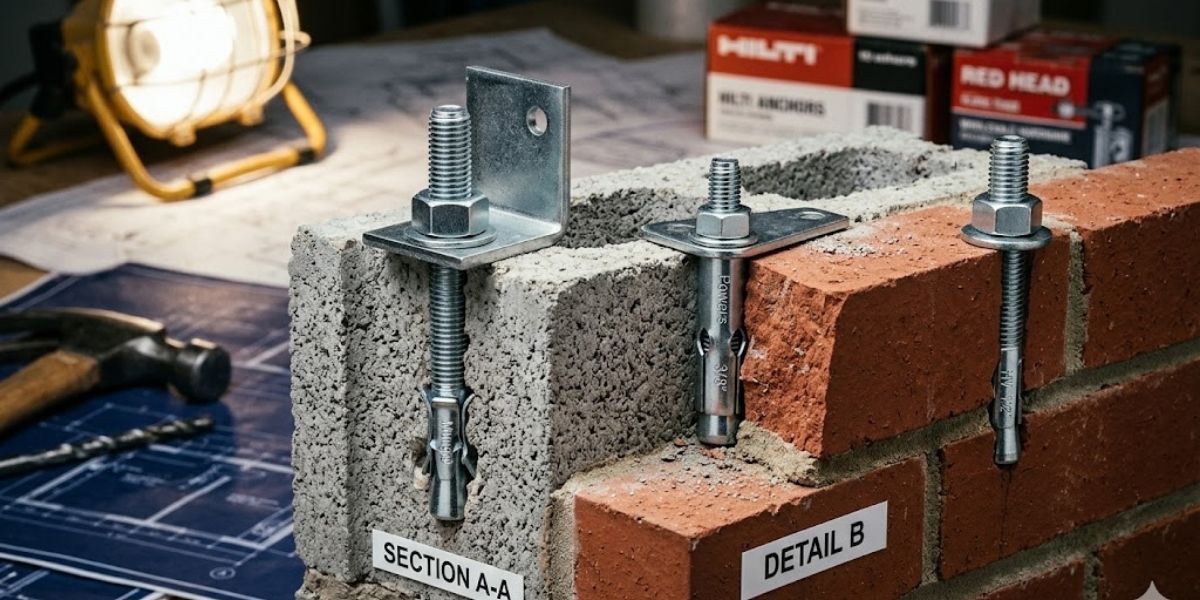
Buying wholesale masonry anchors for commercial brick and block work is not a fastener decision, it is a performance decision. If you buy by shelf label instead of tested substrate, drilling method, embedment, and compliance path, you build failure into the job before the first hole gets drilled. This guide breaks down the technical specifications that actually control anchor performance at commercial scale, so you can buy with confidence, protect your schedule, and keep inspections moving.
What “Wholesale Masonry Anchors” Means on Commercial Brick and Block Projects
In commercial procurement, wholesale masonry anchors are not retail-grade mixed boxes for light-duty maintenance work. The term refers to high-volume, specification-driven post-installed anchoring systems used in brick, CMU, grout-filled block, hollow block, and mixed masonry assemblies. That includes mechanical anchors, screw anchors, adhesive systems, threaded rod, sleeves, screens, setting tools, drill bits, cleaning accessories, and the documentation that makes the system acceptable to engineers, inspectors, and owners.
That distinction matters. A commercial bidder does not need an anchor that simply “fits masonry.” You need an anchoring system with substrate-specific load data, installation instructions that can be repeated by crews across hundreds or thousands of placements, corrosion options matched to exposure, and traceability strong enough to support submittals, inspections, and closeout.
At wholesale scale, anchor selection also affects labor planning, not just material cost. If your project requires controlled cure times, rotary-only drilling, screen tubes, proof testing, or torque verification, those are procurement issues from day one. The wrong anchor purchased in volume is not a bargain. It is rework, inspection failure, and lost production.
That is why CEP treats masonry anchoring as a system category, not a commodity hardware line. With more than 10,000 products in stock and access to specialty domestic factory sourcing, you can align quantity, compliance, and field performance before the order leaves the warehouse.
Why Anchor Performance in Masonry Is More Complex Than in Concrete
Concrete gives you a more uniform base material. Masonry does not. Brick units vary by density and brittleness. CMU changes by web geometry, face-shell thickness, and grout condition. Mortar joints introduce another material entirely, often weaker, often inconsistent, and frequently weathered in retrofit work. Once you move into existing buildings, patching, moisture, hidden voids, and undocumented repairs make the substrate even less predictable.
That is why catalog ratings alone are dangerous in masonry. Published values often assume controlled testing conditions that do not match your existing wall, your drilling method, or your installation location inside the unit. Real capacity depends on where the anchor bears, how the hole was drilled, whether the shell cracked, and how load is transferred into the surrounding material.
Research keeps pointing in the same direction: performance is substrate-dependent, and installation quality changes outcomes materially. A field study of 400 adhesive anchors in 11 masonry buildings found that adhesive type, masonry strength, embedment, anchor diameter, installation direction, and use of mesh sleeves all changed performance. That is exactly why a masonry spec has to be built around the actual wall, not a generic fastener category.
Brick, CMU, Hollow Block, and Mortar Joint Differences
Solid brick gives you a denser, more continuous substrate, but it is also brittle. Expansion force that performs acceptably in sound concrete can split brick near edges or corners. Pullout resistance is strongly influenced by anchor location. In controlled testing of chemical anchors in solid clay brick, anchors placed in the body of an uncracked brick generally showed the highest tension resistance, while mortar-joint placements were more vulnerable to pullout and local damage.
CMU changes the equation. In hollow block, the face shell carries the initial bearing unless the anchor system is designed to span the void or bond through a screen tube. Face-shell thickness becomes a controlling variable. If the shell is thin and brittle, high expansion pressure, overtightening, or aggressive hammer drilling can crush the shell before the anchor ever develops its nominal load.
Grout-filled block is better, but only if the grout is actually present and properly consolidated. Existing walls often contain partially grouted cells, inconsistent fill, or weak consolidation around reinforcement. If your drawing assumes a solid grouted core and the field gives you voids, your anchor choice changes immediately.
Mortar joints deserve special attention. Joint material varies more than the unit itself, and weathered joints are common in retrofit work. Yet joint installation is not automatically inferior. In one pull-out study, embedment depth increases produced substantial gains in capacity, and installation location changed failure mode and usable strength. The point is simple: joint versus unit is not a rule-of-thumb decision. It is a tested-substrate decision.
Cracked, Weathered, and Existing Masonry Conditions
New construction gives you control. Existing masonry gives you surprises.
Aged mortar loses consistency. Moisture intrusion softens joints, corrodes embedded metal, and creates freeze-thaw damage. Previous patching creates isolated strong and weak zones in the same wall bay. Hidden voids behind brick or inside block webs reduce bearing area. Hairline cracks that look cosmetic can cut anchor performance sharply under tension or repeated loading.
Laboratory testing on chemical anchors in brick masonry showed that a 0.50 mm crack reduced capacity by about half in several configurations, and repeated loading caused another meaningful drop in resistance. That matters for seismic retrofit, façade retention, equipment support, and any application exposed to vibration or cycling.
On retrofit work, treat “existing masonry” as a separate engineering condition. Assume variation. Plan for mockups and proof testing. Buy anchors that have enough documentation to survive what the wall actually is, not what the original drawings suggest it should be.
The Main Anchor Types Used in Brick and Block
Commercial projects generally compare a few core anchor families. Each has a place. None is universal. The right choice depends on load path, substrate condition, environmental exposure, and how much installation variation your project can tolerate.
Mechanical Expansion Anchors
Mechanical expansion anchors transfer load by expanding against the hole wall. In dense, sound, well-confined masonry, that can work well. In brittle brick, near edges, or in weak face shells, expansion force creates risk.
Wedge-style anchors are typically poor choices for hollow masonry because they rely on dense, continuous material to develop holding strength. Sleeve-style anchors spread load over a larger area and are often more forgiving, but they still depend on shell integrity and controlled torque. For commercial work in block, expansion anchors belong in known, suitable substrates, not in uncertain hollow units by default.
Immediate loading is the main advantage. There is no cure delay, no resin temperature window, and no concern about adhesive shelf life. For repetitive mounting in predictable substrate, expansion systems often deliver the fastest production pace. If you are pricing large repetitive runs, compare that labor value against adhesive cure delays and cleaning requirements. If your scope is heavy wedge anchor use in concrete-adjacent conditions, this is where understanding bulk wedge anchor sourcing economics sharpens your purchasing plan.
Screw Anchors for Masonry
Screw anchors cut or form threads in the base material. In masonry, that gives you fast installation, easy visual confirmation of seating, and useful removability for temporary fixtures or adjustable supports. They are often strong performers in solid brick and fully grouted block when hole diameter is exact and the bit is still within tolerance.
The catch is hole sensitivity. An oversize hole, worn bit, drifting drill, or shell blowout destroys thread engagement. That makes drill-bit condition and drilling method part of the anchor spec, not an afterthought. Screw anchors also rely on torque discipline. Overdriving strips the masonry. Underdriving leaves incomplete engagement.
For production teams, screw anchors are attractive because the workflow is clean and fast. For brittle masonry, use rotary-only drilling where specified, verify bit wear, and do not let crews “make it fit” with whatever bit is closest in the gang box.
Adhesive and Epoxy Anchor Systems
Adhesive systems combine resin with threaded rod or rebar inside a pre-drilled hole. That eliminates expansion stress and makes them especially strong in retrofit work, edge-sensitive conditions, and high-load applications. It is also why epoxy anchors for block continue gaining share in commercial masonry work.
The market confirms that shift. Resin fixing systems held 61.40 percent of the anchors and grouts market in 2025 and are forecast to grow fastest through 2031. That is not a trend driven by marketing. It is driven by performance demands in retrofit, infrastructure, and code-driven anchorage.
Adhesive systems are especially effective in hollow masonry when paired with screen tubes. The resin flows through the mesh, keys into the internal geometry, and distributes load along the rod rather than concentrating force at one expansion point. In weak or variable substrate, that broader load transfer is often the difference between a stable installation and a blown face shell.
But adhesive systems demand discipline. Hole cleaning, hole diameter, moisture condition, resin temperature, dispensing technique, gel time, and cure time all control final capacity. If you want a deeper side-by-side look at material and labor trade-offs, the comparison of chemical and mechanical anchor approaches adds useful context.
Sleeve Anchors, Drop-In Anchors, and Specialty Internally Threaded Options
Sleeve anchors are common for medium-duty attachments where through-fixture installation is useful and substrate conditions are known. In hollow masonry, performance depends heavily on shell thickness and whether the sleeve bears in a solid section or starts crushing the face shell. They are practical, but only inside their actual field conditions.
Drop-in anchors and other internally threaded options work best in solid concrete or fully grouted masonry where the body can expand inside a reliable cavity. In hollow block, standard drop-ins are usually poor practice unless the system is specifically engineered for the substrate. That is where procurement errors happen: a suspension detail gets copied from concrete work into block work and passes through estimating without anyone asking where the anchor body will actually bear.
Specialty internally threaded systems make sense where repeated fixture attachment is expected, such as suspended mechanical supports or removable service assemblies. The value is in repeat access and clean thread engagement, not raw universality.
Veneer Ties, Retrofit Connectors, and Hybrid Assemblies
Façade and retrofit anchorage rarely depend on a single component. You are dealing with ties, connectors, insulation stand-off, backup-wall engagement, washers, plates, and sometimes hybrid systems that combine mechanical restraint with bonded elements.
In veneer applications, tie strength and fastener strength must be evaluated as an assembly. Research on brick masonry veneer anchorage found that insulation reduced pullout strength of mechanical fasteners under cyclic loading. That matters because façade details often include insulation layers, clips, or stand-off brackets that increase eccentricity and reduce real capacity.
For wall-to-floor retrofit, parapet stabilization, and façade retention, stop thinking in terms of “anchor only.” Think in terms of complete load path, cyclic demand, and tested assembly behavior.
How to Match the Anchor to the Actual Application
Anchor selection starts with the application, not the product family. Your load path, fixture geometry, eccentricity, exposure, seismic demand, installation access, and substrate certainty determine the correct category. Once that is clear, the anchor type becomes easier to narrow.
Structural Connections and Seismic Retrofit
Structural retrofit work demands tested qualification and documented performance. Generic fastener substitution has no place here. If the anchor supports wall stabilization, collectors, drag struts, reinforcement, diaphragm ties, or other primary load transfer, your specification must align with project code requirements and the substrate being anchored.
In seismic work, cyclic performance matters just as much as static capacity. Past earthquake failures made that painfully clear. During the Canterbury earthquakes, adhesive epoxy anchors in wall-to-floor applications reportedly failed more often than through-bolt connections in certain conditions. The lesson is not “avoid adhesive anchors.” The lesson is “specify qualified systems for the actual connection type, substrate, and demand.”
For these applications, start with anchors that have code-recognized testing and documented seismic qualification. Then verify the exact installation method, rod grade, embedment, and inspection requirements. If your project is already comparing qualified assemblies, reviewing certified structural anchor upgrades helps frame substitution risk correctly.
Hollow Block Attachments and Screen-Tube Applications
Hollow block is where bad assumptions go to die. You cannot treat a hollow CMU wall like concrete with voids. Load is carried by thin shells and webs unless a screen-tube adhesive system redistributes stress across a larger internal zone.
Chemical anchors for hollow block are the standard answer for a reason. The screen tube retains resin, prevents waste into the cell, and builds a bonded mass that engages more material. That approach is more reliable than trying to force high expansion pressure into a thin face shell.
Depth and torque control are especially important here. In hollow block, embedment has to be planned around face-shell thickness, web position, screen length, and rod projection. Torque is not a “tighten until snug” operation. Excess torque crushes the shell, distorts the sleeve, or breaks bond before the anchor is fully cured. On verified CEP wholesale masonry anchors used for hollow block systems, usable load ratings are tied directly to specified hole diameter, screen size, rod diameter, and cure completion. If the system calls for hand snug plus a controlled final set, that is the rule. Field improvisation destroys verified performance.
A practical rule is simple: never let torque demand exceed what the face shell can resist. If the fixture requires aggressive clamp load to pull tight across stand-off, redesign the connection or change the anchor system. Hollow block does not forgive overtightening.
Brick Veneer, Façade, and Nonstructural Life-Safety Attachments
Façade attachments are nonstructural only on paper. If the assembly fails over an entry, sidewalk, loading area, or egress route, it becomes a life-safety event immediately.
Veneer ties, façade supports, and retention anchors must be selected for cyclic demand, stand-off distance, insulation compression, and the actual backup wall. Eccentric loading reduces capacity because the anchor is no longer seeing pure tension or pure shear. It sees a combination, and the fixture amplifies movement.
This is where many specifications fail. The anchor is sized for nominal vertical load, but the assembly is actually controlled by out-of-plane cycling, insulation compression, and repeated wind demand. If your project includes façade supports, compare your assumptions against broader wind-driven fastener selection criteria, then confirm the masonry-specific assembly data before buying.
Equipment, Handrail, Rack, and Support-System Mounting
Commercial mounting work often falls into a gray zone between simple attachment and engineered anchorage. Equipment supports bring vibration. Handrails bring impact and repeated directional load. Storage racks bring overturning demand and edge-distance constraints. Support systems add spacing, slotted holes, and field tolerances that change loading.
Mechanical anchors win when immediate loading, repetitive placement, and predictable substrate dominate. Adhesive systems win when vibration resistance, edge distance, or uncertain masonry conditions dominate. The correct answer is not based on habit. It is based on demand and substrate reliability.
Technical Specifications That Actually Control Anchor Capacity
This is the section that separates compliant purchasing from guesswork. Anchor capacity in masonry is controlled by the combination of embedment, hole quality, base-material strength, loading regime, and environmental exposure. Get these wrong and the anchor category stops mattering.
Embedment Depth, Effective Embedment, and Edge Distance
Embedment depth is not just how deep the rod goes into the hole. Effective embedment is the portion that actually develops load in sound material. In hollow block, any portion extending into an empty void without bonded containment is not contributing the same way a designer assumes in dense masonry.
Deeper is not automatically better. Under-embedment reduces capacity. Over-embedment in brittle masonry can push the load zone into weaker material, increase drilling damage, waste resin, or create installation inconsistency. Research has shown strong gains from increased embedment in many masonry conditions, but only when the substrate supports that embedment and the bond line remains reliable.
Edge distance and spacing matter just as much. Place anchors too close to an edge and you trade steel strength for masonry breakout. Place anchors too close together and the failure cones overlap or the shell fractures between holes. In brick and block, those limits are often tighter than crews expect.
Hole Diameter, Tolerance, and Drill Bit Condition
Hole diameter controls everything: expansion engagement, thread formation, bond-line thickness, and resin confinement. A worn bit changes diameter. A cheap bit cuts out-of-round. Hammer drilling in weak masonry enlarges and damages the hole even if the nominal bit size is correct.
That is why drill-bit selection belongs in your anchor package. For screw anchors and adhesive systems especially, bit condition is a measurable performance variable. If you are standardizing production, build your drilling plan around carbide-tip bit performance data and replace bits on schedule, not after failure starts showing up in the wall.
Rotary-only drilling deserves serious attention in masonry. Research on screw anchors found that rotary-only drilling reduced blowout and micro-cracking and improved capacity in brick, block, and stone. On brittle substrate, that is not a minor adjustment. It is a load variable.
Base Material Strength and Face-Shell Thickness
Anchor manufacturers publish data for specific base materials, not for “masonry” as one universal condition. Compressive strength, unit type, joint quality, and face-shell thickness often control usable load more than the anchor’s nominal steel rating.
In hollow block, face-shell thickness is a hard limit. If your anchor needs more bearing than the shell can provide, torqueing harder does not help. It simply crushes the shell. Operationally, this is where torque limitation and depth planning must work together. Set the hole only as deep as the approved system requires. Use the specified screen or sleeve length. Verify that the threaded rod engagement leaves enough projection for fixture attachment without forcing excessive clamp-up load into the shell. CEP’s verified masonry anchor systems are rated on that complete configuration, not on loose parts assembled in the field.
Static, Shock, Fatigue, and Cyclic Loading
Static dead load is the easiest load case. Real jobs rarely stop there.
Shock loading comes from impact, slamming gates, guardrail contact, or sudden equipment movement. Fatigue loading comes from repeated vibration. Cyclic loading comes from wind movement, thermal movement, and seismic action. Each one reduces confidence in anchors chosen only for static catalog strength.
Testing in masonry has shown meaningful losses under repeated loading. In brick masonry chemical-anchor tests, repeated displacement cycles reduced tension resistance by about 20 percent in some configurations. That tells you exactly what to do: if the connection is exposed to cycling, demand tested cyclic data or choose a system with enough verified margin and inspection control to account for it.
Corrosion Resistance and Environmental Exposure
Corrosion class is not a finish preference. It is a life-cycle requirement. Zinc-plated anchors belong in dry interior conditions. Hot-dip galvanized products are for many exterior and damp environments. 304 stainless improves corrosion resistance but is not the top choice for chlorides or coastal exposure. 316 stainless is the right call for coastal, high-humidity, washdown, or more aggressive corrosive environments.
Stainless steel masonry anchors are often the correct spec for exterior façades, rooftop equipment mounts, parking structures, water-adjacent facilities, and coastal commercial work. But material matching matters. Rod, nut, washer, screen, and anchor body must be compatible. A stainless rod paired with a lesser carbon-steel accessory is a weak link waiting to surface during punch list or, worse, after occupancy.
Drilling Method and Hole Preparation Requirements
Installation quality is where compliant submittals either become real capacity or become job-site fiction.
Rotary-Only vs. Hammer Drilling in Masonry
Hammer drilling is fast, but speed is not the same as quality. In weak brick, aged mortar, and thin-shell block, hammer action creates micro-cracking, edge blowout, and enlarged holes that reduce performance before the anchor is even installed.
Rotary-only drilling preserves substrate integrity and produces a cleaner, tighter hole in brittle masonry. That is why many qualified systems specify rotary-only drilling in certain brick and block conditions. Your crews need to understand that this is not a preference. It is part of the load path.
Cleaning Protocols for Adhesive Anchors
Adhesive anchors fail more often from bad cleaning than from bad resin. Dust acts like a bond breaker. If you leave pulverized masonry in the hole, the resin bonds to dust instead of sound substrate.
Use the specified blow-brush-blow sequence, or the vacuum-assisted cleaning method required by the anchor manufacturer. Match brush diameter to hole diameter. Replace worn brushes. Do not skip cleaning because the hole “looks clean.” That shortcut is one of the most repeated causes of reduced adhesive performance in field and market research.
Screen Tubes, Sleeves, and Resin Containment in Hollow Units
In hollow units, screen tubes and sleeves are not accessories. They are part of the anchor system. The mesh controls resin distribution, limits waste, supports proper bond geometry, and helps develop more consistent performance across variable cells.
Without the correct screen, resin drops into the void, bond length becomes unpredictable, and the rod ends up held by a partial resin mass instead of a designed anchorage. For hollow block, that is unacceptable on commercial work.
Temperature, Cure Time, and Job-Site Installation Windows
Resin systems are temperature-sensitive. Heat shortens working time. Cold extends cure. Humidity, stored cartridge temperature, and substrate temperature all affect installation speed and loading schedule.
On large projects, this directly impacts sequencing. If your crews plan to mount hardware the same shift, choose a system that permits that timeline under actual field temperatures, not only under lab conditions. If staged curing is required, schedule it. Buying wholesale without considering cure windows is how crews end up standing around a pallet of anchors that cannot be loaded yet.
Code Compliance, Testing Standards, and Submittal Documentation
Commercial masonry anchorage lives or dies by documentation. If the product cannot be defended in submittal review, field inspection, and closeout, it is not the right product.
ACI, IBC, TMS, ETAG, and ICC-ES References That Matter
ACI 355.4 is a key qualification path for post-installed adhesive anchors. IBC drives code acceptance at the building level. TMS 402 and TMS 602 govern masonry design and construction requirements that affect anchor use, veneer anchorage, and prescriptive or engineered masonry details. ETAG and ETA documentation remain relevant on some systems and multinational product lines.
For seismic retrofit and life-safety work, qualification to the applicable standard is not negotiable. Code pressure is moving toward more documented seismic performance, not less. Market research notes updated code requirements in key regions requiring anchors qualified under ACI 355.4 or ETAG 001 for structural retrofit categories. That direction is consistent with what inspectors and structural engineers already expect on serious projects.
ESR Reports, Load Tables, and Manufacturer Qualification Data
Read the evaluation report, not just the front-page data sheet. Verify the substrate. Verify whether the values apply to concrete, grouted masonry, brick, or hollow units with sleeves. Verify temperature range, cracked-substrate claims, edge-distance assumptions, required installation method, and corrosion options.
Load tables are only valid inside their conditions. If the report requires a certain brush size, bit diameter, hole-cleaning sequence, curing period, or installer qualification, those are binding parts of the system. For complex projects, tightening your review process with a stronger commercial anchoring hardware protocol reduces substitution errors before they hit the field.
Seismic, Wind, and Life-Safety Documentation
Special inspection triggers are common where seismic qualification, façade retention, or life-safety attachment is involved. If the project is in a higher seismic category, ask for cyclic qualification data and any required installer certification up front. If the connection supports cladding or façade retention, wind and cyclic performance need documented support.
Submittal packages should include evaluation reports, load tables, installation instructions, material certifications, corrosion class, and lot or date traceability for adhesive products. If any one of those pieces is missing, your procurement package is incomplete.
Mechanical vs. Adhesive Systems: Which Delivers Better Value at Wholesale Scale
At wholesale scale, value is total installed cost and project continuity, not piece price.
When Mechanical Anchors Win
Mechanical anchors win when the substrate is predictable, the crew needs immediate loading, and the connection is repetitive. Think support rails in grouted block, routine attachments in solid brick, or large quantities of medium-duty mounts where cure delays would slow the job.
They also reduce variables tied to adhesive shelf life and temperature windows. On high-volume work with well-controlled drilling, mechanical systems often give you the cleanest labor numbers.
When Adhesive Systems Win
Adhesive systems win where edge distance is tight, vibration is present, retrofit conditions are uncertain, or higher loads need to be transferred without aggressive expansion pressure. In hollow masonry, they often outperform mechanical alternatives because they engage more substrate when installed with the correct screen and resin volume.
That is why so many commercial masonry fastening systems now center around adhesive rods and sleeves for retrofit and façade work. The material cost is higher, but the installed value is often better because you avoid cracked substrate, failed pull tests, and limited edge-distance performance.
Cost of Failure, Rework, and Inspection Delays
The cheapest anchor on paper becomes the most expensive anchor on site when it fails pull testing, blows out face shells, or triggers rejected inspection reports. Rework means patched masonry, new submittals, labor duplication, delayed follow-on trades, and compressed schedule recovery.
Procurement has to account for that risk. Buy the anchor system that preserves production, not the one that only lowers the PO line item.
Bulk Procurement Strategy for Commercial Projects
Commercial buyers should purchase anchoring systems the same way disciplined teams purchase structural steel hardware or electrical terminations: by complete system, traceability, and deployment sequence.
Ordering by System: Anchors, Rod, Resin, Bits, Brushes, and Tools
Do not buy anchors as isolated SKUs. Buy the system. That includes anchor bodies or resin, rod, nuts, washers, screens, setting tools, dispensers, bits, hole brushes, blow-out pumps or vacuum accessories, and any torque tools required by the spec.
That system approach prevents field substitution and keeps crews productive. It also keeps your submittal package aligned with the accessories that were actually used. If you are managing multi-trade staging and replenishment, stronger inventory control for construction supply flow helps keep anchor accessories from becoming the missing piece that stops installation.
Lot Traceability, Packaging, and Job-Site Inventory Control
Adhesive anchors require date control. Cartridges expire. Lot numbers matter. Packaging quantities affect staging efficiency. Large commercial jobs also need area-based allocation so crews are not opening mixed cartons and losing traceability halfway through a floor or elevation.
For mechanical anchors, carton labeling by size, finish, and lot improves quality control. For resin, expiration date and temperature storage logs matter. Treat anchor inventory like controlled installation material, not loose hardware.
Domestic Sourcing, Lead Times, and Specialty Item Availability
Lead time kills schedules faster than price. Stainless, oversized diameters, seismic-rated products, specialty screens, and project-specific rod lengths are exactly where supply problems show up.
Domestic sourcing improves schedule control, especially on specialty or code-sensitive items. It also gives you a better path for replacement quantities, submittal updates, and urgent phase delivery. CEP’s supply model is built around that reality: stock depth for standard commercial items, plus factory access for specialty requirements that cannot wait on uncertain import timing.
Common Specification and Installation Mistakes That Cause Anchor Failure
Anchor failures on commercial masonry jobs are usually not mysterious. They come from a short list of repeated mistakes.
Specifying by Catalog Capacity Instead of Tested Substrate
This is the biggest one. Generic values do not survive contact with hollow block, weak brick, patched joints, or weathered retrofit masonry. If the load table is not for your actual substrate, you do not have a valid basis for design or procurement.
Ignoring Insulation, Stand-Off, and Eccentric Loading
Insulation layers, brackets, clips, and offsets increase moment and reduce effective capacity. Research on veneer systems shows that insulation can materially reduce pullout strength under cyclic conditions. If your design ignores that, the anchor will not behave the way the clean detail suggests.
Substituting Drill Methods or Skipping Hole Cleaning
Changing rotary-only drilling to hammer drilling, using worn bits, or skipping adhesive hole cleaning are direct paths to failure. Those substitutions are common because crews view them as “means and methods.” They are not. They are specification variables.
Using the Wrong Corrosion Class or Rod Grade
Exterior work with interior-grade zinc is a failure waiting to happen. Mixed metal assemblies invite galvanic problems. Wrong rod grade changes elongation, strength, and compatibility with the approved system. Match every component to the environment and approved submittal.
Recommended Anchor Selection by Use Case
You need a decision framework that turns all of this into buying logic.
Best Choices for Solid Brick and Grouted Block
In sound solid brick and fully grouted block, screw anchors, selected sleeve anchors, and adhesive threaded-rod systems are all valid categories. Prioritize substrate-specific data, correct bit size, verified embedment, and controlled edge distance. For higher loads or edge-sensitive conditions, adhesive systems usually give you better risk control.
Best Choices for Hollow CMU and Uncertain Existing Substrates
Use adhesive systems with screen tubes and controlled drilling. Plan around face-shell thickness, resin containment, and proof testing where the wall condition is uncertain. Avoid high-expansion anchors unless the substrate is verified and the system is specifically approved for that condition.
Best Choices for Seismic Retrofit and Façade Stabilization
Use qualified systems with seismic and cyclic documentation, and evaluate the whole assembly rather than the anchor body alone. Include mockups, inspection planning, and exact installation controls in the procurement package. If your work crosses from masonry into adjacent structural concrete, compare assumptions against broader enterprise anchor sourcing standards so mixed-substrate details do not slip through review.
Best Choices for High-Volume, Time-Sensitive Commercial Installations
For predictable substrate and repetitive mounts, mechanical systems often lead on speed. For variable or hollow masonry, adhesive systems win on reliability if curing can be planned properly. The best choice is the one that keeps crews installing at production pace without creating inspection risk or rework.
Field Verification, Proof Testing, and Quality Control Before Full Deployment
Before full rollout, validate the system in the actual wall. That protects the estimate, the schedule, and the engineer of record.
Mockups, Pull Testing, and On-Site Qualification
Install representative anchors in representative substrate. Test the actual units, joints, or block conditions you expect across the project. If the wall is existing or inconsistent, proof testing is not extra caution. It is standard risk control.
Installer Training and Inspection Readiness
Crews need training on torque control, hole cleaning, resin dispensing, cure verification, and bit replacement. Inspectors need clear documentation. If either side is improvising, the project is already behind.
Acceptance Criteria for Production Rollout
Do not scale installation until submittals are approved, mockups pass, tools are calibrated, lots are logged, and crews demonstrate repeatable installation quality. Production starts after verification, not before.
How to Evaluate a Wholesale Masonry Anchor Supplier
Your supplier is part of your performance chain. A weak supplier creates field problems even when the anchor itself is sound.
Product Depth and Availability Across Anchor Categories
You need access to mechanical, adhesive, stainless, specialty, and code-documented options from one reliable source. That reduces substitution pressure and keeps procurement aligned with actual field conditions.
Technical Support for Spec Review and Submittals
A qualified supplier should support evaluation-report review, load-table interpretation, corrosion matching, accessory selection, and substitution screening. If the supplier cannot speak to drilling method, screen selection, cure windows, or hollow-block torque limitations, the supplier is only moving boxes.
Fulfillment Speed, Bulk Pricing, and Project Continuity
Speed matters. So does accuracy. You need dependable lead-time communication, bulk packaging that fits field deployment, and same-day shipment capability on stocked material. That is how your crews keep moving when schedules tighten and phases overlap.
Construction & Electrical Products Inc. has built that model for decades. With deep inventory, wholesale volume support, specialty sourcing, and practical technical knowledge grounded in real job-site demands, you get more than material. You get continuity.
Frequently Asked Questions
What is the best anchor type for hollow CMU on commercial jobs?
For most commercial hollow CMU applications, adhesive anchors with perforated screen tubes are the strongest and most controllable option. That system spreads load through the bonded resin mass instead of concentrating expansion pressure at the face shell. It is the preferred choice when substrate variability, higher loads, or retrofit conditions are part of the job.
How do torque limitations affect anchors in hollow block?
Torque control is a primary performance variable in hollow block. Excess torque crushes the face shell, strips thread-forming anchors, distorts sleeves, or damages a bonded assembly before full cure. You should always follow the system-specific torque or tightening procedure tied to the tested load rating. In hollow block, more torque does not create more strength. It usually creates failure.
Does deeper embedment always increase masonry anchor capacity?
No. Deeper embedment helps only when the substrate can support it and the system is designed for that depth. In solid or fully grouted masonry, added embedment often increases capacity significantly. In hollow units, extra depth can push the anchor into voids or unstable geometry and reduce consistency. Effective embedment matters more than raw drilled depth.
Are adhesive anchors better than mechanical anchors for seismic retrofit?
For many retrofit conditions, adhesive anchors offer better edge-distance performance and less expansion stress, but “better” depends on qualification and assembly design. Seismic retrofit requires documented cyclic and code-compliant performance. A qualified mechanical system is preferable to an unverified adhesive system every time. Use tested data, not assumptions.
What documents should you require before buying wholesale masonry anchors?
Require evaluation reports, substrate-specific load tables, installation instructions, corrosion information, lot traceability, and any seismic or wind qualification relevant to the project. For adhesive systems, include expiration-date control and curing data. If those documents are missing, the material is not ready for commercial deployment.
How do you know a supplier is qualified for commercial masonry anchoring?
A qualified supplier stocks complete systems, not just anchor bodies. The supplier should understand masonry substrate differences, drilling requirements, code references, corrosion classes, and accessory compatibility. Fast fulfillment matters, but technical support matters just as much. If the supplier cannot help you defend the spec, the supplier is not set up for serious commercial work.
The right masonry anchor system does more than hold a load. It protects your sequence, your inspection outcome, and your reputation. Buy by tested substrate, verified installation method, and complete-system support, and your anchor package stops being a risk item and starts doing its job.
