
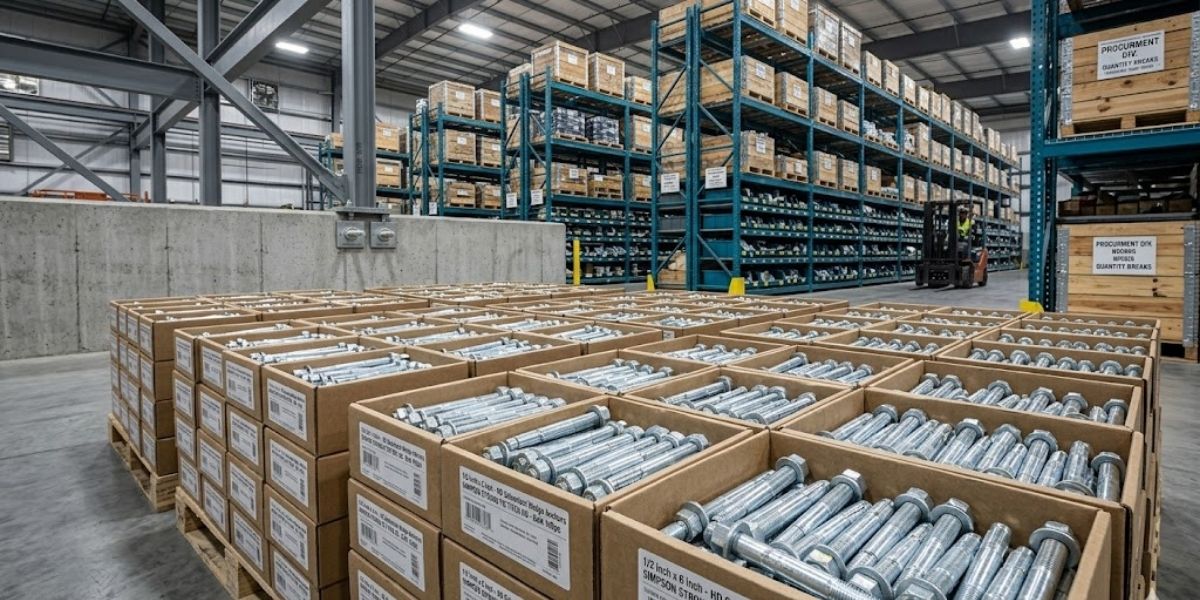
Buying wedge anchors wholesale on unit price alone is one of the fastest ways to lose margin on a commercial job. The anchor line item looks small during bid review, but the wrong product, the wrong finish, or the wrong supplier turns into labor drag, failed inspections, resubmittals, and schedule damage. This guide breaks down how to control total installed cost, protect compliance, and source wedge anchors at wholesale volume without buying future problems.
Why Unit Price Fails as a Wholesale Cost Strategy
The cheapest anchor on a quote sheet rarely delivers the cheapest job cost. On a large commercial development, anchor spend sits inside a larger chain of costs: drilling time, bit wear, torque verification, inspection acceptance, replenishment speed, and the cost of not having approved material when crews are ready to install.
That is why experienced estimators and procurement teams stop treating wedge anchors like commodity hardware. In a base plate package, equipment mounting scope, or large MEP support run, the anchor only works as a cost saver when it installs consistently, matches submittals, and passes inspection the first time. A low quote that creates field friction is not savings. It is deferred cost.
In practice, cost mitigation means controlling every factor that touches the anchor after purchase order release. That includes compliance, corrosion resistance, dimensions, packaging, lead time, freight, and technical support. Once you price the entire chain, the gap between a bargain anchor and a reliable anchor closes fast.
Define Total Cost of Ownership for Wedge Anchors
Total cost of ownership starts with unit price, but it does not end there. You need to account for freight, storage, receiving time, on-site handling, drilling consumables, installation labor, quality control, inspection exposure, punch-list replacement, and schedule impact. If your anchor choice adds even a few extra minutes per install across thousands of placements, your labor overrun wipes out any material discount.
Lead time belongs in that same calculation. A low-cost imported shipment that misses mobilization costs more than a domestic release that arrives on time. The same logic applies to damaged cartons, partial shipments, undocumented substitutions, and anchors that require extra verification before use. All of those issues consume project management hours and field labor.
A serious procurement review also includes failure consequences. Failed pull tests, torque inconsistency, rejected submittals, or corrosion misapplication trigger direct replacement cost and indirect delay cost. If the anchor package touches structural steel attachments, rooftop equipment, or life-safety-related support systems, that exposure increases fast.
Where Cheap Anchors Create Expensive Failures
Cheap anchors fail in predictable ways. Thread quality runs rough. Clip geometry varies. Nut fit is inconsistent. Plating is thin or uneven. Cartons arrive with weak labels and no lot traceability. Published load data is incomplete or unsupported. None of that looks dramatic at the quote stage. It becomes dramatic in the field.
Torque inconsistency is one of the biggest hidden cost drivers. If one anchor sets cleanly and the next spins, binds, or mushrooms during installation, production drops immediately. Crews slow down, supervisors troubleshoot, and inspectors start paying closer attention. What looked like a minor product variance becomes a labor problem.
Poor coating quality creates a second layer of cost. If the finish does not match the environment, you either overspend on unnecessary premium material or underspecify and inherit premature corrosion. Missing certifications create the worst scenario of all: material already on site that cannot be approved for use. At that point, your cheap anchor has become scrap, admin time, and delay.
What Wedge Anchors Are and Where Wholesale Buyers Use Them
Wedge anchors are heavy-duty mechanical anchors designed for concrete. You use them when you need a stud-type anchor that develops holding power through expansion against the concrete wall of a drilled hole. For large commercial work, that usually means permanent attachments that carry meaningful load and demand predictable installation.
In wholesale purchasing, wedge anchors show up across structural support packages, equipment anchorage, railings, MEP systems, retrofits, and steel-to-concrete connections. Their popularity comes from speed and familiarity. Installers know the system, engineers understand the performance envelope, and distributors can stock them in high volume across common diameters and lengths.
That said, wedge anchors are not universal. They are concrete anchors, not a catch-all solution for every base material. If your scope moves into brick, block, or mixed substrates, selection rules change quickly, which is why base material verification matters before any bulk order. For adjacent applications in masonry assemblies, the selection logic differs from anchor choices for brick and block.
Core Components and How the Expansion Mechanism Works
A wedge anchor consists of a threaded stud body, an expansion clip near the embedded end, and an external nut and washer. You drill a hole to the required diameter and depth, clean it as specified, insert the anchor through the fixture or into the concrete, then tighten the nut. As torque is applied, the clip expands against the concrete and creates the mechanical interlock that develops load resistance.
Every one of those parts affects sourcing quality. If the stud diameter runs inconsistent, the drilled hole fit changes. If the expansion clip is poorly formed, the anchor may not set predictably. If the threads are rough, installers lose time fighting nut engagement and torque buildup. If the washer or nut tolerances are sloppy, installation accuracy suffers.
Embedment matters too. The published load capacity of a wedge anchor depends on the correct hole diameter, embedment depth, spacing, edge distance, and torque. That is why manufacturing tolerances are not minor details. They are the difference between a smooth install and a field problem.
Typical Commercial and Industrial Use Cases
On commercial jobs, wedge anchors are commonly used for base plates, handrails, equipment skids, pipe stands, cable tray supports, mechanical supports, strut assemblies, electrical gear mounting, and retrofit steel attachments. You also see them in warehouse fit-outs, parking structures, healthcare facilities, hospitality builds, schools, and industrial processing spaces.
The use case drives the buying decision. A dry interior build-out with repetitive overhead supports calls for one cost strategy. Exterior steel attachment on a parking deck calls for another. Coastal rooftop equipment and washdown facilities demand a completely different corrosion approach.
That distinction matters because wedge anchors are a system purchase, not just a box purchase. The right type depends on load, environment, concrete condition, inspection requirements, and installation method. If your project includes seismic or dynamic loading, you need deeper performance review, not generic catalog selection. That is where a stronger grounding in seismic anchor performance protects both design intent and procurement accuracy.
The Buying Criteria That Control Cost on High-Volume Orders
High-volume anchor buying becomes efficient when you narrow the decision to a handful of criteria that actually affect installed cost. Everything else is marketing noise. You need verified performance data, the correct material and finish, dimensional consistency, and packaging that supports receiving and inspection. If one of those four breaks down, your cost control breaks down.
On large jobs, the anchor decision should also reflect how your crews work. Fast installation, low rejection rates, easy verification, and clean documentation save more money than shaving a few cents off each unit. Procurement teams that understand that usually beat competitors on execution, not just on bid day.
Load Ratings, Approvals, and Engineering Data
Published engineering data is non-negotiable. If the anchor has weak or incomplete load tables, your engineering review slows down, your submittal package gets challenged, and your bidder confidence drops. Verified data shortens approval cycles and reduces argument during preconstruction.
You should expect load ratings for relevant conditions, clear installation parameters, and recognized approvals where required by code or project specification. In many commercial settings, that means looking for ASTM alignment, ISO quality discipline, and ICC-ES or specified equivalent documentation. In regulated markets, the documentation burden is even tighter. For example, GSO 1910:2023 requires certified mechanical anchors on new building projects in the GCC, with third-party certification and periodic inspection built into procurement expectations.
Missing data always costs money. If engineering has to chase clarifications, procurement has to request revised documents, or inspectors doubt the listed performance, your anchor package starts dragging the job before the cartons even hit the slab.
Material Grade and Corrosion Resistance
Finish selection controls lifecycle cost. Zinc-plated anchors are cost-effective in dry interior environments. Mechanically galvanized and hot-dip galvanized anchors serve exterior and damp exposure with stronger corrosion resistance. Stainless steel takes over where moisture, chemical exposure, salt, or washdown conditions raise failure risk.
The mistake is using one material class everywhere. Over-specify and you waste budget on areas that do not need premium corrosion protection. Under-specify and you buy future failure. Both are procurement errors, just with different timing.
The smart move is environment-based segmentation. Match anchor finish to exposure zone, not to habit. Then standardize within those zones to simplify ordering and field control. If your broader fastener package needs the same discipline, the same logic applies to specifying high-load hardware correctly.
Dimensional Consistency and Installation Tolerance
Dimensional consistency is where manufacturing quality turns directly into labor savings. Anchor body diameter, clip expansion profile, thread pitch, nut class, washer fit, and length accuracy all affect installation speed. If tolerances drift, hole fit changes and torque behavior becomes unpredictable.
That problem multiplies on large jobs. A single bad box is manageable. Ten pallets of inconsistent product creates production loss, field confusion, and potential rejection. Crews start sorting anchors, overdrilling holes, or discarding pieces on the fly. Your per-anchor savings disappear.
Consistent dimensions also support drill-bit planning and hole quality. The anchor must match the specified bit diameter cleanly. If your concrete package includes high-PSI structural slabs or repetitive overhead drilling, the right bit selection has direct cost impact. Better understanding of bit life in hard concrete helps you protect both anchor performance and labor output.
Packaging, Labeling, and Traceability
Packaging sounds administrative until a receiving error shuts down installation. On large-volume orders, clear carton labels, lot traceability, finish identification, diameter and length marking, and installation instructions save time at every handoff point. Warehouse staff receive faster, project engineers verify faster, and field crews pull the right material faster.
Traceability matters even more when specifications are strict. If an inspector requests finish confirmation or lot documentation, you need an immediate answer. The supplier that can provide labeled cartons, cert packages, and traceable records reduces risk before the first anchor is installed.
For disciplined procurement operations, traceability should connect directly with your larger stock-control process. On multi-phase jobs, stronger inventory control for construction materials prevents mix-ups between approved stock, release stock, and substitute stock.
Cost Mitigation Starts with Compliance-First Procurement
Compliance-first procurement is not a paperwork exercise. It is cost control in its most practical form. When you verify certifications, approvals, and documentation before issuing the purchase order, you reduce the chance of submittal rejection, inspection failure, and emergency replacement.
In commercial construction, anchors are tied to structural responsibility. That means your procurement standard has to be stricter than “looks equivalent.” Equivalent without documentation is a liability, not an option.
CEP’s quality control approach fits this reality. For bulk wholesale anchoring hardware, rigorous lot review, specification matching, dimensional consistency checks, and documentation discipline matter because job-site continuity depends on it. With large-volume supply, the goal is not just shipping cartons fast. The goal is shipping anchors that match the approved scope, hold their tolerances, and arrive with the paperwork needed to keep your project moving.
Required Certifications and Standards to Verify Before Purchase
Before you release a bulk order, verify the standards named by the project documents and the market you are building in. At minimum, that usually means confirming applicable ASTM references, ISO-backed quality systems, coating or material standards, and recognized evaluation reports such as ICC-ES when specified. If you are bidding internationally or supplying GCC work, regional requirements such as GSO 1910:2023 belong on the checklist from day one.
You also need country of origin clarity, finish identification, and test documentation where the spec calls for it. If the supplier cannot provide those items up front, procurement is already exposed.
A tighter review process helps you avoid last-minute substitution fights. For a broader framework on vetting anchor documentation and approval paths, use the same discipline found in compliance planning for certified anchor systems.
How Non-Compliant Anchors Increase Project Cost
Non-compliant anchors cost money in at least five ways: rejected submittals, failed inspections, engineering resubmittals, field replacement, and schedule extensions. If the issue surfaces after installation, costs rise further because labor, access equipment, and patching get added to the correction scope.
There is also legal exposure. If a structural or life-safety-related attachment fails and the installed anchor lacks the required approvals or documentation, your savings defense disappears instantly. The cost is no longer about fasteners. It is about accountability.
Regulation pressure is rising, not easing. Research tied to changing standards shows compliance measures can increase procurement overhead by about 12% when buyers manage them late instead of early. The cheaper path is simple: buy compliant material first.
Submittal Packages That Save Time in Preconstruction
A strong submittal package should arrive complete. That means technical datasheets, load tables, approvals, installation instructions, coating details, country of origin, and lot documentation where needed. If any of those items are missing, your project team starts chasing paper instead of moving procurement forward.
The benefit is speed. Complete packages reduce engineering review time, simplify bidder leveling, and shorten the gap between award and release. That matters most when mobilization dates are tight and material needs to arrive in phases.
A supplier with strong technical support shortens the entire preconstruction cycle. That support is not fluff. It is a cost-control tool.
How Steel Volatility Impacts Wedge Anchors Wholesale Pricing
Anchor pricing moves with steel, finishing chemistry, energy, labor, and freight. If you source wedge anchors wholesale without accounting for those drivers, you end up reacting to market swings instead of planning around them.
That has become more obvious in the last few years. Mechanical anchor buyers are dealing with shorter quote validity windows, higher import uncertainty, and more aggressive repricing on unfinished or plated steel products. Waiting too long to release a purchase order now carries a direct cost.
Reading Price Swings in Raw Material and Finishing Costs
Steel remains the main cost driver. Research shows projected steel prices in the USD 750 to 850 per ton range, which creates real volatility for anchor manufacturing and wholesale pricing. Add plating, galvanizing, packaging, and freight, and the spread between quote dates becomes material.
Zinc and galvanizing costs also move independently. If your project uses galvanized or stainless anchors, the volatility is not just steel. It is finishing inputs, processing capacity, and transportation.
You should read anchor quotes with that in mind. A longer validity period has value. So does a supplier that communicates market movement early and offers structured release planning instead of surprise repricing.
Contract Timing, Quote Validity, and Escalation Controls
Quote timing matters. If your award decision is delayed, your original anchor pricing may no longer reflect current material costs. That is why you need clear validity windows and escalation language before acceptance. A vague quote creates purchasing disputes later.
Blanket orders and release schedules are strong tools here. They let you reserve pricing and volume while staging deliveries around actual project phases. Indexed contracts also work when material swings are severe and both sides need a clear adjustment formula.
The operational rule is simple: if your anchor package is large enough to affect project margin, manage it like a controlled commodity, not like a last-minute supply purchase.
When Forward Buying Makes Sense
Forward buying makes sense when your specifications are stable, your install sequence is known, and your storage conditions protect the material. It also makes sense when market conditions point toward rising steel or import costs and you have confidence in release timing.
Forward buying does not make sense when the spec is still moving, engineering approvals are not locked, or site storage is poor. It also fails when procurement buys early but field teams are not aligned on quantities and phases. Then your savings get eaten by handling damage, duplicate stock, or obsolete material.
The right answer is usually staged certainty. Lock what is stable. Release what is ready. Keep enough flexibility to absorb design evolution without opening the door to price shock.
Supplier Selection Strategies That Reduce Landed Cost
Supplier selection should reduce landed cost, not just purchase cost. That means evaluating technical support, inventory depth, replenishment speed, documentation quality, and sourcing model, along with price. A supplier that can hold consistency across all five categories protects your schedule and your margin.
This is where sophisticated buyers separate themselves from price shoppers. A low quote from a thin supplier creates operational risk. A disciplined supplier with broad inventory, domestic factory access, and dependable quality control usually lowers total cost even when the unit price is not the absolute bottom.
CEP fits that model because bulk anchor supply works best when quality control and logistics discipline are built into the order, not patched in after a problem surfaces. With decades in manufacturing, importing, and wholesaling, the value is reliability under volume.
Single-Source vs Multi-Source Procurement
Single-source procurement reduces admin work, improves consistency, and simplifies submittals. Your teams deal with fewer documents, fewer finish variances, and fewer packaging differences. It also strengthens buying leverage when your volume is consolidated.
The downside is concentration risk. If one supplier slips on lead time or stock, your whole job feels it. That is why many advanced buyers use a dual-qualified model. Primary supply comes from one source, but a second approved source exists for contingency.
Multi-source procurement increases redundancy but adds management complexity. If you go that route, keep specifications tight and documentation aligned. Otherwise, you create your own inconsistency problem.
Domestic, Imported, and Hybrid Sourcing Models
Domestic sourcing gives you shorter lead times, better visibility, easier communication, and lower disruption risk. Imported sourcing often offers lower unit price, especially on high-volume standard items, but lead times are longer and tariff exposure is real. A hybrid model combines both: imported volume for stable demand, domestic backup for schedule protection and urgent replenishment.
That hybrid model is often the best cost hedge. Research shows North American processing has helped shorten lead times and reduce exposure to global shipping disruptions. That matters when crews are already mobilized and waiting on anchors.
The overseas versus domestic logistics trade-off is straightforward. Overseas buying can reduce first cost on standard SKUs, but freight variability, customs delays, tariff shifts, port congestion, and weaker factory visibility all increase landed-cost risk. Domestic buying usually carries a higher invoice price, but you gain faster replenishment, tighter quality oversight, better document control, and lower expediting exposure. On large commercial work, those operational advantages often win the cost-benefit analysis.
Inventory Depth, Fill Rates, and Emergency Replenishment
Inventory depth protects production. High fill rates mean your first shipment actually supports the phase you planned, instead of forcing field teams to wait on backordered diameters or lengths. That is not a service nicety. It is schedule insurance.
Emergency replenishment matters just as much. If conditions change in the field and you need additional stock fast, your supplier’s ability to ship same day or source from domestic factory channels becomes part of the original buying decision.
Backorders and partial shipments are expensive because they create fragmented labor. Crews install what is available, leave gaps, return later, and lose rhythm. That is why stronger vendor consolidation for fastener buying often lowers total execution cost.
Choosing the Right Wedge Anchor Type for the Environment
Environment-based selection is one of the simplest ways to control cost without compromising performance. Use the least expensive anchor that fully matches the exposure condition and project spec. No less. No more.
This is where many wholesale buyers make preventable mistakes. Interior anchors get upgraded unnecessarily because nobody wants to think through zoning. Exterior anchors get downgraded because someone assumes all plating is basically the same. Both habits cost money.
Zinc-Plated Anchors for Interior Dry Applications
Zinc-plated wedge anchors are the value choice for interior dry concrete applications. In conditioned spaces, tenant build-outs, interior support systems, warehouse interiors, and similar environments, standard plated anchors usually deliver the best cost-performance balance.
The limitation is exposure. Zinc-plated anchors should not be treated as exterior or damp-environment anchors unless the project documents explicitly allow it and the exposure truly remains mild. Once moisture enters the equation consistently, lifecycle risk rises.
For high-volume interior work, this category often gives the strongest per-unit economics and the fastest availability.
Galvanized Anchors for Exterior and Damp Conditions
Galvanized anchors serve the middle ground between zinc-plated economy and stainless premium. Mechanically galvanized and hot-dip galvanized products give stronger corrosion resistance for exterior, damp, or intermittently wet conditions. The distinction between the two matters because coating thickness and durability are not identical.
The value decision here is about service life. If your scope includes exterior railings, exposed steel supports, parking structures, utility spaces, or rooftop attachments, galvanized anchors often deliver a better long-term job cost than plated anchors that need early replacement or trigger inspector concern.
You still need to verify the exact coating system required by the project. “Galvanized” is not precise enough for serious procurement.
Stainless Steel Wedge Anchors for Harsh Environments
Stainless steel wedge anchors are not luxury upgrades. In coastal sites, marine atmospheres, food processing spaces, washdown rooms, wastewater facilities, chemical exposure zones, and other aggressive environments, stainless is the right material. Anything less buys corrosion risk.
The higher purchase price makes some buyers hesitate. That is short-term thinking. In harsh environments, stainless lowers lifecycle cost because it reduces replacement frequency, failure exposure, and maintenance disruption. If a corroded anchor compromises attached equipment or structural hardware, the replacement cost dwarfs the original premium.
When exposure is severe, make the stainless decision early and budget for it properly. Fighting that reality later costs more.
Quantity Buying Tactics for Large Projects and Repetitive Work
High-volume buying only saves money when your quantities align with how anchors are packaged, released, and used. Ordering random box counts without regard to case packs, master cartons, or phase sequencing creates freight waste and inventory sprawl.
On repetitive commercial work, the biggest gains usually come from pricing structure, release planning, and SKU discipline. Get those right and the anchor package becomes easier to estimate, easier to receive, and easier to install.
Breakpoint Pricing, Case Quantities, and Master Cartons
Manufacturers and distributors price around packaging economics. Carton quantities, master cartons, pallets, and full-load thresholds all affect handling cost and freight efficiency. If you order just past a price breakpoint, your per-unit cost often drops more than expected.
That matters most on standardized anchor sizes used across repeated attachments. Align your takeoff and release quantities with full-case logic whenever possible. You reduce repacking, receiving confusion, and broken-carton waste.
You also improve freight density. Loose mixed quantities are expensive to handle. Clean packaging math saves money before the shipment leaves the dock.
Blanket Orders and Scheduled Releases
Blanket orders let you lock pricing and reserve volume while taking delivery in stages. For phased commercial jobs, that is one of the strongest tools available. You get budget protection without flooding the site with material you cannot store properly.
Scheduled releases also improve coordination between procurement and field operations. Instead of emergency orders tied to weekly surprises, you build a release plan that mirrors the install schedule. That reduces expediting and lowers the chance of wrong-SKU substitutions.
For long-duration contracts, this approach is hard to beat.
Standardizing SKUs Across Projects
SKU standardization lowers cost in four places: estimating, purchasing, inventory management, and field installation. If your teams repeatedly use the same approved anchor diameters, finishes, and lengths for the same attachment types, every project becomes easier to plan.
Training improves too. Installers know the torque targets, drill sizes, and common use cases. Warehouse teams know what to stock. Buyers know what breakpoints to chase. That kind of repetition builds efficiency.
Standardization only works when it respects engineering requirements. You should reduce variety, not ignore design conditions.
Installation Efficiency Is a Direct Cost Lever
Field productivity is where anchor cost either stays controlled or gets away from you. If the product installs cleanly with the right tools and the right drilling setup, your crews stay on pace. If not, every hole becomes a small delay.
Procurement has more influence on that than many teams admit. Anchor diameter, embedment, bit quality, drill performance, and torque control all connect directly to installation hours.
Match Anchor Diameter and Embedment to Drilling Productivity
Larger diameters and deeper embedments take more drilling time. That is obvious. What gets missed is how quickly that compounds across hundreds or thousands of holes. More diameter means slower penetration, more bit wear, more heat, and more crew fatigue.
That does not mean undersizing anchors. It means aligning the selected anchor with actual design demand and avoiding oversized habits. If the engineering basis supports a smaller diameter or more efficient embedment, that choice can lower installed cost materially.
Drilling productivity also depends on bit quality. The difference between standard bits and premium carbide options is measurable in hard concrete. For repetitive commercial drilling, data on carbide bit performance helps explain why tool cost and anchor cost should be reviewed together.
Torque Requirements, Tools, and Calibration
Wedge anchors are torque-controlled products. If installers do not hit the required torque range with calibrated tools, the anchor’s installed performance becomes questionable. Under-torque can reduce expansion effectiveness. Over-torque can damage threads, overstress components, or compromise the hole.
That creates hidden cost through retesting, replacement, and inspector scrutiny. On serious commercial work, torque control needs to be treated as part of the anchor system, not as an afterthought.
Calibration discipline also protects consistency across crews and phases. One crew using worn tools while another uses calibrated equipment is a recipe for variable results.
Pairing Anchors with Industrial-Grade Drilling Equipment
Industrial-grade drilling equipment improves hole accuracy, speed, and repeatability. That lowers labor hours and improves anchor reliability. Cheap or underpowered drills cause wandering holes, slow progress, overheated bits, and rough installation conditions.
Dust extraction matters too. Cleaner holes improve installation consistency and reduce cleanup. On occupied or controlled sites, dust management also supports compliance and worker efficiency.
The key point is simple: if your project depends on high-volume wedge anchors, the drill package is part of the cost strategy. Anchor buying and tool buying should never be separated on large commercial work.
Common Wholesale Sourcing Mistakes That Inflate Project Cost
Most anchor overruns come from a small set of repeat mistakes. None of them are complicated. All of them are expensive.
Buying on Unit Price Without Reviewing the Submittal Package
A low unit price means nothing if the submittal package is weak. Missing approvals, vague load tables, unclear finish specs, or absent lot traceability turn procurement into a cleanup operation. By the time those issues are discovered, the cost advantage is gone.
Always review documentation before you compare pricing. If two quotes do not carry the same compliance value, they are not comparable.
Mixing Anchor Specifications Across Phases of the Job
Switching brands, finishes, or dimensions mid-job creates confusion in the field and risk in inspection. Installers grab the wrong stock. Supervisors lose track of approved material. Closeout becomes messy.
Consistency across phases is cheaper than chasing marginal quote improvements. If a change is necessary, document it tightly and isolate the stock.
Ignoring Lead Times Until Mobilization
Late anchor buying is one of the most avoidable mistakes in commercial procurement. Once mobilization hits, every delay gets magnified. Expedited freight, forced substitutions, and fragmented installs cost more than the anchors ever did.
The growth outlook for this market makes lead-time discipline even more important. The global expansion anchor market continues to grow, which means demand pressure is not going away.
Using One Corrosion Class Across Every Environment
A single corrosion class across all environments is lazy procurement. Interior dry zones do not need the same material as coastal rooftops. But coastal rooftops absolutely need more than interior plating.
You control cost by segmenting exposure and matching material accordingly. That is disciplined buying.
Budget Planning for Wedge Anchors Wholesale
Anchor budgeting works best when you break cost into clear drivers: material class, finish, certification burden, freight, waste, and contingency. A single unit-price allowance is not enough for real project control.
Advanced bidders who build anchor budgets this way protect margin better because fewer surprises end up buried in general conditions or field labor.
Cost Tiers by Material, Finish, and Certification Level
At the low end sit basic interior-use plated anchors with standard documentation. In the middle are stronger finish options, better traceability, and fuller technical support for more demanding commercial use. At the upper tier are stainless products, specialized approvals, and stricter documentation packages for high-exposure or highly regulated work.
What moves you up the tiers is not branding. It is material cost, coating process, testing, documentation, and supply-chain control. If your job needs the upper tier, buying down is false economy.
Building Freight, Waste, and Contingency Into the Estimate
Freight belongs in the estimate as its own controlled line, not as a casual add-on. So do damaged cartons, field loss, overage, and schedule contingency. If you leave those out, your anchor budget looks clean on bid day and wrong on job day.
A realistic overage allowance protects against field conditions, counting errors, and minor damage. The right percentage depends on job complexity and packaging discipline, but the allowance should exist.
Contingency also covers market movement when long-duration projects are involved. If your procurement window stretches across volatile steel pricing, build that exposure into the estimate.
When Paying More Delivers Better Job Cost
Paying more makes sense when it reduces a bigger downstream cost. Better coatings reduce replacement and maintenance. Better documentation reduces submittal friction. Better tolerances reduce labor drag. Better inventory depth reduces expediting and downtime.
That is the break-even logic procurement teams should apply every time. If an anchor costs more but removes inspection risk or saves installation hours, it is the lower-cost choice.
Market Trends Wholesale Buyers Should Watch
Anchor procurement is being shaped by construction demand, compliance pressure, and supply-chain restructuring. Ignore those trends and your buying strategy turns reactive fast.
Construction Growth and Rising Anchor Demand
Demand growth is real. The GCC mechanical anchors market alone is valued at USD 1.1 billion, and wedge anchors are one of the major product categories inside that market. Future GCC construction investment is projected at enormous scale, with UAE and Saudi Arabia leading demand through mega-projects and infrastructure expansion.
North America remains a major anchor market as well, supported by sustained construction activity and large commercial output. The result is straightforward: more demand pressure, tighter availability windows, and less tolerance for slow procurement.
Stricter Regulations and Compliance Cost Pressure
Standards are getting tighter. Documentation expectations are expanding. Inspectors are less willing to accept vague equivalency. That pushes compliance cost higher, but it also rewards buyers who organize early and buy right the first time.
The companies that treat anchors as certified structural products instead of hardware commodities will move faster through submittals and inspections.
Sustainability, Recyclable Steel, and Advanced Anchor Technology
Sustainability is showing up in material selection, coatings, and supply-chain strategy. Demand for sustainable construction materials is rising, and anchor manufacturers are responding with improved surface treatments and recyclable steel options. At the same time, digital support is improving. Research points to growing interest in torque monitoring, installation validation, and regional warehousing tied to smarter logistics.
More advanced projects are also using digital coordination tools to reduce clashes and tighten quantity planning. That makes anchor procurement more integrated with the rest of the build, not less.
How to Evaluate Wholesale Suppliers Before Awarding the Order
Supplier vetting should be specific. General claims about quality or service are useless. You need operational answers tied to manufacturing, inventory, and technical support.
Questions to Ask About Manufacturing and Quality Control
Ask where the anchors are manufactured, how dimensions are verified, how coating thickness is checked, and how lot traceability is maintained. Ask what testing is performed on incoming or outgoing material. Ask how nonconforming product is isolated. Ask how certificates are stored and retrieved.
These questions matter because quality problems do not start on your job site. They start upstream, then show up on your job site.
CEP’s standard should be the benchmark here: rigorous quality control for bulk anchoring hardware, disciplined specification review, and dependable documentation that supports commercial procurement instead of slowing it down.
Questions to Ask About Inventory and Lead Time
Ask for actual stock status, normal replenishment cycle, fill-rate performance, emergency shipment capability, and domestic backup options. Ask how release orders are handled. Ask what happens if one SKU goes short during a phased project.
A supplier that cannot answer those questions clearly is not ready for serious commercial volume.
Questions to Ask About Technical Support
Ask how fast submittal documents can be turned, how substitution requests are handled, and who provides product matching support when specifications get tight. Ask whether application guidance is available for environment selection, drilling setup, and installation requirements.
Strong support saves time in preconstruction and protects production in the field. Weak support pushes that burden back onto your project team.
Best Sourcing Recommendations by Use Case
The right sourcing strategy changes with the job. Your goal is not to buy the same way every time. Your goal is to buy in a way that fits the environment, schedule, and risk profile.
Best Approach for Interior Commercial Build-Outs
For dry interior concrete attachments with high installation volume, standard plated anchors sourced through wholesale case quantities usually provide the strongest value. Prioritize dimensional consistency, complete submittals, and packaging that supports fast receiving. Standardize common diameters and lengths across projects when engineering allows it.
This is the environment where disciplined SKU reduction delivers real savings.
Best Approach for Exterior Structural and MEP Attachments
For exterior work, move toward galvanized options with stronger documentation and tighter sequencing control. Use blanket orders with scheduled releases so you can protect pricing and align deliveries with phase turnover. Do not let exterior exposure get supplied with generic plated material because it happened to be in stock.
If wind or structural attachment criteria are driving anchor selection, keep your anchorage review aligned with the same discipline used for fastener choices under wind demand.
Best Approach for Coastal, Washdown, and Aggressive Environments
Use stainless-focused sourcing and stricter certification review. Plan for lifecycle cost, not invoice reduction. Demand complete coating or alloy documentation, confirm traceability, and avoid mixing downgraded substitutes into the package.
In aggressive environments, the material decision is simple. Buy for service life.
Best Approach for Multi-Site Contractors and National Accounts
Centralized purchasing, release scheduling, and standardized SKUs create the biggest cost advantage for multi-site work. Build a controlled anchor program, negotiate volume structure, maintain approved alternatives, and connect the anchor package to a broader stocking strategy for repeated jobs.
This approach works best when supplier relationships are stable and replenishment performance is proven.
Your Wholesale Wedge Anchor Procurement Checklist
Before you buy, verify the application, concrete base material, load demand, exposure condition, finish, approvals, and installation requirements. Confirm that the submittal package is complete, the packaging is traceable, the lead time matches mobilization, and the pricing structure reflects actual quantity breakpoints. Then check replenishment options, emergency supply capability, and release scheduling before final award.
That checklist sounds basic. It is not. It is the difference between buying anchors and buying control. Once you treat wedge anchors wholesale as a total installed cost decision, your procurement strategy gets sharper, your field execution gets cleaner, and your bid margin is better protected from the start.
Frequently Asked Questions
What is the biggest mistake buyers make when sourcing wedge anchors wholesale?
The biggest mistake is buying on unit price without verifying approvals, finish, tolerances, and lead time. A cheap anchor that fails submittal review or installs inconsistently costs more than a properly documented anchor with a slightly higher invoice price.
Are imported wedge anchors always cheaper than domestic supply?
Imported anchors often carry a lower initial unit price on standard high-volume SKUs, but the full landed cost is not automatically lower. Freight volatility, tariff exposure, customs delays, and weaker replenishment speed frequently erase the price advantage. Domestic supply usually gives better schedule protection and stronger quality visibility.
How much extra should you budget for freight, waste, and contingency?
You should budget those items as separate estimate lines, not bury them inside unit price. The exact allowance depends on project size, phase complexity, and shipping method, but every serious estimate should include freight, reasonable overage, carton damage exposure, and a contingency for schedule or market movement.
When should stainless steel wedge anchors be specified?
Specify stainless steel in coastal environments, washdown areas, chemical exposure zones, wastewater facilities, food processing spaces, and any location where moisture and corrosive conditions are persistent. In those settings, stainless is a lifecycle cost decision, not a premium option.
What documentation should a wholesale supplier provide before purchase order release?
You should expect technical datasheets, published load data, installation instructions, coating or material details, approvals or evaluation reports required by the spec, country of origin information, and lot traceability records where applicable. If the supplier cannot provide those documents promptly, procurement risk is already too high.
How do drilling tools affect the total cost of wedge anchor installation?
Drilling tools affect hole quality, install speed, bit life, dust control, and anchor reliability. Underpowered drills and poor bits slow crews down and increase rejection risk. Industrial-grade drilling equipment and the right bit selection lower labor cost and improve installation consistency across high-volume placements.
