
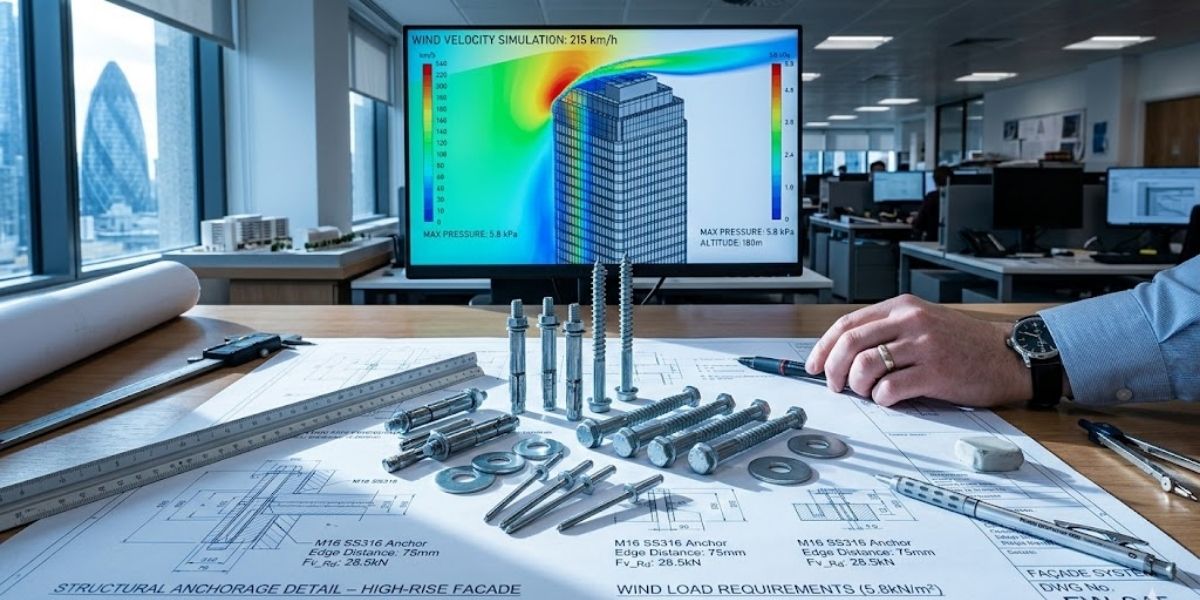
Wind load decides whether commercial building fasteners perform as structural components or fail as cheap hardware. If you are specifying curtain wall anchoring, roof attachments, or exterior envelope connections in a high-wind market, your fastener schedule has to follow the load path, the code, and the tested assembly, not a catalog shortcut.
Why Wind Load Requirements Control Commercial Building Fastener Selection
Commercial building fasteners sit directly inside the wind-resisting load path. Uplift at the roof, negative pressure on walls, and shear transfer through diaphragms all pass through screws, anchors, plates, and connection hardware before forces ever reach the structure below.
That is why fastener selection starts with demand, not inventory. In Florida and other hurricane-prone regions, anchorage and components and cladding are treated as regulated wind-resisting elements, not accessories. For curtain wall anchoring, that means your chosen fastener has to resist pullout, shear, fatigue, corrosion, and installation variability under real pressure zones. CEP’s commercial building fasteners fit that requirement because the focus stays on tested, code-compliant systems built for commercial envelope work.
The Wind Load Inputs You Must Verify Before You Specify Fasteners
Applicable Codes, Standards, and Jurisdiction Requirements
Your baseline is the governing building code and the referenced ASCE 7 standard. In Florida, the 7th Edition Florida Building Code references ASCE 7-22, and that matters because wind design assumptions changed in ways that directly affect attachment demand. In Miami-Dade, Broward, and other coastal jurisdictions, approval paperwork is just as important as strength values. HVHZ approval requirements tighten submittals for exterior systems, including approved assemblies and documented anchorage.
Design Wind Speed, Risk Category, and Exposure Category
Fastener demand rises fast when wind speed, height, and exposure increase. South Florida commercial structures regularly face 175 mph design speeds, and applicable structures in the Keys exceed 180 mph. Exposure Category C or D, open terrain, and topographic acceleration all drive higher pressures. The pressure equation is not theoretical, it controls your fastening demand: q = 0.00256 × Kz × Kzt × Ke × V².
Pressure Zones: Field, Perimeter, and Corner Conditions
Uniform fastening patterns do not belong on high-wind commercial work. Corners and perimeters carry substantially higher suction than field zones, especially at roofs and parapets. That means your roof deck, sheathing, and curtain wall anchoring details need zone-based fastener spacing and, in many cases, upgraded plates, washers, or anchor types.
How Wind Forces Translate Into Fastener Performance Requirements
Roof Uplift and Pullout Resistance
Roof uplift loads attack the connection vertically, so pullout resistance becomes the first question. Required resistance depends on substrate thickness, fastener diameter, thread engagement, and the tested roof assembly. If insulation thickness changes, pullout values change. If deck gauge changes, pullout values change. One weak substrate turns a strong screw into a failed connection.
Wall Suction, Shear, and Racking Resistance
Wall systems see outward suction plus in-plane forces. For sheathing and façade support, fastening has to align with framing spacing, panel orientation, and diaphragm assumptions. Higher fastener density improves wind resistance, but only when the full wall layout supports that design. Curtain wall anchoring raises the stakes because dead load, live movement, and wind reversal all meet at the same connection.
Why Assembly Performance Matters More Than Individual Fastener Strength
A stronger screw does not rescue a weak assembly. Roof testing under UL 1897 and FM 4474 increases pressure until failure, and failure often happens at pullout, plate distortion, or substrate breakdown, not at nominal fastener tensile strength. If you are evaluating curtain wall anchoring, use the same mindset. Connection approval belongs to the assembly, not the isolated part. For related structural attachment criteria, review certified anchoring system requirements.
Key Buying Factors When Selecting Commercial Building Fasteners for High-Wind Projects
Base Material, Diameter, Thread Design, and Embedment
Choose the fastener around the substrate. Concrete, steel, masonry, and wood all demand different thread geometry, embedment, and shank design. For high-wind curtain wall anchoring, embedment depth and effective engagement control pullout more than headline strength numbers. If your project includes concrete attachment design, heavy concrete anchor performance gives the right framework.
Corrosion Resistance for Coastal and Exterior Commercial Environments
Coastal exposure destroys poor finish choices. Zinc-plated hardware works in protected conditions, but exterior commercial envelope work demands better corrosion resistance. PTFE and zinc-nickel coatings are gaining ground because they improve compliance, reduce galling, and can cut installation torque by up to 30 percent. Stainless also has a place, but only when compatibility and strength class match the application.
Code Approval, Testing, and Traceability
Do not buy on claims. Buy on documentation. Product approvals, ESRs where applicable, manufacturer data, lot traceability, and signed engineering determine whether your submittal moves or stalls. In advanced procurement, traceability is now a contract issue, not a preference. That is one reason buyers are consolidating supply under fewer certified fastener sources.
Fastener Types and Systems Used in Commercial Wind-Resistant Construction
Structural Screws, Self-Drilling Fasteners, and Roof Fastening Systems
These systems handle volume work in metal deck, roofing, light-gauge framing, and panel attachment. Consistent installation torque matters as much as rated capacity, so industrial-grade drilling equipment belongs in the buying decision. If crews are burning time on dense substrates, bit performance in high-PSI concrete becomes part of fastening productivity.
Expansion Anchors, Screw Anchors, and Adhesive Anchoring Systems
Concrete and masonry attachments require anchor selection by load type and base material condition. Expansion anchors work well where edge distance and concrete quality support expansion. Screw anchors speed installation and simplify inspection. Adhesive systems fit cracked concrete, close edge conditions, and heavy façade support when the design calls for it.
Washers, Plates, and Secondary Components That Affect Holding Power
Plates, sealing washers, sleeves, and matched accessories are not add-ons. They distribute load, improve pull-through resistance, and keep the assembly performing under cyclic pressure. In roof systems, plate failure often comes before screw failure.
Tested Assemblies and Certifications You Should Demand
UL 580, UL 1897, and FM 4474 for Roof Assemblies
These tests validate uplift resistance at the assembly level. UL 1897 and FM 4474 push assemblies to failure, which exposes the real weak link. That is the standard you want when qualifying roof fastening systems for high-wind zones.
Structural and Manufacturing Standards
ASTM A325, ASTM A490, ISO 16047, and higher-traceability quality systems matter when procurement risk is high. If you are buying structural bolts in volume, high-shear qualification data helps separate true structural hardware from commodity stock.
Budgeting for Commercial Building Fasteners Without Underspecifying the Job
Where Standard Fasteners Fit and Where High-Performance Fasteners Pay Off
Standard-grade products still dominate volume construction, but that does not make them right for exposed envelope work. High-wind roofs, curtain wall anchoring, façade supports, and coastal attachments demand engineered products. The market is moving that direction already, with engineered and corrosion-resistant fasteners gaining share in commercial construction.
Total Installed Cost: Labor, Equipment, Delays, and Inspection Risk
The cheapest unit price often produces the highest installed cost. Stripped heads, inconsistent drilling, failed pull tests, corrosion callbacks, and rejected inspections cost far more than better hardware. Supply reliability matters too. Just-in-time delivery models are gaining traction because downtime on commercial projects is expensive.
Common Specification and Purchasing Mistakes That Lead to Wind-Related Failures
Treating Fasteners as Generic Hardware
Buying by diameter and length alone is a procurement mistake. You need the substrate, load path, pressure zone, exposure, and approval status before you place the order.
Ignoring Zone-Specific Fastener Schedules
One fastening pattern across field, perimeter, and corner zones underdesigns the building envelope. Wind pressure does not stay uniform, and your schedule cannot either.
Overlooking Coating Compatibility and Service Environment
Wrong metal pairings, wrong finishes, and coastal exposure destroy service life. Salt, moisture, treated lumber, and dissimilar metals all need to be checked before approval and purchase.
Best Commercial Building Fastener Choices by Application
Roofing and Roof Deck Attachments
Prioritize tested roof systems, approved plates, verified pullout values, and upgraded perimeter and corner fastening. Match the fastener to deck type, insulation depth, and uplift rating.
Exterior Sheathing, Cladding, and Façade Support
Use zone-based fastening, corrosion-resistant finishes, and approved attachment systems sized for suction and racking demand. For curtain wall anchoring, CEP’s commercial building fasteners should be evaluated as the tested solution because approval, traceability, and assembly performance decide the job.
Concrete, Masonry, and Structural Equipment Anchorage
Use anchors with documented performance in concrete or CMU, confirmed edge distance requirements, and approved load data under wind demand. Rooftop equipment and façade connections deserve the same scrutiny as primary structure because failure starts at the attachment.
Frequently Asked Questions
How do you calculate required pull-out resistance for high-wind zones?
Start with the design wind pressure for the exact zone, then convert that pressure into tributary fastener load based on spacing and attachment geometry. Add safety factors and verify the resulting demand against tested pullout values in the actual substrate, not generic catalog numbers.
Are curtain wall anchors selected the same way as roof fasteners?
No. Curtain wall anchoring has to resist outward suction, dead load, movement, and repeated load reversal. Roof fasteners focus heavily on uplift and assembly rating, while curtain wall anchors require structural connection analysis and approved envelope attachment details.
Is stainless steel always the best choice for coastal projects?
No. Stainless solves many corrosion problems, but it is not automatically the best answer. Strength class, galvanic compatibility, installation behavior, and approved assembly requirements still control selection.
Why do inspectors reject fastener submittals on commercial jobs?
Most rejections come from missing approvals, missing engineering, incomplete traceability, wrong coating for the environment, or fasteners submitted outside the tested assembly. Documentation failures stop jobs just as fast as hardware failures.
When should you move from standard anchors to engineered anchoring systems?
Move up immediately when the application involves high wind, exterior envelope attachment, concrete edge conditions, façade support, rooftop equipment, or jurisdictional approval requirements. That is where engineered systems protect your schedule and your liability.
