
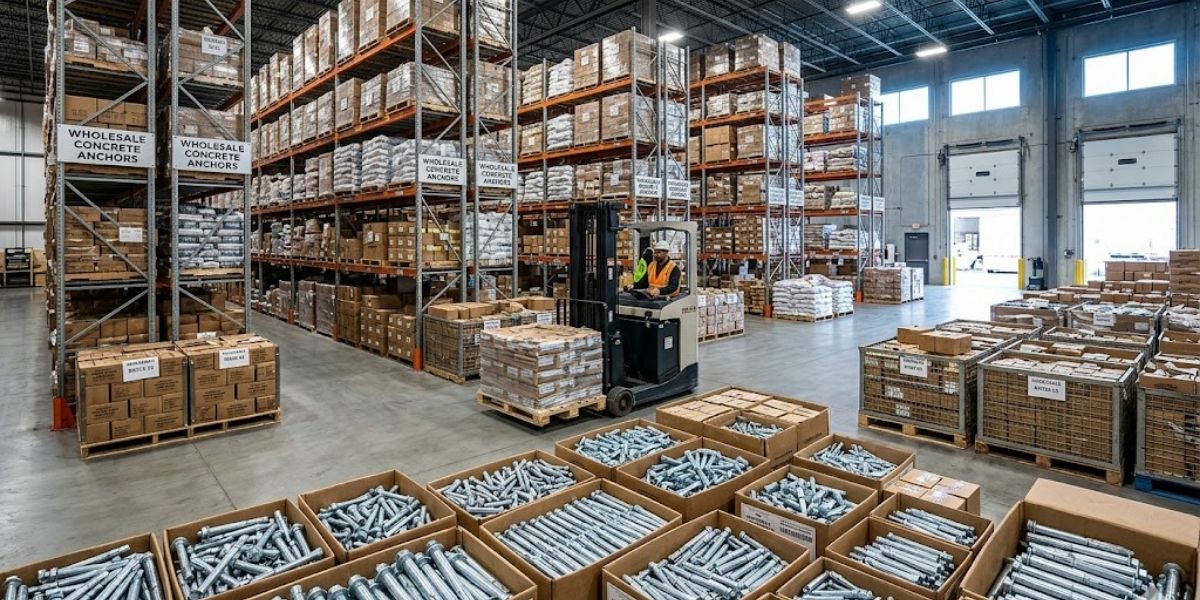
Buying wholesale concrete anchors for an enterprise project is no longer a simple exercise in getting three quotes and picking the lowest number. If your package includes structural steel, equipment setting, seismic retrofit work, utility infrastructure, or multi-site commercial build-outs, your anchor buy directly affects schedule, compliance, labor productivity, and exposure to rework. This guide shows you how to source wholesale concrete anchors at scale, how to build a reliable bulk supply chain, and how to protect your job from the failures that usually start in procurement and end in the field.
Why Wholesale Concrete Anchors Have Become a Strategic Procurement Category
Anchor packages used to sit in the background. Not anymore. On large commercial and infrastructure work, concrete anchoring has moved into the same decision tier as structural bolts, rebar accessories, and key MEP support hardware because the wrong buy creates cascading problems: rejected submittals, missing approvals, mismatched accessories, stalled crews, and expensive substitutions after layout is complete.
That shift is backed by market movement. The anchors and grouts market is projected to rise from $2.94 billion in 2026 to $3.99 billion by 2031. That is sustained growth in a category tied directly to structural connection points, retrofit work, and infrastructure expansion. Demand pressure alone makes procurement discipline more important. Add code scrutiny and labor costs, and this stops being a commodity purchase.
For enterprise buyers, the target is simple: buy a compliant anchor system once, keep it flowing to the site without interruption, and avoid switching midstream.
What Is Driving Volume Demand Across Commercial and Infrastructure Work
Volume is coming from multiple directions at once. Infrastructure spending remains a major force, with infrastructure representing 37.60% of the market in 2025. Transportation facilities, utility upgrades, water and wastewater work, industrial modernization, tenant improvement cycles, warehouse growth, healthcare expansions, and seismic rehabilitation all consume anchors in large quantities.
Renovation is a major driver because retrofit jobs rely heavily on post-installed anchoring. Existing slabs, existing walls, equipment upgrades, new rooftop units, tenant reconfiguration, and structural reinforcement all create anchor demand where cast-in hardware was never planned. That means more drilling, more adhesive systems, more cracked-concrete applications, and more documentation.
The broader construction sector is also expanding. With global construction projected to reach $15 trillion by 2030, anchor demand rises with every new structure, every equipment pad, and every structural connection point. You are buying into a category under constant pull from new construction and remedial work at the same time.
Why Enterprise Buyers Need More Than a Low Unit Price
Low unit price is the wrong metric if it ignores approvals, lead times, shelf life, drilling efficiency, cure windows, and field installation controls. An anchor that saves a few cents per piece and costs two extra minutes per hole will burn labor margin fast on a 5,000-anchor package. An adhesive that arrives with short remaining shelf life can stop a phased rollout before the first inspection.
Your actual cost sits in the installed connection, not in the carton. That includes submittal preparation, engineering review, installation accessories, crew familiarity, inspection success, and replacement liability if the selected system does not match project conditions. On a public or spec-heavy project, paperwork delays cost as much as freight delays.
This is why advanced buyers treat anchor procurement as a schedule protection strategy. Price matters. Installed risk matters more.
What Counts as a Wholesale Concrete Anchor in Enterprise Projects
In enterprise procurement, wholesale concrete anchors include every post-installed anchoring system purchased in volume for structural, mechanical, electrical, equipment, and support applications in concrete and, in some scopes, grout-filled masonry. This is not a homeowner category. You are dealing with repetitive, code-governed, inspection-visible connections.
The main families break into mechanical anchors, chemical anchors, and specialty engineered systems. Each has a place. The mistake is treating them as interchangeable.
Mechanical Anchors
Mechanical anchors transfer load through expansion, bearing, threading action, or undercut engagement. In large commercial work, that includes wedge anchors, sleeve anchors, drop-in anchors, concrete screw anchors, undercut anchors, and heavy-duty expansion anchors. These products dominate repetitive fastening where installation speed matters and conditions are predictable.
Wedge anchors remain common for baseplates, rails, miscellaneous steel, and equipment fastening in sound concrete with adequate edge distance and embedment. Sleeve anchors fit lighter-duty attachment and mixed base materials but generally fall outside high-demand structural packages. Drop-in anchors serve suspended systems where flush installation is required. Concrete screw anchors have earned space because they install fast, work well in many repetitive tasks, and simplify some service or removable applications.
For deeper evaluation of repetitive expansion hardware, it helps to review the cost and stocking patterns behind high-volume wedge anchor buying, especially when your package involves standard commercial steel-to-concrete connections at scale.
Chemical and Adhesive Anchors
Chemical anchors include injectable epoxy, vinylester, polyester, hybrid mortars, capsule systems, and foil packs used with threaded rod or rebar. These systems bond into the drilled hole instead of relying on expansion pressure alone. That changes everything in retrofit work, cracked concrete, close edge conditions, seismic applications, and high-load connections.
This segment is gaining market share for a reason. Resin fixing held 61.40% of the anchors and grouts market in 2025, and chemical anchors overall are also growing fast. Epoxy-based systems account for roughly 45% of the chemical anchor market because the format handles high loads, difficult substrates, and demanding approvals.
On the job, the value is straightforward. Adhesive systems give you design flexibility where expansion anchors create stress in the base material or where embedment geometry drives the design. In retrofit and rehabilitation work, that flexibility is often the only practical path.
Specialty and Engineered Anchoring Systems
Specialty systems cover the products that complicate sourcing and separate enterprise procurement from routine buying. This includes seismic-rated anchors, cracked-concrete-qualified systems, water-filled-hole approvals, fire-rated assemblies, corrosion-resistant alloys, and engineered rod-and-adhesive combinations supplied for specific load cases or service-life requirements.
These SKUs demand tighter documentation control. You need exact approvals, lot traceability, installation instructions, compatible accessories, and often engineering review before release. This is also where substitution risk becomes dangerous. One small deviation in rod grade, coating, hole preparation procedure, or approved installation condition can void the basis of design.
If your package includes these systems, you are not buying anchors. You are buying a tested, documented connection process.
How to Match Anchor Type to Project Conditions
Anchor selection starts with the actual job condition, not with brand familiarity and not with whatever sits cheapest on a distributor shelf. You match the anchor to the load path, substrate condition, installation access, environmental exposure, and inspection standard.
That sounds obvious. In practice, it gets ignored constantly.
New Construction vs Retrofit and Remedial Work
New construction gives you more predictability. Concrete strength, placement sequence, slab access, and embedment conditions are usually known. Your anchor selection can favor installation speed, standardization, and labor throughput if the design allows it. Mechanical systems perform well here when edge distance, spacing, and concrete condition stay within published parameters.
Retrofit and remedial work are different. Existing reinforcement is often unknown. Edge distances are tighter. Hole drilling conditions vary. Concrete quality is less predictable. Surface contamination, moisture, voids, and damaged substrates show up without warning. That is why retrofit work pushes procurement toward adhesive anchoring and more heavily documented engineered systems.
This is also where cross-category coordination matters. If your scope shifts between concrete and block, the evaluation framework should align with how you approach post-installed fastening in brick and block assemblies, because substrate uncertainty changes both anchor choice and accessory requirements.
Cracked Concrete, Seismic Demand, and Cyclic Loads
Cracked concrete and seismic loading kill lazy buying habits. Generic substitutions fail here. If the spec or engineer calls for cracked-concrete performance, seismic qualification, or cyclic load resistance, the anchor system must carry the right approvals and published data for that exact condition.
Code pathways are tightening. In 2024, updated code requirements in jurisdictions such as California, Japan, and Italy pushed anchors qualified under ACI 355.4 or ETAG 001, especially for seismic categories C1 and C2. That trend matters even outside those exact markets because design teams, insurers, and public owners increasingly expect the same documentation standard.
For your buy, that means no broad descriptions like “seismic epoxy” or “heavy-duty wedge anchor.” You need the tested system, the published report, and installation instructions that match the approved use. If seismic performance is a key driver, the engineering side of approved high-load anchoring in seismic conditions deserves the same attention as the purchase order itself.
Dry Holes, Damp Holes, and Water-Filled Holes
Installation environment changes adhesive performance, cure time, hole preparation requirements, and approval status. Dry holes are the easiest condition. Damp holes require approved products and disciplined cleaning. Water-filled holes narrow the field further and remove guesswork from product selection.
Infrastructure, repair, and rehabilitation packages run into wet conditions all the time: bridge work, coastal structures, treatment plants, utility vaults, podium decks, and below-grade applications. If the anchor is not approved for those conditions, it does not belong on the pallet.
The same rule applies to cure performance in heat and humidity. Hot, damp jobsites accelerate some reactions and complicate others. Adhesives need to match actual field conditions, storage conditions, and installation temperature ranges. Buying the wrong chemistry for your climate is not a field problem. It is a procurement problem.
Corrosion Exposure and Service-Life Requirements
Corrosion exposure drives material and coating selection fast. Zinc-plated anchors suit interior dry applications. Hot-dip galvanized anchors fit many exterior and damp environments. Stainless steel and specialty corrosion-resistant materials belong in coastal, marine, wastewater, chemical, and parking structure work where service life matters as much as initial load.
The cost delta between finishes is real, but so is the cost of premature replacement. If your project sits near salt exposure, washdown chemicals, standing moisture, or industrial contamination, standard plated anchors are the wrong buy. On long-life public assets, the design team increasingly expects documented durability, not assumptions.
Service-life data is becoming part of competitive evaluation. One notable example in the market is a 120-year service-life approval for a high-performance injectable anchor in cracked, water-filled concrete. That tells you where the market is heading: documented longevity, not vague claims.
The Non-Negotiable Buying Criteria for Wholesale Concrete Anchors
This is the core of the decision. If your procurement team gets these criteria right, the project runs cleaner. If these criteria get ignored, you spend the job fixing preventable mistakes.
Code Compliance and Third-Party Approvals
Before issuing a purchase order, you need the full compliance package. That includes ICC-ES reports where applicable, ETA documentation when required by the spec or funding source, ACI qualification data, fire ratings, seismic approvals, cracked-concrete approvals, and relevant ASTM references tied to the product category and installation method.
Do not buy on catalog language. Buy on approved documentation. The carton label, technical data sheet, and evaluation report must align with the submitted system. If the order includes threaded rod and adhesive, those components must be approved together where the listing requires it. If the order includes sleeves, nuts, washers, screens, capsules, or dispensing accessories, compatibility matters there too.
For formal compliance workflows, the discipline used in certified anchoring submittal packages should be your baseline. Early documentation speeds approvals and protects you against last-minute rejection.
Load Values, Design Software, and Engineering Support
Published load values matter, but only when read in context. You need tension and shear values, edge distance and spacing limitations, cracked versus uncracked concrete parameters, and reduction factors tied to actual installation conditions. A high headline load number means nothing if your edge distance is restricted or the slab thickness does not support the tested embedment.
Design software and engineering support reduce submittal friction. On advanced projects, digital anchor design platforms save time because they let estimators, project managers, and engineers check load cases, spacing, edge conditions, and rebar interaction before material gets released. That reduces field improvisation, which is where connection failures start.
A supplier that understands structural fastening should also understand the relationship between anchors and adjacent connection hardware. That same discipline shows up in load-focused fastening decisions for structural applications, where published values and real installation conditions have to line up.
Installation Requirements and Crew Productivity
Labor cost decides more anchor packages than buyers admit. Hole diameter tolerance, drill bit wear, blow-brush-blow cleaning sequences, torque control, cure times, proof loading, and inspection steps all affect throughput. A product that looks efficient on paper can slow a crew badly if it needs tighter hole prep or longer waiting periods.
On repetitive installation, matched drilling accessories matter as much as the anchor itself. Poor bit performance widens holes, slows drilling, and increases operator fatigue. Worn brushes fail cleaning requirements. Missing dispensers or setting tools stall the floor. If your crew cannot install the anchor exactly as approved, your package is incomplete.
That is why bulk sourcing should include the entire installation chain, especially when high-PSI concrete is part of the scope. The drilling side is covered well in guidance on bit selection for dense concrete work, and that decision directly affects anchor installation speed and consistency.
Availability, Lead Times, and SKU Continuity
Enterprise buyers need more than stock. You need continuity. The supplier has to support rods, nuts, washers, capsules, adhesives, screens, dispensing tools, setting tools, and drill consumables in the same release cadence as the anchor package itself. If one component drops out, the system breaks.
Mid-project anchor changes are expensive because every substitution triggers paperwork, engineering review, and field retraining. On a large development, that can jam multiple trades at once. Continuity matters even more when the work is phased across several buildings or when public inspection windows are fixed.
This is where direct-to-site freight capability becomes a real procurement advantage. If your supplier can stage material by phase, consolidate SKUs, and ship pallets straight to the project instead of forcing warehouse rehandling, you cut lead-time drag and reduce handling errors. On heavy-duty anchoring infrastructure, direct-to-site releases protect labor flow better than a low quote that arrives in pieces.
Packaging, Case Quantities, and Jobsite Distribution
Packaging affects handling, counting, traceability, and spoilage. On large jobs, carton size, pallet configuration, labeling, lot segregation, and expiration dating all matter. Adhesives need clear shelf-life control. Mechanical anchors need case quantities that match installation pace without creating loose-count confusion in the trailer or gang box.
Phased releases matter too. You do not want every cartridge and rod bundle on site at once if the work stretches over months. Good procurement splits the order into realistic release windows tied to foundations, equipment setting, structural steel, and MEP support phases.
That same thinking belongs inside a broader stocking plan for keeping commercial jobsite inventory moving, because anchor packages fail when site distribution is treated as an afterthought.
Mechanical vs Chemical Anchors: Which Delivers Better Enterprise Value?
This comparison matters because the wrong assumption distorts both estimate and field plan. Mechanical and chemical anchors both have strong use cases. Enterprise value depends on application, labor model, inspection burden, and substrate condition.
Where Mechanical Anchors Win
Mechanical anchors win on installation speed, familiar workflow, and immediate or near-immediate loading in many common applications. For repetitive steel-to-concrete connections, equipment anchoring, rails, supports, and general commercial build-outs in suitable concrete, these systems keep crews moving.
They also simplify logistics. No cure windows. No cartridge shelf-life management. Fewer environmental limits for many applications. Easy counting, easy distribution, easy training. If your project has predictable geometry and a large number of repetitive installs, mechanical anchors often deliver better labor efficiency.
For many estimators, this is where the savings show up fastest. Less waiting. Less specialty handling. Fewer opportunities for storage abuse.
Where Chemical Anchors Win
Chemical anchors win when conditions get demanding. Cracked concrete, close edge distances, seismic design, rebar doweling, retrofit work, unknown substrates, high loads, and wet conditions all push selection toward adhesives. Injectable systems also perform better in many rehabilitation applications because they bond without expansion stress that can damage the base material.
The market trend confirms it. The chemical anchors market is projected to grow from $3.5 billion in 2026 to $5.2 billion by 2032, and epoxy-based systems hold the largest share. That growth is tied directly to construction demand, code requirements, and the need for better performance in difficult conditions.
If your package includes structural rehabilitation or seismic retrofit, chemical systems usually offer the cleaner path to compliance.
How to Compare Total Installed Cost Instead of Piece Price
To compare correctly, start with the full installation sequence. Count drilling time, cleaning steps, cure windows, torque procedures, proof testing, inspection hold points, and rework exposure. Then add the cost of accessories, training, and documentation handling.
A cheaper mechanical anchor loses its edge if the substrate cracks, the edge distance is restricted, or the submittal gets rejected for lack of approvals. A premium adhesive loses its edge if your crew waits on cure time in a fast-track interior build where immediate loading is required and no cracked-concrete or seismic issue exists.
Estimating and procurement need to use the same scorecard. Piece price belongs in the analysis, but only beside labor minutes, compliance confidence, and schedule certainty. If those teams are not aligned, your anchor package turns into a field argument.
Budgeting for High-Volume Anchor Procurement
Budgeting anchor packages at enterprise scale means planning for material volatility, logistics, phased releases, and selective standardization. You are not just pricing boxes. You are protecting the margin inside the installation.
Expected Price Drivers in the Wholesale Concrete Anchor Market
Steel input costs, resin feedstock, coatings, certification expense, import exposure, and freight all affect pricing. Adhesive systems carry another layer of volatility because raw materials shift faster than steel in some periods. Epoxy resin prices have fluctuated by up to 20% in recent years, which puts pressure on both manufacturers and wholesale buyers.
Coatings add cost fast. So do premium alloys. Imported product can look cheaper until freight, lead times, and continuity risk get factored in. Certification burden also matters. Products with seismic, cracked-concrete, wet-hole, and fire approvals cost more because testing, reporting, and quality control cost more.
That is not waste. That is the price of a documented system.
When Paying More Protects Margin
Pay more when failure costs more. That includes seismic work, public work, wet-condition installations, high-corrosion environments, structural rehabilitation, and any scope where rejected documentation or failed inspection will stop follow-on trades. In those jobs, premium anchors protect margin because they reduce the probability of delay, rejection, and replacement.
The same logic applies when labor is expensive or access is difficult. If crews are working off lifts, over water, in active facilities, or during restricted shutdown windows, a more expensive anchor that installs predictably and passes inspection on the first cycle is the cheaper choice.
This is where experienced buyers stop chasing a low quote and start buying certainty.
Standardization vs Project-Specific Sourcing
Standardization helps when your work repeats across multiple projects. If your team regularly installs the same equipment supports, steel attachments, or MEP anchoring details, locking in a preferred anchor family simplifies training, stocking, and field execution. It also strengthens forecasting and bulk-buy leverage.
Project-specific sourcing makes sense when the design demands a unique approved system, unusual corrosion resistance, special service-life performance, or exact compliance language tied to a public or lender-controlled project. Forcing standardization onto those jobs creates risk.
The best approach is selective standardization. Standardize where the installation conditions repeat. Go project-specific where the engineering basis requires it. If you are consolidating vendors across categories, the broader procurement logic behind reducing supplier spread in fastening buys applies here too.
How to Vet a Wholesale Concrete Anchor Supplier for Enterprise Work
Product selection matters. Supplier qualification matters just as much. On enterprise work, the supplier has to support technical review, inventory continuity, and phased logistics without excuses.
Technical Documentation You Should Demand Up Front
Demand the full submittal package before you release the order. That includes technical data sheets, installation instructions, safety data sheets, evaluation reports, approvals, lot traceability information, shelf-life data for adhesives, and country-of-origin disclosure. If your project is funding-sensitive or publicly bid, ask for the compliance package in the same format your approval chain uses.
Early documentation speeds approvals because it lets engineering, quality control, and field supervision review the exact system before material starts moving. It also exposes gaps while you still have time to correct them.
If a supplier cannot produce clean documentation up front, that supplier is not ready for enterprise work.
Inventory Depth and Bulk Order Reliability
You need more than access to anchors. You need access to the related ecosystem: rods, nuts, washers, bits, brushes, blow-out pumps, dispensers, and specialty items that keep installation moving. On large developments, your supplier should support bulk quantities, reserve inventory when needed, and schedule phased deliveries without forcing constant emergency orders.
Depth matters because heavy anchoring packages rarely stand alone. They tie into drilling tools, accessory hardware, and jobsite supply flow. A supplier with broad inventory and factory relationships protects your schedule better than a narrow-line seller chasing price.
This is where CEP stands out. With 10,000-plus products in stock, access to specialty sourcing, and direct-to-site freight capability, your anchor package can move as part of a coordinated supply chain instead of a disconnected fastener order. That reduces handling delays and keeps heavy-duty anchoring infrastructure arriving in the sequence your crews actually need.
Domestic Factory Access vs Import Dependence
Domestic factory access gives you shorter lead times, stronger continuity, cleaner communication on approvals, and more resilience when imports tighten up. Import-dependent supply can still make sense on stable, standard SKUs, but the tradeoff is exposure to freight swings, customs delays, and mid-project continuity issues.
Regional manufacturing is becoming more relevant as buyers push for supply resilience and standardized documentation. If your project cannot absorb lead-time surprises, domestic access deserves real weight in the buying decision even when the initial quote comes in higher.
For enterprise procurement, the right question is not “import or domestic?” The right question is “which part of this package can tolerate import risk, and which part cannot?”
Value-Added Support That Saves the Job
The best supplier does more than ship cartons. Valuable support includes takeoff help, cross-referencing approved alternates, submittal assembly, accessory bundling, and fast turnaround on specialty requests. When plans change, that support becomes schedule protection.
Bundling drilling accessories with anchor packages is especially useful because it closes a common procurement gap. If the same order covers the approved anchor system and the correct installation tools, your field team starts faster and installs closer to the tested method.
On large projects, support also means logistics. Direct-to-site freight, release scheduling, and staging by phase matter. Heavy-duty anchor packages should land where the work happens, not bounce through unnecessary warehouse steps that add days and create loss.
Procurement Workflows That Scale Across Multi-Site and Public Projects
Large projects fail in procurement when the workflow is too informal for the project size. Anchor sourcing at enterprise scale needs process, visibility, and release control.
Centralized Contracts, Approved Vendor Lists, and Bid Packages
Public owners, national contractors, and large private developers often buy through centralized contracts, approved-vendor lists, master service agreements, or formal bid packages. That structure changes your sourcing strategy because the supplier has to fit the paperwork, insurance, and compliance model before price even enters the conversation.
That is not bureaucracy for its own sake. It creates consistency across projects, improves audit readiness, and simplifies purchasing controls. Public procurement frameworks illustrate the point well. New York State’s centralized contract system, for example, updates its master contract list monthly, which shows how formal and current vendor qualification has to be in institutional buying environments.
If your supplier does not understand contract-driven procurement, the job gets delayed before material ever moves.
Forecasting Demand Across Phases and Locations
Forecasting prevents emergency buying. You should map quantities to phases: foundations, slab work, structural steel, MEP rough-in, equipment setting, finish-out, and retrofit tie-ins. Then tie those quantities to realistic release dates and lead times.
Multi-site work raises the stakes. If several projects pull from the same preferred anchor family, procurement needs visibility into burn rates, alternates, and contingency stock. Otherwise, one urgent site drains inventory and creates shortages everywhere else.
The cleanest supply chains use phased release planning, not single-drop ordering. That is especially true for adhesives with shelf-life limits and for premium corrosion-resistant hardware with longer replenishment cycles.
Quality Control, Lot Tracking, and Inspection Readiness
Quality control starts in purchasing. Lot tracking, expiration management, product labeling, and installation instruction control all influence inspection readiness later. If a field inspector asks for product verification and your team cannot connect installed material to approved documentation and lot data, you created your own dispute.
Adhesives require extra discipline because expired stock is a real failure point. Storage temperature matters. Remaining shelf life on receipt matters. Rotation practices matter. On public and specification-heavy work, that data trail should be organized before the first hole gets drilled.
A strong procurement workflow leaves the field with clear documentation, clean traceability, and no surprises at inspection.
Common Failure Points When Sourcing Wholesale Concrete Anchors
This is where projects lose money. Most anchor failures in procurement are not dramatic. They are ordinary mistakes repeated at scale.
Buying to Generic Description Instead of Approved Performance
“Epoxy anchor” is not a spec. “Wedge anchor” is not a submittal basis. Generic descriptions ignore load data, substrate condition, seismic approvals, cracked-concrete qualification, installation environment, and exact system components. That opens the door to substitutions that do not match the approved design.
Buy to approved performance, not generic category language. Match the evaluation report, the installation condition, and the published values. Anything less is guesswork disguised as purchasing.
Ignoring Shelf Life, Storage, and Environmental Limits
Expired cartridges, heat-damaged adhesive, poor storage, and short remaining shelf life on delivery create waste and failed installations. Hot and humid jobsite conditions make the problem worse. Adhesives need temperature control in storage, rotation in inventory, and realistic release timing to the field.
This is one reason phased direct-to-site freight works so well. Instead of pushing all adhesive inventory onto the project months early, release what the crew can actually install within the proper storage and shelf-life window.
Separating Anchors From Drilling and Installation Accessories
Incomplete procurement kills productivity. Buying anchors without matched bits, brushes, blow-out tools, dispensers, setting tools, or torque tools slows crews and increases installation errors. The approved anchor is only part of the system.
Field teams should not be forced to improvise accessories from another manufacturer or another truck. That breaks installation consistency and invites inspection issues. Procurement has to buy the connection process, not just the fastener.
Underestimating Documentation Demands
A missing seismic report, absent fire data, incomplete installation instructions, or mislabeled cartridge can stop field work as fast as a stockout. Documentation failures create rejection at submittal, confusion at installation, and disputes during inspection.
The fix is simple: demand the document set early, review it against the spec, and keep it tied to the released material. Paperwork is part of the product.
Recommended Sourcing Strategies by Project Type
Different project types deserve different sourcing logic. The anchor system, release schedule, and supplier support model should follow the actual work.
Large Commercial Ground-Up Developments
For ground-up commercial work, standardization usually wins. Use a controlled group of approved mechanical and adhesive systems that cover slab connections, structural steel attachments, equipment anchoring, and MEP support details. Keep the SKU count tight, confirm accessory compatibility, and secure stocking depth early.
Your goal is predictable labor performance and uninterrupted releases. Direct-to-site freight becomes valuable here because phased deliveries can follow building sequence, which reduces trailer congestion and unnecessary material handling.
Seismic Retrofits and Structural Rehabilitation
This work demands approved adhesive systems, cracked-concrete ratings, seismic documentation, and technical support from day one. Generic substitutions do not belong here. Rebar doweling, close edge conditions, unknown substrates, and inspection scrutiny make this one of the highest-risk anchor categories in procurement.
Your sourcing strategy should center on engineering review, complete documentation, and strict control over installation accessories and storage conditions. If any package deserves premium product selection, it is this one.
Infrastructure, Transportation, and Utility Projects
Infrastructure work puts pressure on durability, wet-condition approvals, traceability, and release planning across long durations. Corrosion exposure and service life deserve more weight here than in standard interior commercial work. So does staged delivery, because these projects often run by segment, shutdown window, or geographic zone.
Forecasting is mandatory. One missed release on a utility or transportation schedule creates outsized downstream cost.
Coastal, Marine, and High-Corrosion Environments
In marine and coastal work, stainless or specialty corrosion-resistant systems should lead the conversation. Standard plated hardware is a false economy in salt exposure and aggressive environments. Lead times on premium materials are often longer, so supplier coordination has to start earlier.
Your buy should include service-life review, coating or alloy confirmation, and realistic release planning for premium SKUs. This is not the place to chase cheap stock.
Public Sector and Specification-Heavy Bid Work
Public and specification-heavy work rewards documentation discipline. Prioritize approved systems with clear reports, clean country-of-origin disclosure where required, and suppliers that respond quickly on submittal questions and alternates. Contract compliance, audit readiness, and labeling accuracy matter as much as price.
In these jobs, supplier responsiveness is part of product value. Fast answers keep approvals moving and protect schedule.
Digital Tools and Emerging Trends Changing Anchor Procurement
Anchor procurement is getting more technical. Digital tools and market changes are pushing buyers toward better planning, stronger documentation, and more performance-based decisions.
Design Software, 3D Scanning, and Pull-Test Data
Design platforms help validate load cases, spacing, embedment, and edge conditions before material release. 3D scanning improves layout accuracy in retrofit work, especially when existing conditions are imperfect. Digital pull-test logging adds traceable field verification and cleaner records for QA.
These tools are not gimmicks. In one cited pilot, digital inspection workflows linked with scanning reduced labor by 12%. On enterprise work, that kind of efficiency matters.
Service-Life Data and Performance-Based Specifications
Owners and engineers are moving toward documented durability and lifecycle-based selection. That means service-life approvals, wet-condition performance, corrosion data, and long-term performance evidence carry more weight during review. Performance-based specs are replacing vague category language, especially on infrastructure and funded public work.
For procurement, this means your supplier has to speak in documented performance terms, not marketing terms.
Supply Chain Localization and Spec Harmonization
Regional manufacturing, local stock strategies, and standardized documentation are becoming more valuable as projects demand resilience and audit-ready records. International lenders, public owners, and large engineering teams increasingly want harmonized paperwork and predictable compliance packages regardless of project location.
That shift favors suppliers with strong factory relationships, organized documentation, and the ability to support repeatable procurement across multiple jobs. It also rewards buyers who standardize submittal formats and release procedures across regions.
Your Enterprise Buying Checklist for Wholesale Concrete Anchors
Before placing a large anchor order, run a disciplined review. Confirm the application, the load path, the substrate condition, and the environmental exposure. Verify whether the installation is new construction or retrofit, dry or wet, interior or corrosive, static or seismic. Match the anchor system to those exact conditions.
Then confirm the approvals. Check evaluation reports, cracked-concrete ratings, seismic qualification, fire requirements, and any project-specific specification language. Make sure the published design values fit the actual edge distances, spacing, slab thickness, and embedment limits in the field.
After that, evaluate the installation chain. Verify drill-bit compatibility, hole cleaning requirements, cure time, torque procedure, setting tools, and inspection process. Buy the accessories in the same procurement cycle as the anchors. Do not assume the field will source them later.
Next, lock down supply. Confirm stock position, replenishment lead time, case quantities, lot traceability, shelf life for adhesives, and phased release dates. Use direct-to-site freight when the project sequence supports it, especially for large, heavy, or time-sensitive anchoring packages. That approach reduces rehandling, preserves shelf life, and keeps your crews supplied in the order the work actually occurs.
Finally, qualify the supplier. Demand clean documentation, strong inventory depth, technical support, and the ability to respond when plans shift. On enterprise jobs, reliability is not a sales claim. It is a requirement.
Frequently Asked Questions
What is the biggest mistake in wholesale concrete anchor procurement?
The biggest mistake is buying to a generic description instead of an approved performance standard. If your order says “epoxy anchor” or “wedge anchor” without tying the product to the exact approvals, load data, installation condition, and accessory requirements, you invite rejected submittals and field rework.
How far in advance should you source anchors for a large project?
Source standard anchor packages during preconstruction and lock in phased delivery schedules before field installation starts. For specialty corrosion-resistant, seismic-rated, or engineered adhesive systems, secure documentation and supply commitments even earlier because those items carry longer lead times and tighter approval requirements.
Are chemical anchors always better than mechanical anchors?
No. Chemical anchors are stronger in cracked concrete, seismic work, retrofits, close edge conditions, and many high-load applications. Mechanical anchors are often the better value in repetitive, predictable commercial installations where immediate loading, speed, and simple logistics matter more.
Why do drilling accessories need to be part of the same purchase order?
Because anchor performance depends on approved installation. If your order excludes compatible bits, brushes, blow-out tools, dispensers, or torque tools, your crew loses time and installation quality drops. The anchor and the installation accessories function as one system in the field.
How do you manage adhesive shelf life on enterprise jobs?
Use phased releases, inspect expiration dates on receipt, store cartridges within the manufacturer’s temperature limits, and avoid pushing months of adhesive inventory onto the site at once. Direct-to-site deliveries tied to the installation schedule make shelf-life control much easier.
When does domestic factory access justify a higher price?
Domestic factory access justifies a higher price when your project cannot absorb delays, documentation gaps, or continuity risk. That includes public work, phased multi-site projects, specialty engineered systems, and jobs with fixed inspection windows or restricted shutdown schedules.
