
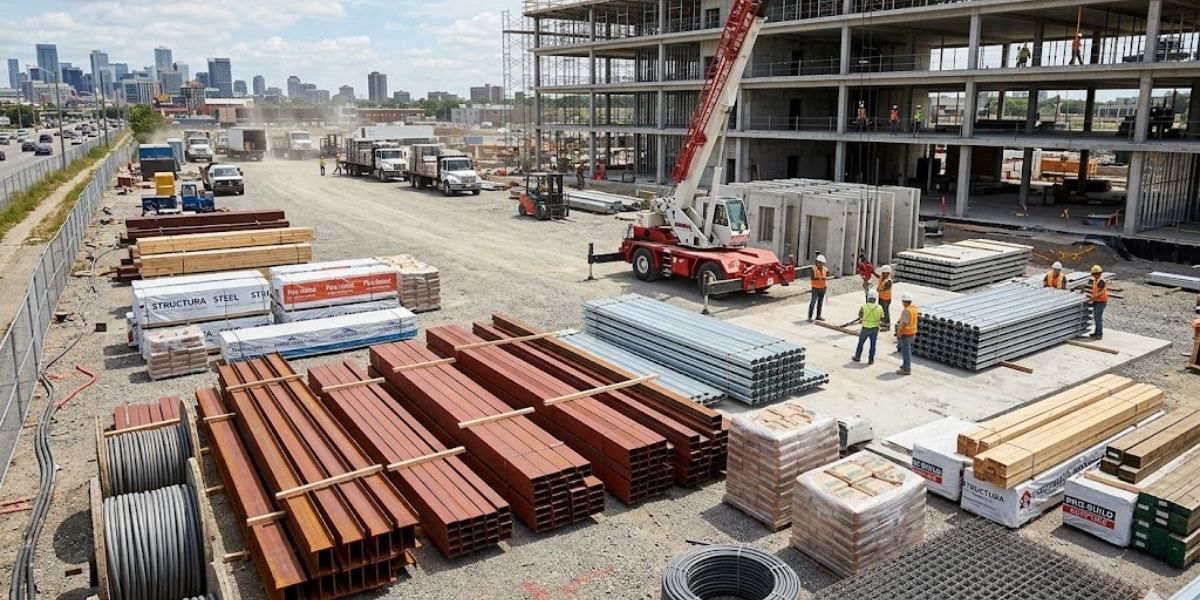
Commercial construction supplies decide how your job runs long before crews hit full production. If your anchors, bits, blades, safety stock, and code-driven hardware are scattered, duplicated, or late, your schedule slips, your labor burns time, and your margin disappears. This guide shows how to tighten inventory control so your sites stay supplied, compliant, and bid-ready.
Why Inventory Optimization Matters in Commercial Construction
Inventory control is not a warehouse chore. It is a project control function. Procurement accounts for a huge share of construction spending, and weak inventory discipline turns purchasing into reactive buying, premium freight, and field delays.
That pressure is getting worse, not better. The U.S. commercial construction market is still expanding, with USD 723.25 billion by 2031 projected across logistics, retrofit, infrastructure-adjacent, and data-heavy work. At the same time, tariff volatility, freight swings, and supplier instability keep changing actual buy costs after the bid is already locked.
Your inventory of commercial construction supplies directly affects four outcomes: schedule performance, bid accuracy, labor efficiency, and margin protection. When stock is standardized, forecasted, and staged correctly, crews install faster and submittals move cleaner. When stock is unmanaged, every missing anchor or nonapproved substitute becomes an expensive decision.
Audit Your Current Inventory Before You Buy Another SKU
Before adding stock, get honest about what is already sitting on racks, trucks, trailers, and branch shelves. Most commercial contractors carry more waste than expected: slow-moving specialty items, duplicate SKUs under different brands, and field substitutions that never should have entered stock in the first place.
Start with actual movement, not assumptions. Review usage by job type, project phase, and crew. Then compare that data against your active backlog and bid pipeline. That tells you what belongs in core inventory and what should stay on controlled procurement only.
Classify Supplies by Criticality, Usage Rate, and Lead Time
Not every item deserves the same control level. High-volume consumables such as fasteners, blades, gloves, sealants, and common drill accessories need fast replenishment and tight reorder points. Code-sensitive anchoring products need approved alternates, documentation, and tighter issue control. Long-lead or specialty items need early procurement and reserved stock.
This is where category discipline matters. If you regularly install post-installed anchors, your team should already understand the differences in certified anchoring assemblies instead of treating every anchor as interchangeable hardware. Critical-path products need tighter oversight because one wrong substitution can stop inspection, not just installation.
Identify Overstock, Stockouts, and Specification Gaps
Overstock ties up cash and hides bad buying habits. Stockouts stop work immediately. Specification gaps create the worst outcome of all: material on hand that still cannot be used.
Look for patterns. Which items repeatedly trigger emergency orders? Which SKUs sit untouched for six months? Which products fail engineer review because the paperwork is incomplete or the rating does not match the application? Those answers show where your inventory is hurting field productivity. For anchor-driven scopes, reviewing commercial anchoring procurement standards helps expose weak spots before they hit submittal review.
Build a Smarter Purchasing Strategy for Commercial Construction Supplies
Once your inventory is cleaned up, purchasing needs a framework. Good buying is not about chasing the lowest unit price. It is about matching demand, standardizing stock, and using volume intelligently.
Forecast Demand Using Project Pipeline, Seasonality, and Historical Usage
Forecast from awarded work first, then active bids with a high close probability, then recurring service and maintenance demand. Use past consumption by phase to estimate anchors, epoxies, bits, blades, electrical hardware, and safety products. Historical usage gives you the baseline. Your current pipeline tells you when to accelerate it.
That matters because lead times still disrupt projects. Industry reporting shows 51% of firms have seen projects delayed by long lead times. If your site depends on industrial drilling equipment or specialty fastening systems, forecast by installation sequence, not by monthly average.
Standardize Core Products Across Crews and Project Types
Too many SKUs create confusion, weaker pricing, slower training, and inconsistent installation. Standardize around approved products that cover recurring applications across your commercial work. That means one defined family of wedge anchors for common concrete conditions, one approved chemical anchoring line for specified embedments, and one drill bit program matched to substrate hardness and tool platforms.
Standardization also sharpens field performance. If your crews are constantly switching brands and geometries, productivity drops. Technical consistency in high-PSI concrete drilling translates into cleaner holes, less bit waste, and fewer installation failures.
Use Bulk Orders and Early Procurement to Protect Margin
Bulk buying works when consumption is predictable and storage control is solid. Lock in volume on fast-moving products and long-lead materials before the market moves against you. That includes anchors, carbide bits, blades, adhesives, PPE, and common structural fastening hardware.
Early procurement protects your estimate from future surprises. It also keeps crews moving when manufacturers extend lead times. For high-consumption categories, disciplined volume fastener sourcing reduces rush buying and smooths replenishment across multiple active sites.
Choose Suppliers That Strengthen Job-Site Continuity
Your supplier does more than ship boxes. A strong supply partner protects continuity across estimating, submittals, releases, replenishment, and urgent recovery orders.
Evaluate Supplier Depth, Technical Support, and Fill Rate
Unit price matters, but fill rate, technical accuracy, and inventory depth matter more on commercial work. Your supplier needs broad stock, same-day shipping capability, access to domestic factories, and people who understand code, load, embedment, and installation conditions.
This is where Construction & Electrical Products Inc. stands apart. With more than 10,000 stocked products and access to specialty sourcing, CEP supports both routine replenishment and high-volume project demand. CEP’s centralized ordering portal also simplifies multi-site logistics for advanced project bidders, giving purchasing teams one control point for releases, allocation, and shipment tracking across branches and job sites.
Avoid Single-Source Risk and Delivery Failures
Overdependence on one vendor is a direct operational risk. A recent supply chain study ranked single sourcing and supplier delivery failure among the top construction supply threats. If one distributor misses a shipment or loses a factory line, your field operation absorbs the damage.
Set approved alternates in advance. Review vendor financial health. Keep secondary sources active for critical categories. For concrete anchoring packages, maintain backup options that still meet engineering and compliance requirements, including proven paths for enterprise anchor purchasing.
Verify Code Compliance and Submittal Readiness
If the documentation is weak, the product is weak. Commercial work demands UL-listed, engineer-reviewed, spec-grade materials with traceable data. Undocumented imports and casual substitutions create rejected submittals, failed inspections, and liability exposure.
Your supplier should be able to deliver data sheets, approvals, certifications, and application guidance fast. That is not extra service. That is part of the product.
Optimize Storage, Tracking, and Field Replenishment
Buying right solves only half the problem. You also need a clean site inventory walkthrough that prevents stockouts after material arrives.
Organize Inventory by Project Phase and Crew Access
Lay out stockrooms, gang boxes, trailers, and branch shelves by phase of work and frequency of use. Fast-moving consumables should be immediately accessible. High-value tools, specialty anchors, and controlled adhesives should be secured separately. Crews should never dig through mixed inventory to find standard install items.
Track Usage in Real Time to Reduce Waste
Spreadsheets break under multi-site commercial work. Use barcode or digital inventory tools to connect planning, receiving, field issue, transfer, and waste recovery. Real-time visibility lets you see what is burning faster than forecast and what needs reallocation before a stockout hits. Better inventory system discipline gives you faster reorder decisions and cleaner cost tracking by job.
Set Safety Stock for Critical Supplies
Safety stock should cover the items that stop production immediately: anchors, drill bits, blades, epoxies, PPE, and electrical hardware. Base that buffer on replenishment time, usage rate, and job impact. Guessing leads to either empty shelves or dead stock. Controlled safety stock keeps service trucks and active sites productive without bloating inventory.
Account for Cost Volatility, Sustainability, and Project-Specific Demands
Your stock mix cannot stay static while the market changes around it.
Manage Tariff Exposure and Material Price Swings
Tariff exposure is now a planning issue, not a trade-office issue. In 2026, 72% of trade professionals identified U.S. tariff volatility as the biggest regulatory disruption. That means your purchasing strategy needs diversified sourcing, contract reviews, and earlier price protection on imported categories.
Source for LEED, Low-Carbon, and Retrofit Requirements
Sustainability is now a bid requirement on a growing share of projects. Demand for sustainable materials is rising across commercial construction, especially where LEED targets, recycled content, or low-carbon specifications are written into procurement packages. Stock products that support those requirements without sacrificing code compliance.
Adjust Inventory for High-Growth Commercial Segments
Warehouse, healthcare, data center, mixed-use, and renovation work all consume supplies differently. Data centers drive early procurement of power and cooling-related systems. Renovation work increases demand for retrofit anchors, patching materials, and specialty drilling accessories. Your inventory should follow local project mix, not last year’s habit.
Common Inventory Mistakes That Cost Commercial Contractors Money
The expensive mistakes are predictable.
Buying on Price Instead of Performance and Compliance
Cheap products cost more when installation slows, inspections fail, or replacements hit the schedule. Performance and compliance come first. Price comes after the product proves it belongs on the job.
Carrying Too Much of the Wrong Inventory
Slow-moving stock is not security. It is trapped cash. If your shelves are full of obsolete or rarely used items, your buying process is solving the wrong problem.
Waiting Too Long to Procure Critical Items
Late ordering weakens execution and bidding at the same time. If you know an item is long-lead, code-sensitive, or hard to substitute, buy early and control it tightly.
How to Streamline Your Supply Inventory for Faster, More Reliable Project Execution
The practical formula is simple: audit what you have, classify what matters, standardize what repeats, diversify supply risk, and set safety stock where downtime hurts most. Then connect your purchasing and field replenishment with real usage data so stockouts stop being a surprise.
Once inventory is managed that way, your crews keep moving, your bids get tighter, and your supply chain starts working like a competitive advantage instead of a recurring fire drill.
Frequently Asked Questions
How often should you audit commercial construction supplies?
Cycle-count fast-moving and critical items weekly, review branch and truck stock monthly, and run a full inventory audit on a set quarterly schedule. High-volume commercial operations need tighter count discipline than annual-only checks.
What supplies deserve safety stock first?
Start with anything that stops production immediately or creates inspection risk: anchoring systems, drill bits, blades, epoxies, PPE, and common electrical hardware. Set buffer levels from lead time and usage rate, not gut feel.
Is centralized ordering better for multi-site commercial projects?
Yes. Centralized ordering gives you better control over allocation, pricing, releases, and tracking across multiple jobs. It also reduces duplicate buying and makes it easier to shift stock between sites before placing emergency orders.
How do you reduce SKU overload without hurting field flexibility?
Standardize the products used in repeat applications and keep approved alternates for exceptions. That gives your crews consistency on daily work while preserving coverage for engineered or project-specific requirements.
What is the biggest inventory mistake in commercial construction?
Treating inventory as a back-office issue. Once purchasing, storage, field usage, and replenishment are disconnected, stockouts, waste, and margin erosion show up fast.
