
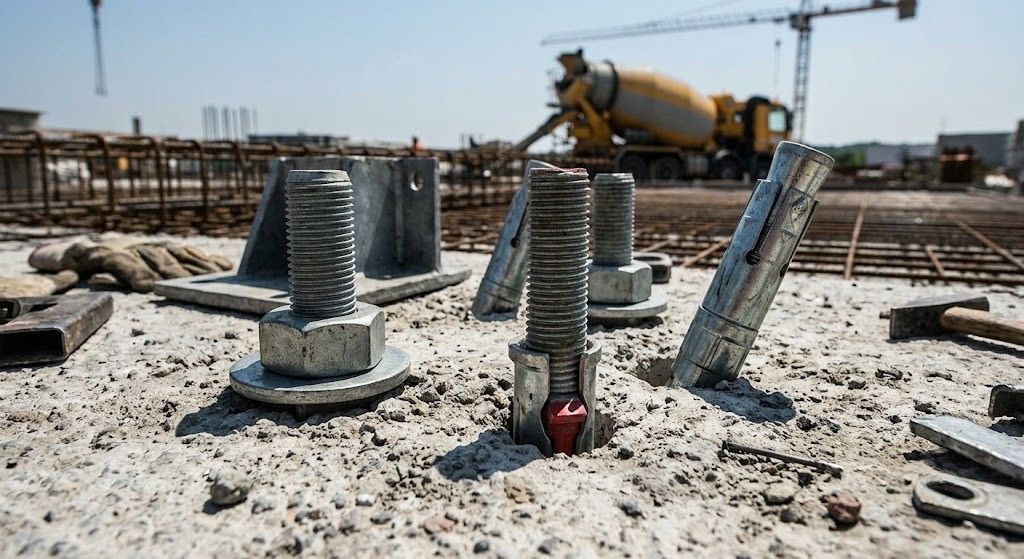
Commercial construction does not forgive guesswork, and heavy duty concrete anchors are a perfect example. If you pick the wrong anchor, miss an edge-distance requirement, or ignore installation torque, you do not just risk a bad connection, you risk failed inspections, rework, and a crew standing around waiting on the fix.
Best Heavy Duty Concrete Anchors for Commercial Construction Projects: What You Need to Know
The best heavy duty concrete anchors are not the ones with the biggest published number on a spec sheet. They are the ones that match the load, the concrete condition, the geometry, and the code path for the job in front of you. On commercial work, that means you are balancing structural demand, nonstructural attachments, and the realities of the slab, wall, or foundation you are drilling into.
That is why anchor selection belongs in the submittal process, not in a last-minute field scramble. You need code-compliant fasteners, approved data, and installation details that your crew can execute without surprises. If you are still sorting out the basics of concrete anchors, start there before you lock in a product family.
Why Anchor Selection Determines Schedule, Inspection Results, and Long-Term Performance
A weak anchor choice creates a chain reaction. The installer drills the hole, the anchor seats poorly, the inspector flags the condition, and then you are dealing with remediation, extra labor, and a schedule hit that costs far more than the hardware ever did. On commercial projects, the anchor is part of the structure, not a commodity bolt.
The real risk is mismatching the product to the base material and the load case. A fastener that works fine for light-duty attachment can fail completely when it sees sustained load, vibration, seismic demand, or a tight edge condition. That is why you have to treat anchor selection as an engineering and field-conditions decision, not a price-per-piece decision.
Focus Keyphrase and Search Intent: Heavy Duty Concrete Anchors
When you search for heavy duty concrete anchors, you are usually not looking for a generic hardware definition. You need a commercial-grade anchoring solution that can support structural and nonstructural attachments, pass inspection, and hold up under real jobsite conditions.
The intent is practical: identify the right anchor type, verify whether the concrete is cracked or uncracked, confirm code compliance, and choose a material and size that fits the connection. If your project depends on accurate load data, understanding anchor load capacity is not optional. It is the difference between a clean install and a callback.
How Heavy Duty Concrete Anchors Work in Commercial Construction
Heavy duty concrete anchors transfer load from steel or equipment into the concrete mass through mechanical interlock, friction, bond, or a combination of those forces. In plain terms, the anchor gives your attachment something to bear against so the load does not rip through the connection point.
In commercial construction, that can mean securing structural steel, MEP equipment, façade systems, handrail supports, tray racks, or retrofit framing. The anchor type matters, but so does how the load travels through the assembly and into the concrete.
The Four Load Types You Need to Account for
Tension pulls the anchor straight out of the concrete. Shear pushes it sideways. Combined loading does both at once, which is common on brackets, standoffs, and equipment supports. Sustained or dynamic loading adds another layer, because vibration, cyclic forces, and long-term stress can change how the anchor behaves over time.
That is why a rooftop unit, a pipe support, and a structural connection never get judged by the same standard. The load path, direction, and duration all matter. If you need a quick refresher on field setup, how to install concrete anchors covers the fundamentals that keep the connection honest from the start.
Failure Modes That Control Anchor Performance
Anchor capacity is usually governed by the weakest failure mode, not the biggest advertised rating. Steel failure, concrete breakout, pullout, pryout, and concrete splitting all show up in commercial work, and the governing mode changes with embedment depth, edge distance, spacing, and concrete condition.
That is the part many buyers miss. An anchor can be strong in steel and still fail the surrounding concrete. Under tight edge conditions, splitting becomes the problem fast, especially when the hole is too close to a slab edge or when installation torque changes the way the anchor bears on the base material. The hardware did not fail in isolation, the system did.
Code Compliance and Design Requirements You Cannot Ignore
Commercial anchor selection lives inside the code framework, not outside it. Under the 2024 IBC, concrete anchor design is tied to ACI 318-19 Chapter 17, and the code anchors recognized there include headed studs, headed bolts, hooked bolts, expansion anchors, undercut anchors, screw anchors, and adhesive anchors.
That matters because product choice alone does not make an installation compliant. You need a product that fits the design method, the concrete condition, and the documentation package your inspector expects.
What Counts as a Code Anchor
The current code framework recognizes both cast-in and post-installed systems when they are properly qualified. Headed studs and headed bolts are common in cast-in work. Hooked J- or L-bolts still show up where geometry calls for them. Expansion anchors, undercut anchors, screw anchors, and adhesive anchors cover most retrofit and post-installed commercial applications.
The practical point is simple. If the product is not covered by the approved design path, it does not belong in the job. For a deeper comparison of attachment styles, wedge anchors versus sleeve anchors is a useful starting point when you are narrowing down mechanical options.
When Evaluation Reports and Test Data Matter
Evaluation reports and technical bulletins are not paperwork fluff. They are how you verify that the anchor has been tested, qualified, and approved for the application, load conditions, and code edition you are working under. ACI 355.2 covers mechanical anchors and ACI 355.4 covers adhesive anchors, so the data behind the product matters as much as the product name.
For post-installed anchors, the submittal package should line up with the exact use case, including cracked concrete where applicable, seismic classification, and any special inspection requirements. The code also requires continuous special inspection for certain adhesive anchor installations in horizontal, upwardly inclined, and overhead drilled holes when those anchors resist sustained loads, because installation quality becomes harder to control in those orientations (special inspection requirements).
Concrete Strength Limits and Design Assumptions
ACI 318-19 Chapter 17 generally limits anchor calculations to concrete compressive strengths up to 8,000 psi. That does not mean stronger concrete is irrelevant, it means code design follows a defined range and cannot be treated like a free-pass shortcut.
Concrete strength alone does not guarantee anchor capacity. Edge distance, embedment, cracking, spacing, and base material quality all control the real outcome. A high-strength slab with bad geometry still fails.
Types of Heavy Duty Concrete Anchors and Where Each One Fits
The anchor category you choose should match the job, not the other way around. Cast-in anchors usually provide the strongest integrated performance for new construction. Post-installed anchors give you flexibility for retrofit, repair, and field changes, which is why they are used so widely in commercial buildings, bridges, tunnels, and equipment anchorage.
Cast-In Anchors for High-Performance Structural Attachment
Cast-in anchors belong in new work where the concrete placement is controlled and the attachment points are known ahead of time. Headed studs and headed bolts develop excellent load transfer because the steel is already integrated into the concrete mass before the pour.
Use cast-in anchors when you want repeatable structural performance and fewer installation variables. They are the right choice for embedded plates, structural steel connections, and other conditions where access after the pour is limited and the connection must be right the first time. Proprietary cast-in products also rely on test data, and some evaluated systems are tested with multiple specimens to confirm installation-specific performance, which tells you how much manufacturing consistency matters.
Torque-Controlled Expansion Anchors for Heavy Nonstructural Loads
Torque-controlled expansion anchors are the workhorse for many heavy nonstructural attachments. They are common on mechanical equipment, supports, brackets, and retrofit installations because they install quickly and develop capacity through mechanical expansion against the concrete.
The catch is that installation torque changes actual performance. In pull-out testing of 85 specimens, torque affected the inflection load, the maximum displacement, and the failure behavior of the anchor (85 specimens). That is not a minor detail. Tightening conditions change how the anchor engages the concrete, and under critical edge distance conditions, splitting can become the governing failure.
Undercut Anchors for Demanding Structural Applications
Undercut anchors rely on mechanical interlock below the surface of the drilled hole. That makes them a strong option when you want controlled expansion and dependable load transfer in demanding structural applications. They are often chosen where reliability is more important than installation speed.
You use undercut anchors when the design calls for a high-confidence mechanical connection and the base material supports the more precise installation process. They are not the simplest option, but they deliver serious performance when the geometry and installation are controlled.
Screw Anchors for Fast Installation and Retrofit Work
Screw anchors shine when speed matters and the connection needs to go in cleanly with minimal disruption. They are widely used for retrofit work, overhead applications, and jobs where you need a faster installation cycle without giving up documented capacity.
The value here is labor efficiency. A crew can move quickly, especially on repetitive work like hangers, brackets, and nonstructural attachments. The trade-off is straightforward: you need to verify the load tables, base material requirements, and approved use conditions before you count on the anchor for a commercial connection.
Adhesive Anchors for Deep Embedment and Sensitive Edge Conditions
Adhesive anchors give you flexibility where deep embedment or limited edge distance makes mechanical expansion less attractive. They are widely used for threaded rod, rebar doweling, and retrofit structural work, especially when you need to work around existing concrete geometry.
The installation discipline is strict. Hole cleaning, adhesive placement, cure time, and ambient conditions all control performance. In overhead and inclined holes, the installer has to avoid air entrapment and voids, because a bad fill leaves you with a bad connection no matter how good the resin is. For hardware selection details tied to product type, drill bits for concrete anchors is worth reviewing before crews start drilling.
Key Factors That Decide Which Anchor Is Best
The right anchor comes down to five things: load, concrete condition, geometry, installation consistency, and environment. Miss one of those, and you are guessing. That is how projects end up with overdesigned hardware in the wrong place or undersized hardware in a high-consequence location.
Load Requirements and Safety Margins
Do not shop by ultimate strength alone. Match the anchor to service loads, factored loads, and the project’s specific design criteria. The biggest number on the box means nothing if the design is controlled by edge distance, cracked concrete, or shear demand.
A good selection accounts for the whole connection, not just the fastener. That includes the base plate, fixture stiffness, spacing between anchors, and whether the attachment will see vibration or occasional impact. If the job requires precision, use a supplier that can furnish exact-spec sourcing and the right documentation without delay.
Base Material Condition: Cracked, Uncracked, or Damaged Concrete
Cracked concrete changes the design equation. It changes failure behavior, reduces available capacity, and pushes you toward products that are qualified for that condition. If you assume uncracked concrete on a slab that is clearly cracked, you are building a problem into the install.
Age, moisture, deterioration, and patch history also matter. A new-looking surface can hide bad substrate conditions. You need to inspect the concrete, confirm the design assumptions, and then choose the anchor family that matches the condition rather than hoping the hardware will make up the difference.
Edge Distance, Embedment Depth, and Spacing
Geometry governs capacity more often than people admit. Close-edge conditions reduce breakout resistance and increase the risk of splitting. Shallow embedment leaves less material for the anchor to develop load. Tight spacing creates interaction between anchors that lowers the overall capacity of the connection.
Here is where commercial work gets unforgiving. If the anchor is too close to the edge, the concrete usually fails before the steel does. That is why layout review belongs before drilling starts, not after the first hole is in the wall.
Installation Torque and Field Consistency
Installation torque is a real performance variable for torque-controlled expansion anchors. The research is clear that tightening changes the inflection load, the maximum displacement, and the way the anchor fails under pull-out (installation torque). In other words, the wrench setting is part of the design outcome.
Field consistency matters just as much. Over-torqueing, under-torqueing, dirty holes, and poor depth control all create variation from one anchor to the next. That is why disciplined crews and calibrated tools pay off. The hardware is only as good as the install.
Environmental Exposure and Corrosion Resistance
Moisture, chemicals, salt air, and exterior exposure decide the material finish. Zinc-plated hardware works in dry interior conditions. Galvanized coatings help in many general commercial settings. Stainless steel is the right call when corrosion resistance is part of the design requirement, not an upgrade you hope to skip.
On exterior jobs, long-term durability matters because anchor failure is rarely just a performance issue, it is a maintenance and liability issue. Choose the material for the environment, not the bid day budget alone.
What Recent Research Says About Real-World Anchor Performance
The best anchor is not always the one with the highest theoretical capacity. Recent studies make one point very clear: actual performance depends on installation conditions, geometry, and how the anchor transfers load into the surrounding concrete.
Why Installation Conditions Change Performance So Much
A 2021 pull-out study on torque-controlled expansion anchors showed that installation conditions changed contact behavior between the anchor and concrete and also altered tensile failure mode. That is the real-world lesson, the anchor does not live in a vacuum.
The same family of anchor can behave differently when torque, embedment, and edge distance change. That is why you cannot treat field conditions as secondary. They are part of the design.
What Pull-Out Testing Reveals About Anchor Behavior
The pull-out data is useful because it shows how unpredictable performance becomes when installation conditions vary. In that study, 85 specimens were tested, and the anchor response shifted as tightening conditions changed (pull-out testing). Similar peak loads did not mean identical behavior, which is exactly why submittal review and product selection have to go beyond the catalog page.
For procurement, that translates into one rule: demand test-backed documentation, not marketing language. If you are buying for a high-load structural application, you need verified data that matches your concrete, geometry, and code path.
How Improved Anchor Geometry Can Increase Capacity
A 2025 study on sleeve and head optimization found that geometry changes can materially improve performance. The optimal sleeve length was 9.0 mm and the optimal head length was 3.0 mm, and the optimized model improved performance by about 1.71 times. In testing, pull-out strength gains reached 1.25x to 1.56x for M12 anchors and 1.33x to 1.42x for M16 and M20 anchors depending on concrete strength and embedment depth (optimized model).
That matters because it proves manufacturing precision is not a minor detail. Better geometry changes load transfer, and that changes whether the anchor fails by pull-out or by a stronger concrete cone mechanism.
Why Numerical Models and FEA Still Need Test Verification
Finite element analysis is useful, but it is not a substitute for tested data. Anchor behavior depends on cracked concrete, interface friction, material uncertainty, and geometry that is often too irregular for a clean model. Even the better models work best when the problem is symmetric and well defined.
Use simulation as support, not proof. On a jobsite, verified load tables and approved test data carry more weight than a nice-looking model.
How to Choose the Right Anchor by Application
Once you know the code path and the load case, the application usually narrows the choice fast. The right anchor for a steel connection is not the same as the right anchor for rooftop equipment or façade work.
Structural Steel and Framing Connections
For structural steel, bracing, and framing attachments, prioritize anchors with documented structural capacity, strong edge-distance performance, and clean code support. Cast-in anchors are the first choice in new construction. Post-installed structural systems belong in retrofit or change-order work where the attachment point is already built.
Your focus here is load transfer, not convenience. If the connection is carrying real structural demand, choose the system that gives you the clearest compliance path and the least ambiguity during inspection.
Mechanical, Electrical, and Plumbing Equipment
MEP equipment brings vibration, access limitations, and repetitive attachment points. Torque-controlled expansion anchors, screw anchors, and adhesive systems all have a place here, depending on the substrate and the load direction.
For rooftop units, supports, trays, and hanger assemblies, speed matters, but so does long-term holding power. That is where installation mistakes become expensive, because one bad hole or one missed cleaning step can take out an entire equipment run.
Curtain Walls, Facades, and Exterior Attachments
Exterior envelope work demands careful attention to edge distances, corrosion resistance, and tolerance for movement. Curtain walls and façade attachments often live near slab edges or embedded steel, which makes geometry a major design factor.
In these conditions, reliability beats speed. Pick the anchor that matches the approved design and the environmental exposure, then verify every installation detail before the first bracket goes up.
Seismic and High-Consequences Applications
Seismic work, life-safety attachments, and other high-consequence applications demand tighter documentation and more disciplined installation. You need approved products, clear engineering, and records that show the anchor was installed exactly as specified.
This is where exact-spec materials matter most. On these jobs, the wrong coating, wrong diameter, or wrong evaluation report creates more than a delay, it creates a compliance problem.
Budget Considerations Without Sacrificing Jobsite Reliability
Cheap hardware is expensive when it costs you labor, inspection time, or a failed installation. On commercial projects, the real cost is installed cost, not unit cost.
Upfront Cost Versus Total Installed Cost
A lower-priced anchor looks good until you factor in rework, extra drilling, missed inspections, and crew downtime. If an anchor takes longer to install, needs more cleanup, or creates more variability in the field, the labor cost eats the savings fast.
That is why buyers should compare the whole package, product, tools, documentation, and labor. The hardware is only one line item.
When Paying More Delivers Better Value
Pay more when the job calls for better corrosion resistance, stronger documentation, or a product with a clearer compliance path. Stainless hardware, qualified adhesive systems, and higher-spec structural anchors pay for themselves when the project risk is high.
You are not buying the metal, you are buying fewer problems.
Bulk Ordering and Project Standardization
Standardizing anchor families across a project reduces mistakes, speeds up installation, and simplifies procurement. Bulk ordering also helps keep crews moving and reduces last-minute substitutions that lead to compatibility issues.
A supplier with same-day delivery options and no minimum order requirements gives you real flexibility when the job changes. That is where a deep inventory matters. When you need exact-spec fasteners, the difference between stocked and backordered is the difference between a productive crew and a stalled one.
Common Mistakes That Cause Anchor Failures
Most anchor failures are not mysterious. They come from predictable mistakes that experienced crews still make when the job is moving too fast.
Using the Wrong Anchor for Cracked Concrete
If the design assumes uncracked concrete and the actual substrate is cracked, the connection is wrong before the first hole is drilled. Use products qualified for cracked concrete whenever the condition exists or cannot be ruled out.
Ignoring Edge Distance and Embedment Requirements
Too little edge distance or embedment cuts capacity fast. It also changes failure mode, which means the anchor may split or break out the concrete before reaching the load you expected.
Over-Torquing or Under-Torquing Expansion Anchors
Expansion anchors depend on correct torque to develop the intended contact pressure. Over-torque can damage the connection, while under-torque leaves capacity on the table and creates inconsistent behavior from one anchor to the next.
Skipping Manufacturer Instructions and Approved Data
Manufacturer instructions and approved load tables control the installation. If the crew ignores them, the anchor is no longer installed under the conditions it was tested for. That is how inspection issues start.
Best Practices for Installation and Quality Control
Good anchor selection means nothing if the install is sloppy. The field process has to be tight.
Hole Drilling, Cleaning, and Depth Control
Use the correct drill bit, keep hole depth consistent, and clean the hole exactly as instructed. Dust, slurry, and debris reduce performance fast, especially on adhesive anchors where bond quality depends on hole preparation. If you want the basics in one place, drilling and hole prep is where you should tighten up the crew standard.
Torque Tools, Calibration, and Inspection Readiness
Torque wrenches and setting tools need to be right, and they need to stay right. Calibrated tools, documented procedures, and a clean installation record make inspection smoother and reduce punch-list arguments.
Proof Loading and Field Verification
Use proof testing or field verification when the project, specification, or inspector calls for it. High-consequence installations deserve confirmation, especially when the anchors support structural or life-safety attachments.
How to Specify Heavy Duty Concrete Anchors for Your Next Project
The smartest buying process is simple: define the load, confirm the concrete condition, verify the geometry, and choose a code-compliant anchor with the right documentation. Once that is done, the rest is procurement and execution.
Match the Anchor to the Load, Concrete, and Code Path
Start with the demand on the connection, then check cracked versus uncracked concrete, edge distance, spacing, and embedment. From there, select the anchor type that fits the design under ACI 318 and the 2024 IBC.
Build a Submittal Package That Passes Review
Your submittal should include product data, evaluation reports, installation instructions, material specifications, and load tables. Leave nothing vague. If the inspector has to interpret it, you have already lost time.
Buy from a Supplier That Can Keep the Job Moving
You need a supplier that understands commercial schedules, stock depth, and technical accuracy. With over 10,000 products in stock, access to thousands more, and the ability to source exact-spec materials fast, CEP keeps your project supplied without forcing substitutions. For contractors who need heavy duty concrete anchors in bulk, that difference shows up on the schedule, not just on the invoice.
Frequently Asked Questions
Which heavy duty concrete anchor is strongest?
There is no single strongest anchor for every commercial job. Cast-in anchors usually deliver the best integrated performance in new construction, while undercut, expansion, adhesive, and screw anchors win in different retrofit and load conditions based on code, geometry, and concrete quality.
Are expansion anchors good for commercial work?
Yes, when the job calls for heavy nonstructural attachment and the anchor is qualified for the concrete condition and load case. Torque-controlled expansion anchors are widely used, but installation torque and edge distance control the final performance.
Do I need different anchors for cracked concrete?
Yes. Cracked concrete changes capacity and failure behavior, so you need anchors and documentation that are approved for cracked conditions whenever that substrate is present or cannot be ruled out.
What matters more, embedment depth or anchor diameter?
Both matter, and neither should be selected in isolation. Embedment depth, diameter, edge distance, spacing, and base material condition all affect capacity. In practice, geometry around the anchor often governs the design more than diameter alone.
Can I mix anchor types on the same project?
Yes, but only when each anchor type is used in the right application and supported by the correct submittal data. Standardization is smart, but mixing systems without a clear design reason creates inspection risk and installation confusion.
What documentation should you demand from a supplier?
Demand product data, code evaluation reports, installation instructions, material certifications, and load tables that match the exact application. If the documentation is incomplete, the procurement is incomplete.
The Practical Rule for Buying Concrete Anchors
If you remember one thing, make it this: the best heavy duty concrete anchors are the ones that fit the load, the geometry, the concrete condition, and the code path, then get installed exactly as specified. That is how you keep crews moving, pass inspection, and avoid paying twice for the same connection.
