
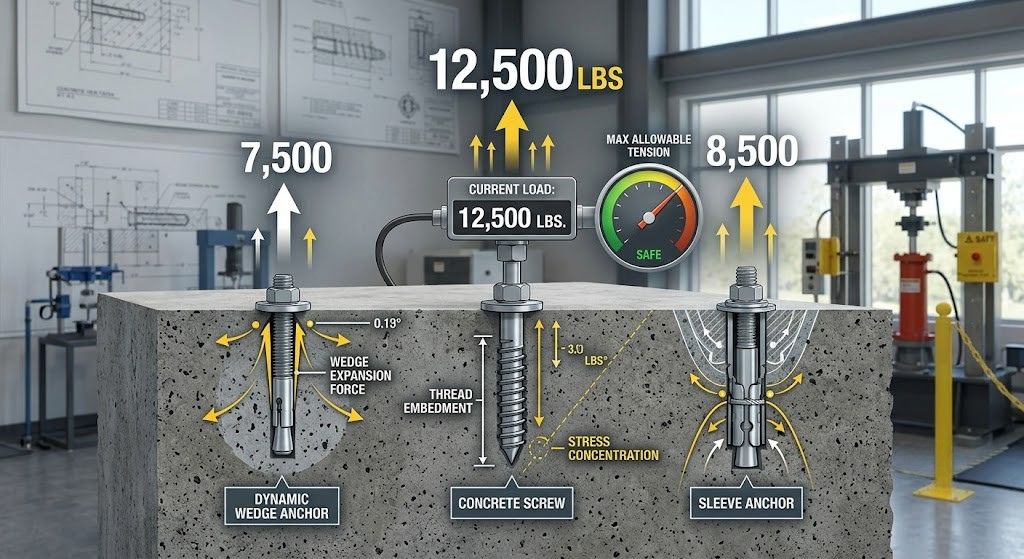
Concrete anchor load capacity is the maximum safe load a fastener can carry in a specific concrete condition, and that definition matters because there is no single number you can trust across every job. A 1/2-inch anchor in sound, thick concrete behaves very differently from the same anchor near an edge, in cracked slab, or with a sloppy install.
How Much Weight Can Concrete Anchors Hold?
Concrete anchor load capacity is a system rating, not a hardware label. You are not just buying a bolt or screw, you are buying performance from the anchor, the concrete, the hole, the spacing, the edge distance, and the installation quality all working together.
That is why two anchors with the same diameter can carry very different loads. If one is installed deep in high-strength concrete with proper torque and clean holes, and the other is set shallow near a slab edge, the second anchor loses capacity fast. For jobs that need reliable heavy-duty performance, it pays to compare the project conditions against the published ratings for heavy duty concrete anchors instead of guessing from size alone.
Why “Weight Capacity” Is Not a Fixed Number
Catalog ratings are not universal truth. They come from test conditions, specific concrete strengths, defined embedment depths, and exact spacing requirements. Actual jobsite capacity only matches the catalog when your install matches the test setup.
That is the part crews miss. A package might list a bold load number, but that number assumes perfect alignment, correct drill size, and the right substrate. A small change in embedment or edge distance changes the concrete failure zone and cuts the usable load.
Concrete Anchor Load Capacity Explained
The cleanest way to think about concrete anchor load capacity is this: the anchor system is only as strong as its weakest failure mode. Steel can be strong, but if the surrounding concrete breaks out first, the anchor is done at that lower limit. That is why engineers design to the controlling failure, not the biggest number in the box.
In commercial work, that distinction keeps you out of trouble. You are not asking, “How strong is the fastener?” You are asking, “What fails first in this exact setup?” On site, that answer usually comes down to the anchor type, the concrete condition, and whether the hole was installed correctly the first time. If the install process is off, concrete anchor installation mistakes quickly become load-capacity problems.
Tensile Load vs. Shear Load
Tensile load is pull-out force, straight away from the concrete. Shear load is sideways force, pushing across the surface of the anchor. They are not interchangeable, and you cannot treat one rating as a rating for the other.
A suspended pipe hanger mostly drives tensile demand. A bracket supporting a machine frame, handrail, or steel plate often creates shear, sometimes with tension mixed in. That mix matters because an anchor that handles one load well can be weaker under the other, especially near edges or when the fixture starts to pry.
Ultimate Load vs. Allowable Load
Ultimate load is failure load, the point where the anchor or the concrete gives up. Allowable load is the safe working load you use on the jobsite after safety factors and code provisions cut that number down to a usable value.
Use the allowable number. That is the one tied to real construction practice, safety margins, and inspection expectations. The ultimate number is useful for testing and comparison, but it is not the number you hang equipment from.
What Determines Concrete Anchor Strength
Several variables control concrete anchor load capacity, and each one changes the result in a real way. Anchor type sets the basic behavior, embedment depth affects how much concrete can resist the load, and concrete strength changes how easily the base material breaks or holds. Add spacing, edge distance, and installation quality, and you have the full picture.
A good example is installation quality. Research shows anchors with misalignment greater than 5 percent carry less load, which is exactly the kind of detail that shows up on a failed inspection or a pulled test. The same is true for torque, hole cleaning, and setting depth. These are not small details, they are capacity details.
Anchor Type and Design
Mechanical expansion anchors, wedge anchors, sleeve anchors, screw anchors, adhesive anchors, and cast-in-place anchors all transfer load differently. Wedge anchors expand against the hole wall, sleeve anchors spread load through a sleeve, screw anchors cut into the concrete, adhesive anchors bond to the hole, and cast-in-place anchors rely on the embedment and head configuration.
That difference changes failure behavior. Wedge anchors are popular because they provide immediate load-bearing capacity, while chemical systems are preferred in retrofit and specialty structural work because they can deliver strong load transfer where mechanical expansion is not the best fit. For a side-by-side look at anchor families, concrete anchors vs epoxy anchors is worth reading before you spec a retrofit job.
Embedment Depth and Anchor Diameter
Deeper embedment generally increases capacity because the anchor engages more concrete. Larger diameter usually helps too because it gives the load more steel and more bearing area. But size alone does not guarantee a higher safe load.
The anchor system still has to fit the concrete around it. If edge distance is short or the spacing is tight, a larger anchor can still lose to breakout. In practice, embedment and diameter only matter when the substrate gives them room to work.
Concrete Strength and Condition
Higher concrete compressive strength improves capacity, but not forever. In testing on post-installed expansion anchors, capacity increased as concrete strength went up, then the gain slowed once strength passed 40 MPa. That is the pattern you should expect: stronger concrete helps, but geometry and installation still govern the final rating.
Condition matters just as much as strength. Cracked, damaged, or deteriorated concrete lowers usable capacity, and crack width has a direct effect on failure load. Studies show certain anchor types lose capacity sharply as cracks open, especially bonded and interface-failure systems. In concrete that already shows distress, you must assume reduced performance and verify it before the install goes live.
Edge Distance and Anchor Spacing
Put an anchor too close to an edge, and the concrete breakout cone gets smaller. Put anchors too close together, and those cones overlap. That overlap is where capacity disappears.
This is why clustered anchors never behave like isolated anchors. The concrete around each fastener is part of the load path, and when those load paths collide, the system fails earlier. If your application depends on accurate hole placement and spacing, using the right drill bits for concrete anchors helps you hold dimension and avoid cheap mistakes that cost real load capacity.
Installation Quality and Alignment
Hole size, hole cleaning, torque, alignment, and embedment depth all affect the result. Excessive torque can crack steel, damage the substrate, or break the screw. Poorly cleaned holes cut bond strength. Misalignment above 5 percent reduces capacity. That is not theory, that is what shows up in load testing.
If you want the anchor to perform at spec, the install has to match the manufacturer procedure exactly. That is why how to install concrete anchors is not a rookie-only topic. On commercial work, installation discipline is part of the design.
Common Concrete Anchor Failure Modes
Understanding failure modes tells you what really limits the anchor. It also tells you what to inspect when something looks wrong. On a live job, the failure mode is the load capacity story.
Concrete Breakout
Concrete breakout happens when the concrete around the anchor fractures and pulls away in a cone or wedge shape. This is one of the most common tension failures, especially when anchors are near edges or closely spaced.
The practical rule is simple. If the concrete cannot form a full breakout cone, capacity drops. That is why edge distance and spacing are not paperwork items, they are structural limits.
Pull-Out and Pull-Through
Pull-out happens when the anchor slips from the hole or loses bond. Pull-through happens when the fixture or anchor head deforms enough to pass through the connected material. Both failures point to installation or design mismatch.
This is where hole cleaning, torque, and correct anchor selection matter most. A perfectly sized anchor in a poorly prepared hole still fails early. No surprise there, and no excuse on inspection day.
Steel Failure
Steel failure happens when the anchor rod or body yields or shears before the concrete breaks. In design terms, that is often a cleaner outcome because steel failure is more predictable than random concrete fracture.
You still do not want it in the field unless the design intended it. But if a system is loaded to its limit, a controlled steel failure is easier to engineer than an uncontrolled concrete breakout.
Splitting and Crack-Related Failure
Cracks change everything. Splitting failure runs through the concrete body and can open rapidly under tension or expansion force. In crack-sensitive systems, a wider crack means lower capacity, sometimes dramatically lower.
For some bonded systems, a 1.5 mm crack width cuts strength hard, and wider cracks can push capacity close to zero. That is why seismic or damaged-concrete applications demand careful verification, not optimistic assumptions.
How Engineers Estimate Concrete Anchor Capacity
Engineers do not guess. They use manufacturer tables, code methods, and test data to determine usable load capacity for the actual job conditions. That is the right sequence, and it is how you stay code-compliant.
In field work, live technical support can save time when a detail does not fit the standard table. Engineers verifying anchor specs on site often need quick confirmation on edge distance, embedment, or base material, and that is where product knowledge matters as much as inventory.
Manufacturer Tables and Evaluation Reports
Manufacturer load tables and evaluation reports give you the first-pass answer. They tell you what the anchor can do under defined conditions, and they usually separate tension and shear ratings, cracked and uncracked concrete, and installation requirements.
Use them as the baseline, not the final word. If the jobsite conditions do not match the test setup, the rating changes.
Code Methods and Design Models
Design codes calculate capacity by checking the likely failure modes, especially concrete breakout and steel limit states. For channel anchors, modified failure cone methods can predict tensile and shear performance with good agreement against test data, which is exactly why engineers trust those models for clustered or edge-sensitive layouts.
The big idea is simple. The code asks which failure controls first, then trims capacity to that limit. That is how a safe working load is established.
Pull Testing and Field Verification
Pull testing is the final check when the application is critical, unusual, or sensitive to existing concrete damage. It confirms real installed performance, not just catalog performance. If the concrete is old, repaired, or visually suspect, pull testing removes the guesswork.
On specialty jobs, that proof matters. You do not want a theoretical rating when the load path is supporting valuable equipment or a life-safety assembly.
Practical Load Capacity Examples by Application
The same capacity rules apply whether you are hanging conduit or anchoring equipment. The only difference is how much margin you have and how much the load shifts over time.
Hanging Pipe, Conduit, and Light Supports
Light-duty suspended work usually stays well below the top end of anchor ratings, but that does not mean you can get casual with placement. A small support bracket still needs correct embedment, proper hole size, and enough edge distance to avoid breakout.
Even low loads deserve safe installation. Small anchors fail early when the base concrete is weak or the hole is sloppy.
Structural Brackets, Equipment, and Frames
Equipment mounts add vibration, repeated loading, and sometimes prying force. That combination raises the real demand beyond the static weight of the item. A frame that weighs 300 pounds can impose much more load on a single anchor once the geometry starts working against you.
This is where anchor type, spacing, and torque all matter at once. You want the load path spread across the fixture, not concentrated at one point.
Overhead and Safety-Critical Installations
Overhead anchors and life-safety related hardware demand the highest level of verification. You need the right product, the right substrate, the right install, and the right documentation. No shortcuts.
On these jobs, the safe number is the only number that counts. If the system cannot be verified, it does not belong in service.
Why Cracked, Damaged, or Retrofit Concrete Changes Everything
Real concrete is rarely perfect. Slabs crack, edges spall, old holes exist, and repair work changes the substrate. Every one of those conditions reduces confidence in the catalog rating.
Cracked Concrete
Cracks interrupt the load path and reduce the concrete cone that resists tension. The wider the crack, the lower the capacity, especially in bonded and interface-sensitive anchors. In seismic-type loading, cyclic movement also changes behavior and increases variability, which means you need a more conservative approach.
Damaged or Delaminated Concrete
Surface damage is only part of the problem. Hidden voids, delamination, and weak patches can make the anchor behave nothing like the test specimen. If the base material is compromised, the published number is no longer reliable without verification.
Retrofit and Anchored Upgrade Work
Retrofit work is where concrete anchor load capacity becomes a real engineering decision. Existing slabs and walls often have unknown condition, mixed repair history, and less-than-ideal edge geometry. That is why retrofit projects often move toward adhesive systems, specialty mechanical anchors, or documented pull testing before final signoff.
Choosing the Right Anchor for Your Load
Start with the load direction, then match the anchor to the concrete condition, then check the environment. That sequence keeps you honest.
For heavy, immediate-load applications in sound concrete, wedge anchors are a strong fit. For retrofit, corrosion exposure, or demanding structural work, chemical or specialty systems often make more sense. If you need a quick technical reference while you sort through options, concrete anchors explained gives you a cleaner starting point than reading product labels in the middle of a job trailer.
Frequently Asked Questions
How much weight can a concrete anchor hold?
There is no single answer. Capacity depends on anchor type, embedment, concrete strength, edge distance, spacing, and installation quality. The controlling failure mode sets the limit.
Are bigger anchors always stronger?
Bigger anchors often carry more load, but not automatically. If edge distance is short, spacing is tight, or the concrete is weak, a larger anchor still loses capacity to breakout or splitting.
Can you trust the number on the package?
Only if your conditions match the test conditions. Packaging numbers assume a specific concrete type, embedment, spacing, and install method. Outside those conditions, the number drops.
What is the safest way to verify capacity?
Use manufacturer data, code-based design checks, and pull testing when the application is critical. That combination gives you the real installed capacity, not a guess.
Do cracked slabs always reduce anchor strength?
Yes. Cracks change how the load transfers into the concrete, and wider cracks reduce capacity further. For damaged or seismic-exposed concrete, treat the rating conservatively and verify the install.
When should you call for technical support?
Call before the holes are drilled if the job has unusual loads, tight edge conditions, corrosion exposure, or uncertain concrete quality. Getting the spec right early prevents rework, failed inspections, and wasted material.
