
If you are deciding between wedge anchors vs sleeve anchors, the wrong choice does more than waste hardware, it slows the job, creates inspection risk, and forces rework. The simple rule is this: use wedge anchors for maximum strength in solid concrete, and use sleeve anchors when you need more forgiveness in concrete, brick, or block with moderate load demands.
Quick Verdict: Wedge Anchors vs Sleeve Anchors
Wedge anchors win for heavy-duty, permanent installs in solid concrete. Sleeve anchors win when substrate varies, installation tolerance matters, and the load is real but not extreme. That is the decision rule you should trust on the jobsite, because anchor choice should follow the base material first, then the load, then the environment.
For commercial work, that usually means wedge anchors for structural steel, machinery, guardrails, and other safety-critical fastenings, and sleeve anchors for handrails, frames, boxes, and mixed masonry. If you are trying to avoid field inspection delays, start with the substrate under the bit, not the fixture on the wall.
Wedge Anchors vs Sleeve Anchors at a Glance
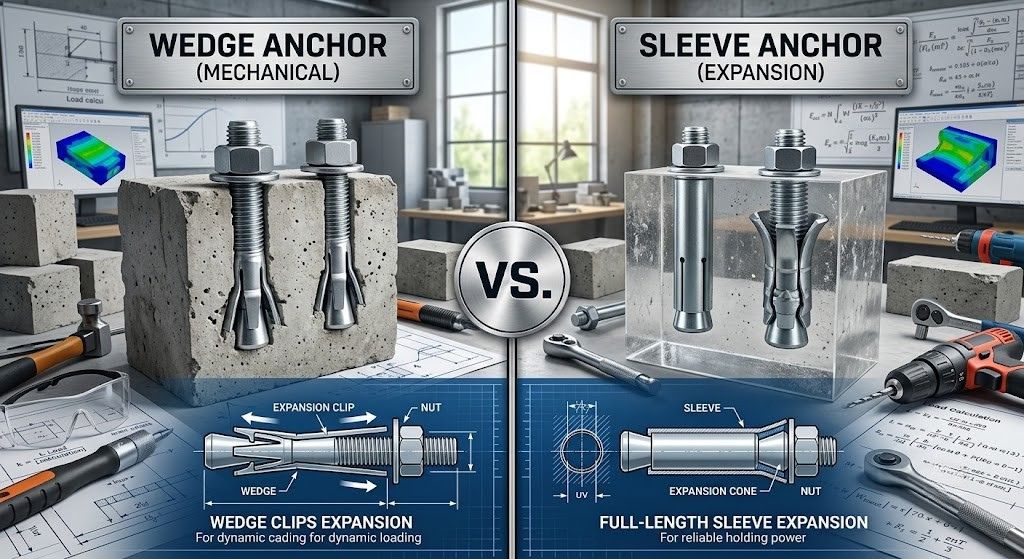
Both are mechanical expansion anchors, but they behave differently once installed. A wedge anchor grips by driving a wedge against the concrete as the nut is tightened, which gives you strong hold in cured solid concrete. A sleeve anchor expands along a sleeve, which makes it more adaptable when the hole or the base material is less predictable.
Marsh Fasteners’ direct comparison of strength and use cases matches what you see in the field: wedge anchors are the stronger, more precise option, while sleeve anchors are the more versatile one. Huyett’s guide also separates them cleanly by substrate and duty level, with wedge anchors for heavier applications and sleeve anchors for medium-duty fastening in masonry.
Quick Comparison Table
| Feature | Wedge Anchors | Sleeve Anchors |
|---|---|---|
| Best substrate | Solid concrete | Concrete, brick, block |
| Load capacity | Higher | Moderate |
| Vibration resistance | Excellent | Good |
| Installation tolerance | Tight | More forgiving |
| Corrosion options | Zinc, stainless | Zinc, stainless |
| Typical use | Structural, safety-critical | Frames, rails, fixtures |
If you need a fast field rule, use wedge anchors where failure is not an option and sleeve anchors where the base material is less uniform. For load planning, keep in mind that concrete anchor load capacity depends on embedment, edge distance, and concrete condition, not just anchor diameter.
How Each Anchor Works
The mechanical difference explains the performance difference. Wedge anchors bite hard into solid concrete because tightening the nut pulls the anchor upward, forcing the wedge against the hole wall. Sleeve anchors spread load differently, expanding a sleeve against the sides of the hole and giving you a more forgiving fit.
That mechanical split matters. Wedge anchors transfer force directly into dense, cured concrete, which is why they are favored for heavy-duty anchoring. Sleeve anchors spread that force more broadly, which helps when the base material has voids, softer zones, or mixed masonry conditions.
Wedge Anchor Expansion Design
A wedge anchor uses a threaded stud, a clip, and a cone-shaped wedge. As you tighten the nut, the wedge is drawn into the clip and the clip locks against the concrete wall. The result is a tight mechanical interlock with strong pull-out resistance and better performance under vibration.
That is why wedge anchors are the go-to choice for structural supports and other loads that stay in place for the life of the installation. They are built for clean, controlled expansion in solid concrete, and they reward precise installation.
Sleeve Anchor Expansion Design
A sleeve anchor works differently. Tightening the nut or head pulls the internal cone into the sleeve, which expands the sleeve along the drilled hole. That makes it easier to use in concrete, brick, and block where the hole is not always perfectly uniform.
The tradeoff is simple. You gain forgiveness, but you give up some load performance. Sleeve anchors handle a lot of real-world commercial fastening tasks well, just not the highest-demand structural ones.
Base Material Compatibility
Base material is the first question, not the last. If the substrate is wrong, the best anchor in the world will still fail inspection or fail in service. That is why solid concrete points you toward wedge anchors, while brick, CMU, and mixed masonry point you toward sleeve anchors.
Huyett’s anchor guide treats substrate condition as the key decision point, and that is the right way to think about it on a commercial site. Cracked concrete, hollow block, and old masonry all change the equation.
Solid Concrete Performance
Wedge anchors are the clear winner in solid, cured concrete. They deliver higher holding power, better vibration resistance, and more reliable performance for heavy loads. Marsh Fasteners is direct on this point, wedge anchors are best for structural support and heavy machinery, which is exactly where you should use them.
If you are anchoring a beam bracket, base plate, racking, or guardrail into sound concrete, wedge anchors belong at the top of your list. Anything less is a compromise you do not need.
Brick, Block, and Masonry Performance
Sleeve anchors are the better fit for brick, block, and mixed masonry conditions. Their expansion pattern tolerates less uniform material better than a wedge anchor, which is why they are commonly used for handrails and frames as well as electrical boxes and light fixtures.
This is also where crews get into trouble by forcing wedge anchors into the wrong substrate. A wedge anchor is not a brick anchor. Use it in brick or block and you are gambling with the base material.
Cracked and Uncracked Concrete Considerations
Cracked concrete changes the decision fast. Wedge anchors are commonly specified for cracked or uncracked concrete when the product is code-approved for that use, while sleeve anchors are better aligned with uncracked concrete and less demanding applications. On structural work, you do not guess here, you follow manufacturer data and ACI 318-19 Chapter 17.
For anyone doing layout or procurement, how to install concrete anchors correctly matters as much as which anchor you buy. Bad installation will undermine the right selection faster than almost anything else.
Load Capacity and Holding Strength
Wedge anchors dominate when the job calls for maximum holding strength. Sleeve anchors carry serious loads too, but they stay in the moderate-load category and that is the proper place to keep them. If the application is heavy, permanent, or life-safety related, choose the stronger anchor and size it from tested data, not guesswork.
A practical rule from BuildToolHQ is simple: light loads go elsewhere, medium loads can use concrete screws, and heavy loads above 150 pounds call for wedge or sleeve anchors. For commercial field work, the real distinction is sharper than that, wedge anchors are the stronger choice once the load gets serious.
Heavy-Duty and Structural Loads
Wedge anchors are the standard choice for structural supports, industrial racking, heavy machinery, and guardrails. They are built for higher pull-out resistance and more dependable long-term performance. BuildToolHQ’s load table shows the pattern clearly, a 1/2-inch wedge anchor carries more safe working load than a sleeve anchor of similar size.
For anchor-heavy work, heavy duty concrete anchors is the category you want to be shopping in, not general-purpose hardware. The difference shows up in design values, not just box labels.
Moderate Loads and Non-Structural Fastening
Sleeve anchors belong on handrails, window and door frames, light fixtures, electrical boxes, brackets, and similar installs. They are strong enough for a wide range of commercial tasks, but they are not the right answer when the connection becomes structural or safety-critical.
That is the cleanest way to think about it. Sleeve anchors are versatile workhorses. Wedge anchors are the heavy lifters.
Safety Factors and Manufacturer Data
Do not size anchors from ultimate numbers alone. Use published tested values, the correct embedment, edge distance, and a proper safety factor, because the real working load is always lower than the headline rating. A 4:1 safety factor is a practical baseline many crews use to keep the installation honest.
If you want to understand how those numbers translate to the field, anchor load capacity is the metric that matters, not marketing language. Capacity is a system issue, anchor, concrete, spacing, and install quality all work together.
Vibration and Long-Term Reliability
Vibration is where wedge anchors separate themselves. Their tighter mechanical bite gives them better resistance to loosening over time, which is why they are preferred on machinery bases, platforms, and installations exposed to movement. Sleeve anchors hold well, but they are not the better answer when constant vibration is part of the job.
That distinction matters on commercial and industrial projects because loosening means callbacks, inspections, and sometimes a full reset. In other words, cheap becomes expensive fast.
Vibration-Prone Applications
Use wedge anchors when equipment moves, runs, or cycles. HVAC supports, industrial racks, and mounted machinery all benefit from the stronger mechanical lock. Huyett places wedge anchors in the heavy-duty category for demanding applications, which lines up with field practice.
If the project lives near traffic, equipment vibration, or repeated loading, wedge anchors are the safer decision.
Permanent vs Adjustable Installations
Wedge anchors are better for permanent installations where the fixture stays put. Sleeve anchors give you a little more flexibility during installation, which can help when alignment is not perfect or when the crew is working in mixed masonry.
That said, “more forgiving” does not mean “better under load.” It means easier to install in less-than-perfect conditions.
Installation Speed and Tolerance
Both anchors require a properly drilled hole and good hole cleaning, but wedge anchors demand more precision. The hole size has to match the anchor size closely, and the torque has to be right. Sleeve anchors are more forgiving, which can save time on rougher masonry work.
That difference shows up when crews are moving fast. The more uniform the substrate, the more wedge anchors make sense. The more variable the substrate, the more sleeve anchors earn their keep. For drilling accuracy, the right drill bits are not a side issue, they are part of the fastening system.
Drill Hole Precision
Wedge anchors need a clean, correctly sized hole. If the hole is oversized or packed with dust, holding power drops and the installation becomes suspect. BuildToolHQ specifically calls for a carbide masonry bit matched to anchor diameter and a hole drilled slightly deeper than embedment.
Sleeve anchors tolerate a bit more variation, which is why they save time on older masonry or mixed construction.
Torque and Setting Requirements
Torque matters on both anchor types. Too little torque leaves the anchor under-set, too much can spall the concrete or damage the fastener. That is not a theoretical concern, it is a common field mistake.
If your crew skips the torque wrench and goes by feel, you are setting up inspection problems. Do it right the first time.
Jobsite Forgiveness
Sleeve anchors are the better choice when the hole is not perfect, the substrate is inconsistent, or the masonry is older. Wedge anchors are the better choice when the substrate is clean, solid, and ready for a precise install. That is the tradeoff, and it is a good one to understand before the crew starts drilling.
Corrosion Resistance and Material Options
Material spec matters just as much as anchor style in outdoor and industrial work. Zinc-plated anchors work in dry interior spaces. Once you get into moisture, chemicals, or coastal air, stainless steel becomes the smart move.
Zinc-Plated vs Stainless Steel
Zinc-plated wedge and sleeve anchors are fine for dry, interior applications. They are the economical choice where corrosion exposure stays low. For exterior utility work, parking structures, and damp environments, stainless steel is the safer specification.
304 Stainless Steel
304 stainless steel handles general outdoor exposure and moisture-prone conditions well. It is a solid default for many commercial exterior installs where salt exposure is not severe.
316 Stainless Steel
For coastal, marine, or chemical exposure, 316 stainless steel is the better choice. Marsh Fasteners specifically recommends 316 stainless steel in harsh corrosion environments, and that is the correct call when long-term reliability matters more than initial price.
Typical Applications by Project Type
The fastest way to choose is by project type. Structural and safety-critical work points to wedge anchors. Moderate-load, mixed-masonry, or fixture-based work points to sleeve anchors. That simple split covers most commercial decisions.
Structural Supports and Safety-Critical Mounts
Use wedge anchors for structural steel, heavy machinery, guardrails, industrial racking, and seismic or high-vibration applications. These are the installs where you want the highest practical holding power and the strongest inspection story.
Handrails, Frames, and Light to Moderate Fixtures
Use sleeve anchors for handrails, light fixtures, window and door frames, electrical boxes, and similar applications. Marsh Fasteners lists exactly those uses for sleeve anchors, and that matches how they get used across commercial interiors and exterior masonry.
Industrial, Commercial, and Exterior Installations
For HVAC, pipe support, exterior fixtures, and utility work, let the substrate and the environment decide. If you are in solid concrete and the load is high, choose wedge anchors. If the wall is brick, block, or mixed masonry and the load is moderate, choose sleeve anchors.
Pricing and Cost Comparison
Sleeve anchors usually cost less up front. That does not make them the better deal. It just means they are cheaper hardware for jobs that do not need wedge-anchor performance.
The smarter comparison is installed cost, not unit cost. If the wrong anchor causes a callback, a failed inspection, or a re-drill, the material savings disappear instantly. That is why install quality and product selection are part of the cost discussion, not separate topics.
Upfront Material Cost
On paper, sleeve anchors are the cheaper buy across common diameters. That makes them attractive for lighter work, repeat fixture installs, and budget-sensitive jobs. But if the application needs more load or more vibration resistance, the lower price is not worth the risk.
Cost vs Performance
Wedge anchors cost more because they do more. They deliver higher load capacity, better vibration resistance, and stronger performance in solid concrete. For permanent commercial work, that value is easy to defend.
Bulk Ordering and Jobsite Supply
On schedule-driven jobs, availability matters. Bulk boxes, exact-spec material, and quick fulfillment keep crews moving and reduce the chance that someone substitutes the wrong fastener because inventory is thin. That is where a supplier with depth helps keep your project on track.
Code Compliance and Engineering Requirements
Code compliance is not optional on commercial anchor work. Anchor selection has to align with the substrate, the load, the edge distance, and the documented performance data. If the project is structural or life-safety related, you need tested values and the right approval basis, not a generic assumption.
Wedge anchors and sleeve anchors are both legitimate mechanical fasteners, but they are not interchangeable under code scrutiny. You need the right tested product for the right substrate and the right application.
ACI 318-19 Chapter 17
ACI 318-19 Chapter 17 governs anchorage design in concrete for many commercial conditions. That includes cracked concrete considerations, spacing, embedment, and edge distance. If the job falls under structural review, the anchor has to match the design intent.
Manufacturer Specifications and ESR Data
Use manufacturer specifications and evaluation data to confirm the installation conditions. Do not rely on box labels alone. The product name matters less than the tested approval behind it.
Edge Distance and Embedment Depth
Poor edge distance can ruin an otherwise correct anchor choice. Wedge anchors in particular need room to expand properly, and setting them too close to an unsupported edge can crack the concrete. Follow layout rules, keep spacing honest, and drill to the specified depth.
Which Anchor Should You Choose
The decision is simpler than most crews make it. Pick wedge anchors when you need maximum strength in solid concrete. Pick sleeve anchors when you need versatility in masonry, more installation tolerance, and moderate load performance.
Choose Wedge Anchors When You Need Maximum Strength
Choose wedge anchors for solid concrete, heavy loads, vibration-prone equipment, permanent fixtures, and safety-critical work. That is the default choice when performance comes first.
Choose Sleeve Anchors When You Need Versatility
Choose sleeve anchors for concrete, brick, block, and mixed masonry where the load is moderate and the hole conditions are not perfect. They are the better fit when jobsite forgiveness matters more than maximum pull-out strength.
Choose Based on Substrate First
Start with the base material, then confirm the load and environment. That rule keeps you out of trouble and helps prevent inspection delays. If the substrate is wrong, every other decision is secondary.
Final Recommendation
Wedge anchors are the better overall choice for maximum performance in solid concrete. Sleeve anchors are the better all-around choice for mixed masonry and moderate loads. If you remember only one thing, remember this: pick the anchor that matches the substrate under the bit, not the fixture in your hand.
Frequently Asked Questions
Can you use wedge anchors in brick or block?
No. Wedge anchors belong in solid concrete, not brick or block. If the base material is masonry or mixed construction, sleeve anchors are the safer choice.
Are sleeve anchors strong enough for heavy loads?
Sleeve anchors handle moderate loads well, but they are not the right choice for heavy structural fastening. Once the load gets serious, wedge anchors take over.
Which anchor is better for vibration?
Wedge anchors. Their tighter mechanical lock gives you better resistance to loosening in machinery, HVAC, and other vibration-prone applications.
Do both anchors require precise drilling?
Yes, but wedge anchors demand tighter hole control. Sleeve anchors give you more tolerance, which helps in older masonry or less consistent substrate conditions.
Which material should you use outdoors?
Use stainless steel for outdoor exposure, and step up to 316 stainless steel for coastal, marine, or chemical environments. Zinc-plated fasteners are for dry interior work.
What causes anchor failures most often?
Bad hole size, poor hole cleaning, wrong substrate selection, and incorrect torque. The anchor is only as good as the installation behind it.
