
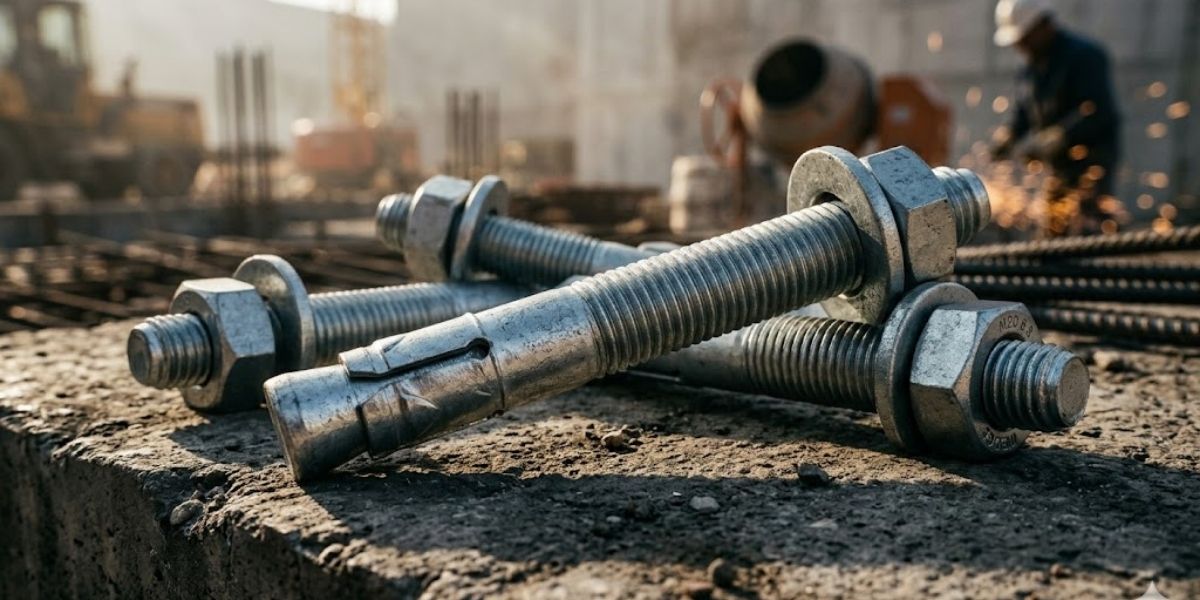
Buying heavy duty concrete anchors for seismic work is not a fastener decision. It is a life-safety decision that sits directly inside your structural load path, your inspection record, and your liability exposure. If you buy off catalog capacity alone, you miss the factors that actually control earthquake performance: cracked concrete behavior, ductility, code approval, and installation discipline.
Why Seismic Performance Changes the Buying Decision for Heavy Duty Concrete Anchors
In ordinary static loading, a high published tension or shear value can look good enough. In seismic loading, that shortcut fails. Earthquake demand introduces load reversals, concrete cracking, prying, displacement, and repeated cycling that expose every weakness in the anchor, the base material, and the installation.
That is why heavy duty concrete anchors belong in a different buying category than commodity jobsite fasteners. Your purchase decision has to start with approved seismic use, cracked-concrete qualification, and a failure mode that remains controlled under movement. The anchor is not just holding equipment or steel in place. It is maintaining a connection after the substrate starts changing under load.
Market demand reflects that shift. Updated codes and retrofit activity are pushing procurement toward certified anchor systems instead of generic alternatives. That is exactly where commercial contractors and estimators get tripped up, because the anchor that costs less per piece often costs more in rejected submittals, inspection delays, and field replacement.
The Real Loads Your Anchors Must Survive During an Earthquake
Seismic demand is dynamic, not static. Your anchors see vertical and lateral forces, repeated back-and-forth movement, and local damage around the hole. The connection does not get one clean pull. It gets a sequence of changing forces that try to loosen the anchor, widen the crack, crush the bearing zone, and trigger concrete breakout.
Brittle failure is the enemy. If the anchor system fails suddenly, you lose load transfer without warning. On a commercial project, that can mean a failed baseplate, detached curtain wall component, dropped MEP restraint, or compromised equipment anchorage. In seismic regions, the right anchor is the one that remains predictable when the concrete is no longer pristine.
Research on damaged concrete reinforces the point. In cyclic and cracked conditions, anchor reliability changes materially with crack width, diameter, and failure mechanism, and variation under cyclic testing rises well above static conditions. That is exactly why seismic selection cannot be reduced to a single load number.
Why Nominal Strength Does Not Equal Seismic Reliability
Catalog strength values are controlled results. Your field conditions are not. A rated anchor loses real performance when the hole is oversized, torque is off, embedment is short, spacing is tight, or the slab already contains shrinkage cracks and service damage.
Even worse, nominal capacity says nothing about how the anchor behaves when the load reverses and the crack opens. An anchor with strong static pull-out numbers can still lose connection quality under seismic cycling if the expansion zone is too sensitive to concrete damage or the steel lacks the ductility to absorb movement.
That gap between lab values and jobsite reality is why you should treat high load ratings as a starting point, not a buying conclusion. On seismic work, qualification data, ESR review, and installation controls matter more than marketing language.
Concrete Condition Controls Anchor Behavior
Concrete controls anchor performance more than buyers like to admit. Uncracked concrete gives you one set of assumptions. Cracked concrete gives you another. Concrete that has already opened under seismic cycling changes the failure path again.
A 2023 experimental study tested anchors in cracked concrete at widths from 0 to 3.0 mm and showed sharp changes in capacity and failure mode as damage increased. For some undercut anchor conditions, bearing capacity dropped up to 18 percent at larger cracks, and interface-related failures dropped much more severely. Small and medium-diameter expansion anchors performed especially poorly in 3.0 mm cracks when bearing capacity had to be preserved.
That is the practical takeaway: if your host concrete is already compromised, anchor selection gets narrower fast. You need a system approved for cracked concrete and backed by seismic qualification, not a general-purpose expansion anchor assumed to behave the same way after the slab opens up.
Code Requirements That Govern Seismic Anchor Selection
Your selection process is governed by code, not preference. Under the 2024 IBC, concrete anchorage design references ACI 318-19 Chapter 17 and uses strength design, not casual allowable-stress assumptions scribbled in the field. For post-installed systems, qualification support through ICC-ES reports or equivalent documentation is part of the package.
That changes how you buy. You are not choosing an anchor by brand familiarity or whatever the distributor has on the shelf. You are choosing a code-recognized anchoring system with defined base material limits, approved installation conditions, seismic categories, and cracked-concrete performance.
For seismic concrete anchors, submittal review is where weak products get exposed. If the report does not clearly state cracked-concrete approval, seismic qualification, allowable concrete condition, and installation limitations, the anchor does not belong in a safety-critical connection.
What to Look for in ICC-ES Reports and Manufacturer Data
Start with the evaluation report. Confirm the anchor category, approved base material, concrete condition, embedment range, diameter range, spacing and edge distance requirements, and seismic design applicability. Then read the limitations. That is where many substitutions fall apart.
A valid ESR should tell you whether the anchor is qualified under the proper acceptance criteria, such as AC193 for post-installed mechanical anchors or AC308 for adhesive anchors. It should also align with ACI qualification standards for the anchor type. If the report only shows static values without seismic qualification context, you do not have enough.
Manufacturer data sheets matter too, but only after the approval path is confirmed. Use those sheets to verify torque, hole diameter, bit requirements, installation sequence, steel type, coating, and accessory compatibility.
Strength Design, Approval Listings, and Inspection Readiness
Inspection-ready anchor systems have three things in place before drilling starts: engineered selection, approved documentation, and a clear installation procedure. That is what plan reviewers, special inspectors, and project engineers expect.
Field substitution is where trouble starts. Swapping a specified seismic anchor for a lookalike anchor bolt with similar diameter is not a technical equivalency. It is a redesign. If you need a faster way to vet approved systems, it helps to keep your procurement tied to certified structural anchoring options that already support submittals, ESR review, and repeatable inspection acceptance.
Types of Heavy Duty Concrete Anchors Used in Seismic Applications
The main anchor categories used in seismic work are expansion anchors, undercut anchors, adhesive anchors, and cast-in anchors. Each develops load differently. That mechanical difference matters because it shapes how the connection responds when concrete cracks and loads reverse.
Mechanical anchors create load-bearing connections through expansion, undercut, or friction without chemical bonding. Adhesive anchors transfer load through bond along the embedment depth. Cast-in systems rely on placement before the concrete cures. None of those categories is automatically best. The right choice depends on access, substrate condition, design loads, service environment, and inspection controls.
Wedge, Sleeve, and Other Expansion Anchors
Expansion anchors develop resistance by forcing an expansion element against the concrete. Wedge anchors and sleeve anchors are common examples. In the right application, they are fast, familiar, and productive. That is why expansion systems remain heavily used in commercial construction, industrial equipment mounting, and MEP support.
But here is the catch: expansion performance is tightly tied to concrete quality and installation accuracy. If the concrete is cracked, edge distance is tight, or the expansion zone is poorly formed because of drilling error, performance drops fast. That is also why detailed engineering matters. Testing has shown that small changes in sleeve and head geometry can improve performance by about 1.71 times in optimized torque-controlled expansion designs.
For seismic buying, that matters directly to CEP’s heavy duty concrete anchors. Expansion mechanisms that satisfy ICC-ES cracked-concrete criteria are not generic sleeves with bigger numbers on the box. The geometry, steel behavior, expansion control, and tested installation procedure are what make the difference between a code anchor and a commodity substitute.
Undercut Anchors for Predictable Mechanical Interlock
Undercut anchors engage a formed undercut in the concrete, creating a mechanical interlock rather than relying mainly on friction. That gives you a more deliberate load path and, in demanding seismic applications, a more predictable response.
This is why undercut anchors command premium pricing in high-performance specifications. They are used when the connection has no room for uncertainty, especially in high-load structural or infrastructure work. For buyers reviewing options on life-safety connections, undercut systems earn attention because the load transfer mechanism is fundamentally less dependent on friction alone.
Adhesive and Hybrid Options in Seismic Design
Adhesive and hybrid systems deserve a careful review, especially on retrofit work where post-installed anchors are the only practical option. Properly approved adhesive anchors can serve high-stress applications, but installation control is stricter. Hole cleaning, adhesive delivery, cure time, temperature, and orientation all matter.
Adhesive anchors also carry inspection implications. Horizontal, upwardly inclined, and overhead installations intended to resist sustained loads require continuous special inspection under ACI 318-19 provisions. If your schedule and field conditions cannot support that discipline, a mechanical post-installed system is often the cleaner choice. For a deeper comparison of where bonding systems fit, review mechanical versus resin-based anchoring.
Cast-In vs. Post-Installed Anchors: What Performs Better on Real Retrofit Work
On real retrofit jobs, post-installed anchors dominate because the structure already exists, access is constrained, and layouts change. Curtain walls, seismic reinforcement, bridges, tunnels, equipment upgrades, and tenant improvement work all rely heavily on post-installed anchors for exactly that reason.
Cast-in anchors still offer advantages in new structural work where location is fixed early and placement can be controlled from the start. But once the slab or wall is already in place, post-installed anchors give you the flexibility to respond to field conditions without tearing up the schedule.
When Post-Installed Anchors Are the Right Choice
Post-installed anchors are the right choice when your project needs field adaptability, retrofit speed, or recovery from layout changes. In existing facilities, that is most of the time. You can respond to actual dimensions, avoid embedded conflicts, and maintain progress through change orders without redesigning the whole connection.
That flexibility only works if the anchor system is approved for the exact condition you have. Use tested post-installed anchors, not generic substitutions. If your crews are drilling large volumes into high-PSI concrete, productivity also depends on better drill bit selection for dense concrete, because poor hole quality ruins even the best anchor.
When Cast-In Anchors Still Make Sense
Cast-in anchors make sense when the design is locked early, access before the pour is clean, and the structural team can control placement precisely. For heavily loaded new structural work, cast-in systems avoid drilling variables and can simplify certain inspections.
Still, cast-in is not automatically superior. Misplaced cast-ins create their own expensive problems, and they offer none of the retrofit flexibility that post-installed systems provide. In fast-moving commercial work, that limitation matters.
The Buying Factors That Actually Determine Seismic Performance
If you want a buying framework that holds up in plan review and in the field, focus on geometry, steel behavior, corrosion resistance, and design detail. Those are the factors that determine how the anchor actually performs after the first crack opens.
Embedment Depth, Spacing, and Edge Distance
Geometry drives capacity and failure mode. Increase embedment properly and you improve engagement. Reduce edge distance too far and you invite breakout. Tighten spacing without engineering support and you make anchors compete for the same concrete cone.
Premium anchors do not overcome bad geometry. If the layout violates the report, your connection is compromised before it is loaded. That is why takeoffs and shop coordination matter just as much as product selection.
Material Strength, Ductility, and Corrosion Resistance
Harder steel is not always better steel in seismic work. You need strength, but you also need ductility. The anchor has to deform in a controlled way rather than fail suddenly. That is the difference between a connection that absorbs movement and one that snaps.
Material selection also has to match the environment. Carbon steel remains common, but corrosive environments demand the right coating or stainless option. Long-term exposure to moisture, salt, or chemicals eats away at seismic reliability. If you are already evaluating the broader connection package, it helps to align anchor decisions with your heavy-load fastening criteria so the steel, finish, and service environment are treated as one system.
Diameter, Head Style, and Sleeve Design Details
Anchor design details are not cosmetic. They directly affect pull-out, shear transfer, expansion control, and consistency. Recent testing showed improved expansion-anchor models increased pull-out performance by about 1.25x to 1.42x depending on diameter and concrete strength at 50 mm embedment. The same research improved prediction accuracy substantially by accounting for both embedment depth and anchor diameter.
That tells you something valuable as a buyer: engineered geometry matters. Diameter alone does not define performance. Head style, sleeve length, expansion profile, and torque response all shape how the anchor engages cracked concrete and how repeatably it installs across a large crew.
Installation Errors That Destroy Anchor Capacity
Most anchor failures on commercial jobs are purchased in the field, not at the factory. The anchor passes review, the spec is solid, and then the hole is wrong, the dust stays in place, the torque wrench never appears, or the crew substitutes hardware to save a trip.
That is how certified heavy duty concrete anchors lose capacity. Not because the report was wrong, but because the installation stopped matching the report.
Drilling Accuracy, Hole Cleaning, and Torque Control
Hole diameter, hole depth, and drilling angle must match the installation instructions. If the bit runs oversized or the hole is shallow, the expansion mechanism does not develop correctly. If dust stays in the hole, the anchor may seat poorly or generate false torque.
Torque control is especially important in seismic applications. Industry data shows torque-controlled installation represents a major share of critical anchor methods for infrastructure and seismic-resistant connections. That makes sense. Calibrated torque gives you a defined installation condition instead of a guess. Pair that with reliable tooling and more efficient carbide drilling performance to improve consistency across high-volume installations.
Common Jobsite Mistakes to Avoid
The repeat offenders are straightforward: wrong embedment, wrong bit, skipped cleaning, anchor substitution, over-torquing, under-torquing, installing into damaged concrete without review, violating spacing, and mixing components from different systems.
Those mistakes kill capacity and create inspection failures. On large projects, the fix is standardization. Keep approved anchors, matching accessories, and installation instructions tied to one controlled procurement channel. That approach also helps when sourcing approved anchor inventory at scale so crews are not improvising with whatever landed on the truck.
Matching Anchor Type to Commercial and Industrial Use Cases
Anchor selection becomes easier when you map the system to the actual connection. Not every seismic anchor problem is the same, even when the code section is.
Structural Steel Baseplates and Equipment Anchorage
Baseplates and equipment anchorage demand predictable load transfer, especially where vibration, uplift, or lateral restraint are in play. Here, ductility and geometry control matter more than bargain pricing. You need an anchor system that stays stable under repeated demand and maintains connection integrity after the concrete cracks.
Heavy industrial applications reinforce the point. Fact.MR identifies heavy duty mechanical anchor segments reaching 10,000 to 25,000 kilograms for bridge infrastructure and heavy machinery use. That is not commodity hardware territory.
MEP Seismic Bracing, Curtain Walls, and Facility Upgrades
This is where post-installed anchors shine. Hospitals, schools, data centers, and occupied commercial buildings rarely give you perfect conditions. You are dealing with existing slabs, tight access, phased work, and strict inspection.
For MEP bracing and retrofit facade work, the best buying decision is usually an approved post-installed system that handles cracked concrete, documents cleanly, and installs consistently under schedule pressure. Speed matters, but not more than approval status.
Infrastructure, Bridges, Tunnels, and High-Demand Retrofits
Infrastructure work raises the bar further. Cracked concrete, access constraints, environmental exposure, and long service life push you toward higher-performance systems with tighter documentation and stronger corrosion planning.
This is where undercut anchors, high-performance expansion systems, or tightly controlled adhesive solutions earn their place. The heavier the consequence of failure, the less tolerance you have for generic anchor bolts and casual substitutions.
Budget Reality: Where to Spend More and Where Cutting Cost Fails
Unit price is the worst way to compare seismic anchors. The true cost sits in engineering acceptance, labor productivity, failed inspections, change-order resilience, and rework. A cheap anchor that takes longer to install, generates rejected submittals, or fails torque checks is not cheap.
Commodity Anchors vs. Tested Seismic Systems
Third-party-tested, code-approved anchors cost more because the testing, reporting, and engineering are built into the product. On safety-critical work, that premium is justified. Updated code pressure and labor productivity demands are already pushing the market in that direction.
There is another cost factor most estimators overlook: labor consistency. Faster, error-resistant installation methods often save more money than a lower piece price ever will. That is especially true when the anchor package is repeated thousands of times.
Bulk Purchasing, Submittal Efficiency, and Supply Continuity
Large projects need approved systems in stock, complete paperwork, and reliable replenishment. If your supplier cannot support volume and documentation, your crews end up waiting or substituting. Both outcomes are expensive.
That is where disciplined purchasing helps. Keeping standardized anchors tied to your wider construction supply inventory strategy reduces substitution risk, supports submittals, and keeps the same approved system moving from bid phase through closeout.
How to Evaluate a Supplier Before You Buy
Your supplier has to do more than ship boxes. For seismic work, the supplier is part of your risk management chain. If documentation is slow, inventory is thin, or specialty sourcing breaks down, your schedule suffers.
Technical Support and Documentation Access
You need fast access to ESRs, load tables, installation instructions, material data, and submittal support. If your PM or engineer asks for cracked-concrete approval and the supplier responds with a generic catalog page, that supplier is not ready for commercial anchoring systems.
A strong supplier supports bid review, submittals, substitutions when required, and high-volume repeat ordering without losing the paper trail. That is exactly where CEP stands apart. With over 10,000 products in stock and decades of sourcing experience, CEP supports technical review and keeps commercial buyers moving instead of chasing paperwork.
Inventory Depth and High-Volume Fulfillment
Seismic work often consumes anchors in serious volume. That requires depth on standard sizes, access to specialty items, and dependable factory relationships. A supplier that handles bulk well protects your schedule and reduces jobsite improvisation.
At CEP, that is a day-to-day operating standard. Bulk orders, specialty items, domestic factory access, and fast turnaround are part of the value, not an add-on. On enterprise projects, supply continuity is performance.
Best-Fit Recommendations by Project Priority
The best anchor choice depends on what matters most on the project. The decision gets simpler when you rank your priorities correctly.
Best Choice for Seismic Retrofit Flexibility
For retrofit work, the best choice is a post-installed, code-approved anchor tested for cracked concrete and seismic conditions. That gives you adaptability in the field without surrendering engineering support. For most existing commercial structures, this is the priority path.
Best Choice for Maximum Predictability in New Structural Work
For new structural work with fixed layouts and early coordination, cast-in anchors or high-performance approved systems deliver the highest placement control. If the formwork, reinforcement, and anchor locations are locked early, that route gives you a very predictable connection.
Best Choice for High-Volume Commercial Procurement
For large-scale procurement, choose standardized systems that are inspection-ready, consistent to install, and readily available in volume. The winning anchor is not the cheapest per carton. It is the one your crews install correctly every time, your engineer approves quickly, and your supplier can replenish without delay.
Final Seismic Anchor Checklist for Contractors, Engineers, and Bidders
Before you approve or buy heavy duty concrete anchors, verify the non-negotiables. Confirm code approval under the applicable framework. Confirm cracked-concrete suitability. Confirm embedment, spacing, edge distance, and torque requirements. Confirm ductile material behavior and the right corrosion resistance for the environment. Confirm the installation procedure is documented and realistic for field conditions. Confirm the supplier can support volume, technical review, and schedule continuity.
That checklist applies whether you are buying seismic concrete anchors for MEP restraint, post-installed anchors for retrofit steel, concrete anchor bolts for machinery, or broader commercial anchoring systems for phased facility upgrades. Once you treat the anchor as a designed seismic connection instead of a commodity fastener, your buying decisions get sharper and your project risk drops.
Frequently Asked Questions
Are heavy duty concrete anchors automatically approved for seismic use if they have high load ratings?
No. High load ratings do not equal seismic approval. You need documented qualification for seismic conditions, cracked concrete, and the applicable code path, typically supported by ICC-ES evaluation reports and ACI-based testing.
What anchor type is usually best for retrofit seismic work?
Post-installed anchors are usually the best fit for retrofit work because existing structures demand field flexibility. The right product is a tested, code-approved system rated for cracked concrete and seismic service, not a generic expansion anchor.
Why does cracked concrete matter so much in anchor selection?
Cracked concrete changes the way the anchor transfers load into the substrate. It reduces confinement, alters failure mode, and can sharply reduce capacity. In seismic events, that condition is expected, not exceptional.
Are expansion anchors acceptable in seismic applications?
Yes, if the specific anchor is qualified for seismic use and cracked concrete under the required acceptance criteria. Approved expansion anchors perform well in many commercial applications, but generic expansion anchors are not interchangeable with tested seismic systems.
What installation issue causes the most anchor failures?
Incorrect drilling and torque control cause repeated failures. Wrong hole diameter, shallow embedment, poor cleaning, and unverified torque all prevent the anchor from developing the tested condition used in the approval data.
How do you reduce procurement risk on large anchor packages?
Standardize approved systems early, lock submittal documentation, and buy from a supplier with technical support and deep inventory. That reduces substitutions, keeps inspections cleaner, and protects your schedule.
