
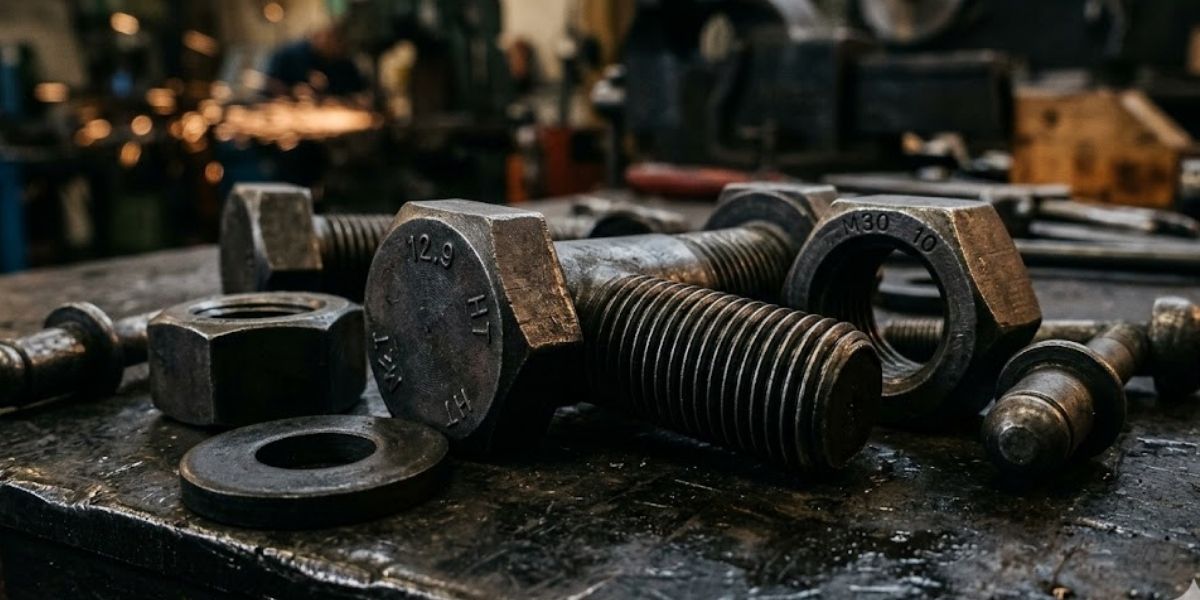
Heavy duty fasteners decide whether a connection holds its load for decades or turns into a callback, shutdown, or failed inspection. If you specify for commercial steel, concrete anchoring, plant equipment, or rooftop mechanical systems, the job is not to buy bigger hardware. The job is to match load path, fatigue life, corrosion resistance, installation control, and documentation to the actual service conditions.
Why Heavy Duty Fasteners Demand Engineering-Level Specification
In commercial work, heavy duty fasteners are load-transfer components. That distinction matters. A beam clip connection, equipment base, seismic restraint, embed plate, or high strength anchor only performs as designed when the fastener, substrate, hole condition, coating, and installation method all work together.
Failure is expensive fast. You absorb labor to remove and replace hardware, schedule disruption while inspectors hold the work, and liability exposure if the joint supports occupied space, rotating equipment, or life-safety systems. That is why advanced buyers treat structural fasteners and industrial fasteners as engineered assemblies, not shelf commodities.
Market demand confirms the point. The North American sector alone is tracking toward USD 27.17 billion by 2031 because construction, OEM, infrastructure, and industrial applications keep pushing for stronger, longer-lasting, traceable fastening systems.
Define the Load Before You Specify the Fastener
Correct specification starts with the service condition. Static dead load is only one piece. Your joint also sees startup torque, thermal movement, vibration, impact, wind, cyclic machine loading, and load redistribution after slip. If you start with a catalog tensile number and stop there, you are already behind.
For commercial anchoring systems, define the full load spectrum first: sustained axial demand, transverse shear, any prying action, eccentricity, vibration profile, expected cycles, and environmental exposure. The right fastener is the one that survives the entire service life, not the one that posts the highest proof strength on paper.
Static, Cyclic, and Variable-Amplitude Loading
A one-time peak load and a repeated service load are not the same design problem. Plenty of heavy duty fasteners survive proof loading, then fail early because cyclic stress keeps working the thread root until a crack starts and grows.
That is why fatigue is front and center in modern specification. Current bolt research increasingly evaluates variable-amplitude loading because field conditions do not behave like a clean constant laboratory cycle. Rooftop units, conveyors, flange joints, and steel connections all see changing amplitudes over time.
Tension, Shear, and Combined Load Paths
You need to identify whether the joint is loaded primarily in tension, shear, or both. Anchor rods resisting uplift are one problem. Baseplate anchors resisting sliding are another. Equipment supports and bracketry usually see mixed loading, and mixed loading is where poor assumptions get exposed.
For threaded bolts, the practical rule is that shear area is about 0.577 times tensile stress area. That matters when you size high strength anchors, machine bolts, and structural fasteners for combined demand. If you are already evaluating connection behavior in wind and uplift conditions, it helps to align that review with wind-driven fastening demands so the fastener choice reflects actual force direction, not just nominal bolt size.
Safety Factors That Reflect Real Service Conditions
A real safety margin accounts for alternating stress, mean stress, joint slip risk, preload loss, and fatigue life. It does not stop at ultimate tensile strength. Goodman gives you a practical fatigue check for ductile materials under tensile fatigue. Soderberg gives you a more conservative screen because it references yield strength.
For safety-critical work, use fatigue safety factors that respect the consequence of failure. Bridges, suspended systems, offshore-like exposure, and vibration-heavy mechanical assemblies justify conservative design discipline every time.
Load Capacity Starts With Material, Grade, and Geometry
Load capacity is set by material, strength class, diameter, thread geometry, and bearing condition. Change any one of those inputs and the connection behavior changes with it. That is why the best specification sheets are boring in the best way: exact, measurable, and complete.
Material Selection for Strength, Environment, and Temperature
Carbon steel and alloy steel remain the workhorses for commercial construction and general industrial duty because they deliver high strength and predictable performance at competitive cost. Stainless steel earns its place where washdown, coastal exposure, and corrosion resistance drive lifecycle value. Aluminum and titanium fit weight-sensitive assemblies and galvanic-sensitive systems. Specialty alloys such as Inconel belong in elevated-temperature service where ordinary steels lose performance.
That requirement is absolute in severe heat. Some aerospace-grade fasteners must withstand above 650 °C, which is why alloy selection is never a cosmetic upgrade. It is a survival requirement.
Grade, Strength Class, and Threaded Performance
Grade designations define tensile strength, yield strength, hardness range, and preload expectations. Higher strength is useful only when the connected material, washer stack, hole quality, and tightening method can support that preload without crushing the substrate or introducing installation error.
In practice, over-specifying grade often creates new problems: brittle behavior where ductility was needed, damaged threads during installation, or preload demands that the base material cannot carry. Good engineering matches the grade to the joint, not to ego.
Diameter, Thread Geometry, and Grip Length
Diameter does not tell the whole story. Thread pitch affects stress concentration and engagement behavior. Rolled threads generally outperform cut threads in fatigue because the process improves surface condition and residual stress profile. Grip length matters because the unthreaded shank should carry through the connected materials whenever the joint design allows it.
Manufacturing detail matters more than many buyers realize. If you need deeper context on test standards and shear performance for large-scale procurement, review how high-shear qualification is handled in practice.
Longevity Depends on Fatigue Resistance, Not Just Tensile Strength
Tensile numbers win catalog comparisons. Fatigue resistance wins real service life. Bridges, steel framing, rooftop mechanical supports, and plant-mounted machinery all prove the same point: long-term durability comes from managing stress range, preload retention, surface quality, and crack initiation points.
Why Fatigue Is the Real Failure Mode in Heavy Duty Fasteners
Fatigue failure starts below ultimate strength. A fastener sees alternating stress, microscopic crack initiation, then progressive damage until the remaining section cannot carry the load. For steel in fully reversed loading, a practical starting benchmark places the endurance limit around 50 percent of ultimate tensile strength, then real-world correction factors reduce that further for size, surface finish, temperature, and reliability target.
That is why larger is not automatically better. Bigger bolts often carry more load, but they also bring larger stressed volumes and higher sensitivity to stress concentration if the thread and surface condition are poor.
The Advantage of Cold-Rolled Threads and Residual Stress
Cold-rolled high-strength fasteners remain the standard choice in safety-critical cyclic joints for good reason. The process creates a work-hardened surface layer and beneficial compressive residual stresses that delay crack initiation.
That is not theory. A 37 full-scale tests fatigue study in 2026 showed that including manufacturing-induced residual stresses materially improved fatigue-life prediction accuracy. If your spec ignores manufacturing method, your life prediction is incomplete.
Surface Finish and Thread Quality as Life-Cycle Factors
Rough finishes, nicked threads, poor concentricity, and loose tolerances all shorten service life. Fatigue cracks look for stress risers, and damaged thread roots are perfect starting points. Your submittal review should verify surface treatment, thread rolling method, dimensional tolerance, and any fatigue-related production controls.
This is where CEP’s heavy-duty fastener line sets the benchmark for strict mechanical load requirements. You need hardware backed by documented specs, dependable manufacturing quality, and lot-level consistency so your design assumptions survive field installation.
Corrosion Protection and Coatings: Where Service Life Is Won or Lost
Corrosion does more than stain hardware. It reduces cross-section, attacks threads, changes friction behavior, and bleeds clamp load out of the joint. In coastal, rooftop, chemical, and washdown environments, service life is often won or lost at the coating decision.
Zinc, Zinc-Nickel, Stainless, and Specialty Finishes
Zinc plating still dominates because it is affordable and broadly useful for indoor and moderate-exposure service. In North America, zinc-plated finishes hold a major market share because they balance cost and baseline corrosion resistance. But higher-performance systems are taking ground fast.
Zinc-nickel, trivalent systems, stainless alloys, and specialty coatings justify the added cost when exposure is severe or the maintenance interval is long. If you are sourcing certified anchoring hardware with compliance documentation, coating performance belongs in the qualification review, not as an afterthought.
PTFE and Low-Friction Coatings for Installation Control
Coatings also affect installation consistency. PTFE and similar low-friction finishes reduce torque scatter, lower thread friction, and help prevent galling, especially on stainless assemblies. In high-volume assembly, that translates directly into more consistent clamp force.
The practical data is strong: PTFE coatings can reduce installation torque by as much as 30 percent. On stainless pairs, that reduction also helps control the seizure risk that ruins threads before the joint ever reaches design preload.
Matching Coating to Environment and Compatibility
Match the coating to the environment and to the connected materials. Dissimilar metals invite galvanic corrosion. Salt spray and moisture cycling demand different protection than dry indoor service. Chemical washdown changes everything. Temperature limits matter too, because some coatings lose performance long before the base material does.
Installation Quality Determines Whether the Spec Performs in the Field
A perfect fastener spec still fails if field installation is sloppy. Clamp force depends on friction, hole quality, alignment, embedment, and tightening method. If your installation process does not reproduce the tested condition, the connection does not match the engineering basis.
Preload, Clamp Force, and Torque Accuracy
Torque is only an indirect route to preload. Friction at the threads and bearing surface consumes a large share of the applied torque, which means lubrication and coating change the final clamp load dramatically. Same torque value, different lubrication, different preload. That is why torque scatter can wreck consistency on large commercial jobs.
Anchoring Conditions, Base Material, and Edge Distance
Concrete and masonry anchoring live or die on embedment depth, spacing, edge distance, cracking condition, and substrate strength. Structural steel attachments bring a different set of variables, such as hole tolerance, faying surface condition, and slip-critical requirements.
If you are drilling into high-PSI concrete for high strength anchors, the bit, hole cleaning, and drilling accuracy deserve as much attention as the anchor itself. That is exactly why drill bit selection for dense concrete belongs in the same conversation as anchor specification.
Common Installation Errors That Shorten Fastener Life
The most expensive failures are usually preventable: over-torquing, under-torquing, damaged threads, reused one-time-use hardware, missing washers, incompatible nuts, wrong finish substitutions, and field swaps to unapproved grades. Large jobs also get burned by inventory gaps and last-minute substitutions, which is why keeping supply flow under control protects quality as much as schedule.
How to Buy Heavy Duty Fasteners for Large-Scale Commercial Work
Procurement for heavy duty fasteners is not a price spreadsheet exercise. You are buying schedule protection, inspection readiness, and mechanical reliability. For large commercial developments, public work, utilities, and plant expansions, supplier qualification matters as much as the hardware itself.
Certifications, Code Compliance, and Traceability
Expect ASTM, SAE, IFI, ICC-ES, and project-specific requirements where applicable. Require mill certifications, heat-lot traceability, and packaging that supports audit-ready identification. Counterfeit and undocumented hardware has no place in safety-sensitive work, especially where inspection, insurance, and warranty exposure are on the line.
Domestic Sourcing, Lead Times, and Bulk Order Reliability
Domestic factory access and regional warehousing protect schedules. Buy America preferences, specialty coating lead times, and custom geometry can derail procurement if the supplier only stocks commodity lines. For high-volume work, that risk is not theoretical. One supply gap can force an unapproved substitution across hundreds of connections.
Supplier Qualification for High-Volume and Critical Applications
A true industrial source gives you documented specs, repeatable inventory, coating options, lot traceability, technical guidance, and fast access to specialty items. That is the difference between a commodity counter sale and a real project partner. If your volume planning includes anchors, bolts, and related hardware across multiple phases, enterprise-scale anchor sourcing should sit inside the same procurement strategy.
Best Heavy Duty Fastener Choices by Application
Application should drive priority. The right choice for structural steel is not the right choice for washdown food processing or elevated-temperature process equipment.
Structural Steel, Framing, and Commercial Anchoring
Use approved structural bolts, code-compliant concrete anchors, and complete assemblies with the required washers and nuts. For load-bearing steel and retrofit anchoring, inspection readiness and listing compliance carry as much weight as nominal strength.
High-Vibration Mechanical and Industrial Equipment
For rotating equipment, conveyors, rooftop units, and machinery bases, prioritize preload retention, fatigue resistance, locking strategy, and coating durability. Industrial fasteners in vibration duty should favor controlled installation and strong thread quality over flashy tensile claims.
Corrosive, Coastal, and Washdown Environments
Pay for stainless, zinc-nickel, hot-dip galvanized, or specialty-coated hardware when corrosion exposure is real. Added upfront cost is minor compared with replacement labor, seized threads, lost preload, and shutdown risk.
High-Temperature and Specialty Duty Applications
For boilers, process systems, and power equipment, specify for thermal cycling, oxidation resistance, and alloy stability at operating temperature. Standard carbon steel stops being a bargain the moment heat starts degrading strength or coating performance.
Budgeting for Value: What Costs More Up Front and Saves Money Long Term
The cheapest line item often produces the most expensive joint. Paying more for better alloy, better coating, cold-rolled threads, traceability, and certified production makes financial sense when access is difficult, downtime is expensive, or inspection risk is high.
Standard heavy duty fasteners remain fully appropriate for dry interior service, moderate loading, and non-critical assemblies. But once the joint sees vibration, weather, corrosives, repeated cycles, or hard-to-access installation, lifecycle cost takes over. Labor, callbacks, shutdowns, and replacement intervals crush any savings from bargain hardware.
Specification Mistakes That Cause Premature Failure
The recurring mistakes are predictable. Choosing by tensile strength alone. Ignoring cyclic loading. Treating coating as cosmetic. Overlooking galvanic compatibility. Assuming torque equals preload without accounting for friction. Buying undocumented hardware for regulated work. Reusing fasteners designed for one-time installation. Substituting finishes or grades in the field because the original supplier could not maintain stock.
That is exactly why disciplined sourcing matters. CEP earns trust on commercial projects by supplying heavy duty fasteners with the inventory depth, technical support, and specification control that keep large jobs moving without compromising load performance.
Heavy Duty Fastener Specification Checklist for Confident Purchasing
Use a simple sequence. Define the load case, including static, dynamic, shear, tension, and fatigue demand. Confirm the substrate and connection geometry. Select the material and grade for strength, temperature, and corrosion exposure. Verify fatigue resistance through thread quality, manufacturing method, and preload strategy. Choose the coating for environment and installation control. Set the installation method, torque or tension verification, and inspection criteria. Require certifications, traceability, and approved documentation. Then confirm supplier capacity before release.
That process removes guesswork. It also protects your schedule, your inspection path, and your warranty position.
Frequently Asked Questions
How do you choose between tensile strength and fatigue resistance?
Start with the actual service condition. If the joint sees repeated loading, vibration, or thermal cycling, fatigue resistance outranks headline tensile strength. Tensile capacity prevents immediate overload. Fatigue performance determines long-term survival.
Are stainless heavy duty fasteners always the best option for corrosive environments?
No. Stainless solves many corrosion problems, but it introduces galling risk, cost, and strength trade-offs depending on grade. Zinc-nickel, hot-dip galvanized, or specialty-coated alloy steel often delivers better value when the environment, preload requirement, and joint design are evaluated correctly.
Why does preload matter so much in structural and mechanical joints?
Preload creates clamp force, and clamp force stabilizes the joint. Correct preload reduces slip, limits alternating stress in the bolt, and improves fatigue life. Wrong preload turns a designed connection into a loose assembly that starts damaging itself under service load.
What documentation should you require from a fastener supplier?
Require mechanical properties, material identification, coating specification, lot traceability, and any applicable ASTM, SAE, IFI, or ICC-ES documentation. On regulated or safety-sensitive work, audit-ready certification is not optional.
When should you pay more for specialty coatings?
Pay more when corrosion, galling, torque consistency, or compliance drive the job. Coastal builds, washdown facilities, rooftop mechanical systems, transportation work, and high-cycle assemblies all justify better coatings because the replacement cost is far higher than the coating premium.
