
By the technical team at Construction & Electrical Products Inc. · Pompano Beach, Florida
Cost per installed epoxy anchor is the number nobody has on the purchase order, and it is the only one that matters when the package is hundreds of holes. The cartridge has a line on the quote. The nozzle has another. The labor, the waiting and the rework have none. So the comparison gets made on the one line that has a figure beside it, and the job pays for the lines that do not. The real comparison is not between two cartridges. It is between two ways of getting a hole drilled, cleaned, filled, cured and written down.
The rule is simple: compare epoxy on the cost of one finished anchor, counting everything that happens to one hole from drill to record, and buy the format and the quantity that fit the schedule, not the line that looks lowest on the quote. On a real job, an installed epoxy anchor is a clean hole of the right size, resin that was mixed properly, a rod or bar of a grade the report lists, a cure that was waited out and a record that proves all of it. The resin is one input among those. This article leaves the dollar figures to your quote and gives you the list of what to set beside them.
What You Are Actually Buying
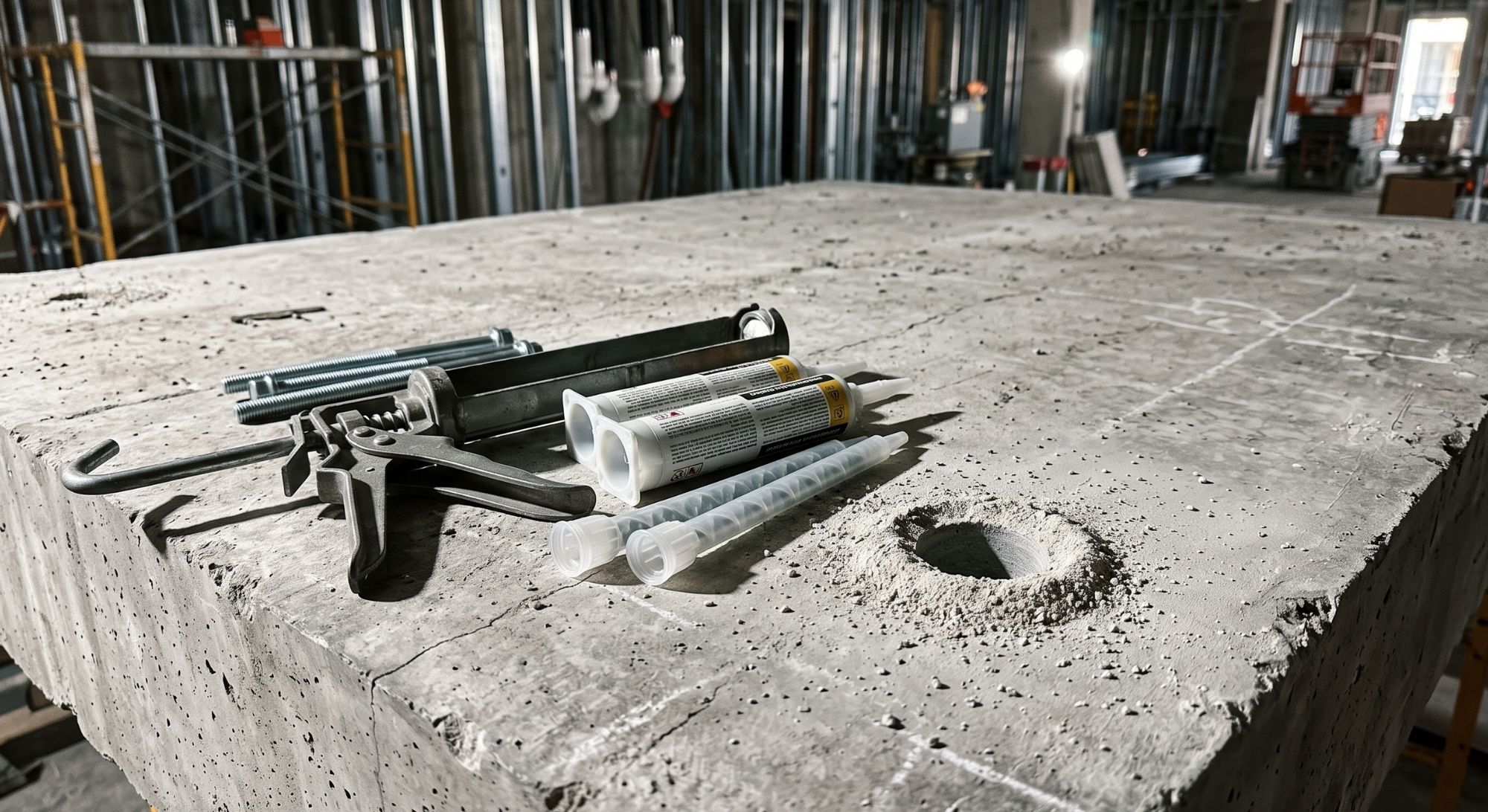
An epoxy anchor is a system, not a cartridge. The resin comes in a dual cartridge or a capsule. A cartridge needs a mixing nozzle and a dispensing tool. The hole needs a bit, a brush and a way to remove dust. The steel needs a grade the evaluation report lists. And the whole assembly needs the manufacturer’s instructions on site. If one component drops out, the system breaks.
The catalog lists epoxy in dual cartridges with mixing nozzles, in hammer anchoring capsules and with a manual dispensing tool for the larger cartridge size. A qualified supplier stocks complete systems, not just anchor bodies. On a quote, ask what is on it and what is missing from it.
What Counts Toward the Cost per Installed Epoxy Anchor
Start at the hole and walk to the record. Each step has a cost, and most of them do not show up on an invoice.
Resin is the obvious line, and it is more than the hole volume. A cartridge that is opened and not finished within the instructions leaves resin behind, so the number of holes you can fill per cartridge matters as much as the cartridge itself. The nozzle is the next line, because it is replaced on every mix cycle and after every pause the instructions define. The tool that dispenses the resin is a line of its own, and it wears and breaks.
Then the hole. Bits wear with every hole in concrete, and a worn bit costs time twice, once when it cuts a hole that is too small and once when the hole has to be redone. Cleaning takes minutes per hole and consumables, and it is the step that decides whether the anchor is accepted. Waiting is a cost too: a hole that is filled is a hole that cannot carry load until the cure time is over, and that time belongs to the schedule. Testing, the record and the rework on holes that fail close the list.
None of these lines is large by itself. That is why they get ignored.
Cartridge or Capsule: Where Each Wastes Less
Neither format is cheaper by default. Each wastes in a different place, and the format that wastes less depends on the job.
A dual cartridge gives you flexible volume. You dispense what the hole needs, and the cost is in the nozzle used on each mix cycle and in resin left in an opened cartridge. It also needs a dispensing tool for the cartridge size. A capsule is a measured quantity sized to a hole and a rod. There is no nozzle and no dispensing tool, and the rod is driven through the capsule. The cost is in sizing: capsules come in steps by rod diameter, so the order has to match the sizes on the drawing, and a capsule bought for the wrong size is a capsule that cannot be used.
What decides it is the number of holes per day, how many rod sizes are on the job, the base material, and above all which product the specification and the evaluation report name. The format the report covers is the only format you can buy.
There is one more line in the catalog that belongs on the order. The catalog lists a standard-set cartridge described for warm weather and a fast-set cartridge described for cold weather. Which set speed the job needs comes from the manufacturer’s instructions and the concrete temperature, which is the subject of epoxy anchor cure time in Florida heat and humidity. Order the wrong set speed and the cost never appears on the invoice.
Why Small Differences Become Large Ones
A small difference per hole becomes a large number per package. Say it in units and time, not in dollars. Assume a nozzle is replaced after every six holes. On 1,000 holes that is about 167 nozzles. Assume a format adds one minute per hole because of a step the crew did not plan for. On 1,000 anchors that is more than 16 labor hours. Neither figure is a price. Both are what a package does to a schedule.
At wholesale scale, value is total installed cost and project continuity, not piece price. The cheapest line on a quote can be the most expensive anchor on the job.
The Documentation to Have Before You Cut the PO
A resin is only usable in the conditions its evaluation report lists, so the report for the exact product is the first document to have. Adhesive anchor reports are written against criteria such as ICC-ES AC308. A quote that cites a different document does not answer for it: ASTM C881 is a specification for epoxy-resin bonding systems for concrete, a separate document from an evaluation report for an anchor. Next are the manufacturer’s printed instructions for the cartridge or capsule, and the shelf date on what arrives. For the steel that goes into the resin, a Certificate of Compliance or a Mill Test Report ties a lot to a grade. Both are provided on request.
The full package an inspector or a building official can ask for is covered document by document in anchor submittal documents. If a supplier cannot produce clean documentation up front, that supplier is not ready for enterprise work.
Lead Time, Shelf Life and Phased Release
Resin has a shelf life, which turns a large early delivery into a risk. A pallet delivered in June and used in September has spent a summer in conditions the instructions may not allow. Lead time kills schedules faster than price, and the answer to lead time is not a bigger first order. It is phased release, with deliveries timed to the installation schedule.
Construction & Electrical Products Inc. ships orders of any size with no minimum order, from eight warehouses in the United States, with same-day shipping on most items and drop shipment to the job site. Freight and returns have terms worth reading before the order, not after. Terms and conditions say that orders ship F.O.B. factory unless bought at book price, that prepaid freight is available above value thresholds that vary by region, that returns need advance approval and a purchase within 60 days, that slow-moving items and special orders for products not listed on the website cannot be returned, and that shortages must be reported within five days of receipt. The shipping page covers the rest.
Packaging, Case Quantity and Getting It to the Right Gate
Cartridges are sold by the unit, and the unit count is part of what you compare, along with how many nozzles come with it. Order the nozzle count with the cartridge count, because a nozzle shortage stops the crew as completely as a cartridge shortage.
Then decide where the order goes. A delivery to the yard and a delivery to the gate where the crew is working are different costs. Check the date on the cartridges when they arrive, keep them out of the sun, and report any shortage inside the window the terms give.
How to Qualify an Epoxy Supplier
Ask five questions before the order goes out. Can the supplier name the evaluation report for the product on the quote? Does the quote list the nozzles, the dispensing tool and the capsule or cartridge sizes, not just the resin? Can the supplier tell you the shelf date on what will ship? Does the order ship with no minimum, so you can release it in phases? And does a person answer the phone when the crew has a question? The product catalog lists the categories, and a salesperson can match a product to the job.
Your Buying Checklist
Compare the cost of one finished anchor: resin, nozzle, tool, bit, cleaning, cure time, test, record and rework. If any of those is missing from the comparison, the quote is not ready to compare. Before the purchase order goes out, confirm:
- The product on the quote is the one named in the specification and the evaluation report.
- The format, cartridge or capsule, fits the hole count, the rod sizes and the base material.
- Nozzles and the dispensing tool are on the order, in the quantity the crew needs.
- The set speed matches the concrete temperature the crew will actually see.
- The shelf date, the delivery schedule and the release plan are agreed.
- The freight, returns and shortage terms were read.
- The documentation for the product, and for the steel, is requested before the order, not after.
For how the finished anchor is built, step by step, see epoxy anchor installation, and for the cleaning that decides acceptance, epoxy anchor hole cleaning.
Frequently Asked Questions
How do you calculate the cost per installed epoxy anchor?
Add every cost that touches one hole, from drilling to the written record, and divide by the number of anchors that passed. The resin is one line among several.
Is a capsule cheaper than a cartridge?
Neither is cheaper by default. A cartridge wastes in nozzles and leftover resin, and a capsule wastes when the size on the order does not match the size on the job.
Does waiting for the cure count toward the cost?
Yes. A filled hole cannot carry load until the cure time is over, and that waiting belongs to the schedule even though no invoice shows it.
Do you need a special tool to dispense epoxy?
A cartridge needs a dispensing tool for its size. The catalog lists a manual dispensing tool for the larger cartridge size, and a capsule does not need one.
Can you return unused epoxy?
Only under the terms: advance approval, a purchase within 60 days, and not for slow-moving items or special orders for products not listed on the website. Read the terms before the order.
What documents come with epoxy anchors?
The manufacturer’s instructions and the evaluation report belong to the product. Certificates of Compliance and Mill Test Reports are provided on request for the steel.
About Construction & Electrical Products Inc. Construction & Electrical Products Inc. is an independent distributor of construction, electrical, safety and industrial supplies based in Pompano Beach, Florida, with more than 50 years in the trade and more than 10,000 products in stock, including anchors, fasteners, drill bits, diamond products, saw blades, epoxy anchoring systems, cable ties, wire connectors, terminals, GFCI devices and emergency lighting. Orders ship with no minimum, drop shipment to the job site is available, and Certificates of Compliance and Mill Test Reports are provided on request. Read more about the company and browse the manufacturer documents in the technical section.
This article is general product and procurement information. It is not an engineering opinion, a design recommendation, or a substitute for the project specification. Anchor selection, embedment, spacing, edge distance and design capacity are determined by the engineer of record for the specific project, and the governing values are those published in the manufacturer’s current evaluation report and installation instructions for the exact part number. Construction & Electrical Products Inc. supplies products and manufacturer documentation. It does not design anchorage or perform engineering services.
The installation steps described here are general and may not apply to the product on your job. Always follow the manufacturer’s current printed instructions for the specific part number, diameter and base material, and follow all applicable OSHA requirements for drilling, silica dust control and personal protective equipment.
Get a Quote
Call 954-972-9787 or toll free 1-888-744-0442 and a salesperson will help you match the product to the job.
Construction & Electrical Products Inc. 1800 NW 15th Ave #155 Pompano Beach, FL 33069 Phone: 954-972-9787 · Toll free: 1-888-744-0442 Email: sales@constructionandelectrical.com Hours: Monday through Friday, 8:30 a.m. to 4:00 p.m. Closed Saturday and Sunday. No minimum order. Same-day shipping on most items. Drop shipment to the job site available. Certificates of Compliance and Mill Test Reports on request.
