
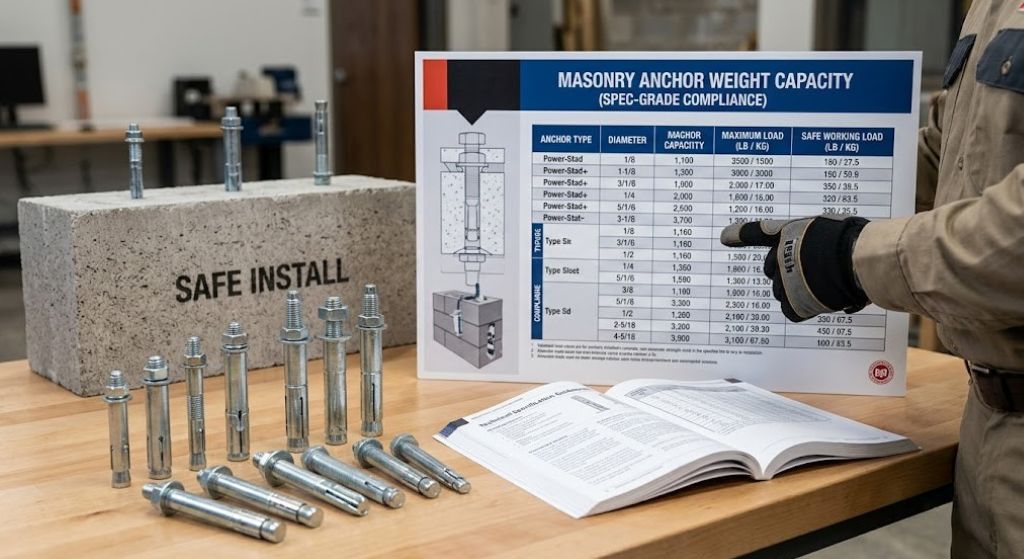
Masonry anchor weight capacity is not a single number, and that is where most purchasing mistakes start. The answer depends on the anchor type, the masonry substrate, embedment depth, edge distance, and installation quality, which is why the same fastener can hold one load in one wall and fail in another.
How Much Weight Can Masonry Anchors Support?
In plain terms, masonry anchor weight capacity is the maximum load an anchor can carry in a specific wall, under a specific load direction, when installed a specific way. Treat it like a rated lifting sling, not a random piece of hardware, because the number only means something when the full application is known.
A catalog rating is a starting point, not a universal promise. A manufacturer’s load chart applies to the exact test conditions used to generate it, including the substrate, hole size, embedment depth, edge distance, and anchor orientation. Change any one of those variables and the number changes.
That is why exact-spec sourcing matters. If you are buying for commercial or industrial work, you need the full job context before you can call a capacity “right.” For a broader primer on anchor families and buying decisions, this hardware guide is a useful companion.
Masonry Anchor Weight Capacity vs. Published Load Ratings
Published ratings come in different forms. Ultimate load is the failure point. Allowable load is the safe working value after reductions. Design value is the code-based number used in engineering calculations, and it is usually lower than the raw failure load.
Here is the trap: a chart showing a big ultimate pullout number does not mean you can spec that value into the job. ASTM E3121 makes the distinction clear, because proof-load checks verify installation, while design values come from controlled test data and code procedures, not from a one-time pull to failure (ASTM E3121/E3121M-17).
That matters on regulated work. The 2024 IBC and ACI 318-19 Chapter 17 push anchor design toward strength-based calculations, which means your submittal package needs the right rating for the right condition, not a marketing number pulled from a generic brochure (IBC anchor design).
Why This Question Matters in Commercial and Industrial Work
Procurement teams do not get rewarded for guessing. A guessed anchor capacity leads to wrong product selection, failed inspections, rework, and jobsite delays that cost far more than the fastener itself.
On commercial projects, the anchor is part of the compliance chain. You need traceable capacity data, installation requirements, and substrate-matched selection before the order goes out. That is especially true when you are buying commercial masonry anchors for walls that support equipment, fixtures, or safety-related loads.
The market is moving in the same direction. Buyers increasingly evaluate anchors by load rating, embedment, corrosion resistance, and documentation, because weight capacity is only one part of the spec. In other words, the paperwork now matters almost as much as the hardware.
What a Masonry Anchor Actually Supports
An anchor does not just “hold weight.” It resists forces. Sometimes that is straight pull, sometimes it is side load, and often it is both at once. A wall-mounted bracket, for example, creates tension at one side of the fastener and shear at the other, which means the governing load is rarely the obvious one.
You also have to account for vibration, repeated loading, and cantilevered attachments. A small piece of equipment can create a far more demanding load path than its dead weight suggests.
Tension, Shear, and Combined Loads
Tension is the pulling force straight out of the wall. Think of a suspended rod, a hanger, or an anchor supporting a load that wants to peel away from the masonry.
Shear is the sideways force across the anchor shank. A bracket, track, or plate loaded parallel to the wall puts the fastener into shear, and that changes the failure mode completely.
Combined loading is the real-world norm. Once a fixture hangs out from the wall or carries vibration, the anchor sees both tension and shear, often with prying action at the connection point. That is why masonry anchors vs concrete anchors is not just a materials question, it is a load-path question.
Why Safety Factor Matters
Raw pullout strength is not usable design capacity. You do not buy to the failure point, because code, inspection practice, and basic risk control all demand margin.
That margin exists for a reason. Masonry is variable, installation is variable, and field conditions are never identical to lab conditions. Published design values reduce the failure number to a safe working level, which is the only number that belongs in procurement and engineering review.
The Main Factors That Control Anchor Capacity
Four anchors of the same diameter can perform very differently if the substrate and installation change. That is the part many buyers miss. The hardware matters, but the wall matters just as much, and in some jobs it matters more.
Anchor Type
Mechanical anchors, including wedge and sleeve styles, create holding power by expansion. They work best where the base material is sound and strong enough to resist that outward force.
Screw anchors cut their own path into the masonry and are useful for lighter-duty fastening where removability matters. Adhesive anchors rely on bond strength, which makes hole cleaning, cure time, and material compatibility part of the capacity equation.
Hollow masonry needs special attention. If the base material is cavity block or another voided substrate, standard expansion behavior changes fast, and the wrong anchor family loses capacity immediately. For matching products to substrate and exposure, choosing the right masonry anchor for the wall is where the decision should start.
Substrate Type
Solid concrete, solid brick, CMU, grouted block, hollow block, and rubble infill do not behave the same. Capacity in one does not transfer to the others.
The most reliable rule is simple: the weaker or more irregular the substrate, the more conservative the capacity. Damaged mortar joints, deteriorated brick, or mixed renovation masonry can slash holding power without changing the anchor itself. SOCOTEC’s rubble-infill testing showed just how wide that spread can be, with pullout results ranging from the low thousands of pounds to more than 5,000 lb depending on location and anchor type.
Embedment Depth
Embedment depth is one of the biggest drivers of capacity. Deeper embedment generally improves resistance because the anchor engages more material and spreads load over a larger zone.
But deeper is not always better. Every anchor has a minimum and maximum embedment range, and performance outside that range drops off quickly. Shallow embedment is especially sensitive to tension loads, which is why structural engineers often push for better performance data on shallowly embedded anchors used for sill plates, MEP support, and light equipment (shallow anchor data).
Anchor Diameter and Material
Diameter matters because a larger shank usually carries more steel strength and can transfer more load. Material matters because steel grade, coating, and corrosion resistance change both capacity and service life.
In humid, coastal, or chemically exposed settings, corrosion resistance is not a luxury. It is part of the performance requirement. That is why outdoor masonry anchors are selected for more than just strength, they need durability that matches the environment.
Edge Distance and Anchor Spacing
Edge distance is the gap between the anchor and the nearest free edge, joint, or corner. Spacing is the distance between adjacent anchors. Both influence how the masonry distributes stress.
Place an anchor too close to an edge and the masonry can split or break out before the anchor reaches its rated capacity. Put anchors too close together and their load zones overlap, reducing the effective strength of both. The SOCOTEC field case showed this clearly, with adjacent anchor tests influencing measured pullout results.
Installation Quality
Installation quality often decides whether the anchor performs to spec. Hole diameter, hole depth, cleaning, alignment, torque, adhesive mixing, and cure time all affect final capacity.
For adhesive anchors, this is non-negotiable. Overhead and horizontal installations demand extra care because gravity does not help keep adhesive at the deepest part of the hole, and voids or trapped air reduce bond strength. Special inspection also checks these details because they directly affect whether the installed anchor matches the design intent.
Understanding Capacity by Anchor Type
A procurement decision gets easier once you understand how each anchor family carries load. The right choice is rarely “strongest on paper.” It is the product that fits the substrate, the load direction, and the compliance requirement without creating install risk.
Mechanical Anchors
Mechanical anchors transfer load through expansion or mechanical engagement. They are fast to install and widely used on commercial jobs where the substrate is sound and the loading is well understood.
Wedge Anchors
Wedge anchors are common in solid concrete and grout-filled masonry where high-load performance is needed. They are often the first choice for structural attachments because they deliver strong tension and shear resistance when installed correctly.
Their weakness is simple: they need solid material to bite into. Put them in the wrong masonry and the expansion force becomes a problem instead of a solution.
Sleeve Anchors
Sleeve anchors are more versatile across brick, block, and concrete, and they are often used for moderate loads. They expand in a controlled way, which helps in mixed applications, but their capacity still depends on substrate quality and proper embedment.
Screw Anchors
Screw anchors are useful for lighter-duty or removable attachments. They are valued because installation is straightforward and the hardware can be reset or removed more easily than some other families.
The tradeoff is capacity. Screw anchors depend heavily on substrate hardness and hole control, so they are not the answer for every support point. They work well for utility attachments, light framing, and similar uses where the load is modest and the masonry is sound.
Adhesive Anchors
Adhesive anchors rely on a bonded interface, not expansion pressure. That gives you excellent performance in many applications, especially where near-edge conditions or high load demand make expansion anchors risky.
The catch is discipline. Proper hole cleaning, mixing, injection, and cure time are part of the capacity. Simpson Strong-Tie notes that for adhesive anchors, installation quality is tied directly to bond behavior, especially for horizontal and overhead placements where the adhesive must reach the deepest point of the hole cleanly (adhesive installation).
Hollow Masonry Anchors
Hollow masonry needs anchors that can work with voids instead of fighting them. That means specialized sleeves, toggles, or adhesive systems designed for cavity conditions.
Standard expansion anchors are the wrong call when there is no solid material to resist expansion. In hollow block or fractured masonry, the anchor family has to match the substrate first, or the chart number is meaningless.
How to Read Load Charts and Technical Data
A load chart is only useful if you read it exactly the way the manufacturer intended. The most common mistake is taking a single number from one substrate and applying it to another with a different edge distance or load direction.
Allowable Loads vs. Ultimate Loads
Ultimate load is the failure threshold. Allowable load is the safe working number after reductions. Design load is the engineering value used under code, and it is the one that belongs in a submittal.
Do not confuse a test result with a design permission. ASTM E3121/E3121M-17 separates ultimate testing from proof testing and says proof-load tests in the confined condition should not be used to develop design values (ASTM standard).
Cracked vs. Uncracked Masonry
Cracking changes everything. Ratings for uncracked concrete or sound masonry do not automatically transfer to cracked or distressed substrates.
That is why modern code language and manufacturer data now cover more substrate conditions, including grouted, hollow, partially grouted, and brick masonry. If the wall is damaged, aged, or mixed, you need data that matches that condition, not a generic assumption.
Load Tables by Material and Condition
Good load tables are organized by substrate strength, embedment, edge distance, and load type. If the table does not match the actual condition, the number is not usable.
This is where masonry anchor installation matters as much as selection. A perfect product installed incorrectly still fails the job, and the fastest way to lose capacity is to skip the details on drilling, cleaning, alignment, or torque.
Approvals, Listings, and Evaluation Reports
For commercial work, approvals are part of the product. ICC-ES reports, manufacturer engineering data, ASTM references, and code recognition all support the documented capacity.
The 2024 IBC treats adhesive anchors, expansion anchors, screw anchors, headed studs, headed bolts, hooked bolts, and undercut anchors as code anchors, while other types can fall under alternative materials and require separate approval. That distinction matters when you are building a submittal package that has to pass review the first time.
Field Testing and Proof Loading
Field testing is the right move when the wall is unusual, the substrate is uncertain, or the project requires verification. It turns guesswork into evidence.
ASTM E3121/E3121M Field Testing Basics
ASTM E3121/E3121M-17 covers static tensile and shear testing in concrete and masonry. It can be used to determine ultimate load or to apply a proof load that verifies proper installation.
That distinction is important. A proof test checks whether the installed anchor behaves correctly. It is not the same as generating a design value from scratch.
Proof Load vs. Ultimate Load Testing
Proof loading is used to confirm sound installation without damaging a properly installed anchor. Ultimate testing pushes to failure to characterize capacity.
On regulated projects, proof loading often governs. CBC-based guidance and special inspection rules often require a defined percentage of anchors to be tested, depending on whether the anchors are structural or nonstructural. The purpose is verification, not destruction.
When Testing Becomes Necessary
Use field testing when the substrate is nonstandard, the load is critical, the documentation is thin, or the wall condition is uncertain. That includes rubble infill, old brick, retrofit facades, and mixed masonry repairs.
The Boston Hudson Building case is a good example. Because published tables did not match the brick rubble infill, the project team had to test anchor options in the field before selecting the final system. That is the right sequence when the wall does not fit the catalog.
What Testing Reveals About Real-World Capacity
Field testing exposes what the chart cannot. It shows the effect of damaged brick, weak mortar, adjacent anchors, poor hole conditions, and substrate variability.
In one SOCOTEC case, measured capacities changed significantly based on whether the anchor landed in the brick face or the mortar joint, and one result came in far below the others because the brick was likely already damaged or loose. That is exactly why site-specific verification matters on retrofit work.
Code Compliance and Special Inspection Requirements
Compliance is not paperwork for its own sake. It is proof that the anchor, the installation, and the wall all match the approved design.
Structural vs. Nonstructural Anchorage
Structural anchors carry loads tied to the building system, not just the finish or accessory being mounted. Nonstructural anchors support fixtures, attachments, or components that do not form part of the primary structure.
That distinction affects inspection frequency and testing requirements. On certain CBC projects, structural anchors can require 100% testing, while nonstructural anchors may require 50% or less depending on the condition and scope. For anyone buying anchors for regulated work, that detail changes the whole purchase order.
Special Inspection Triggers
Special inspections are triggered by anchor type, load condition, location, and code chapter. Mechanical and adhesive anchors installed in hardened concrete commonly fall under periodic inspection, and adhesive anchors resisting sustained tension often trigger extra scrutiny.
Inspectors verify location, edge distance, spacing, type, size, drilling method, hole cleaning, and installation procedure against the approved documents and instructions. If the product data does not support that review, the job gets delayed.
Why Documentation Should Drive Product Selection
Documentation is part of capacity. If the anchor does not have the approvals, load data, and installation language the project needs, it is the wrong product regardless of price.
This is also where procurement gets faster when the supplier knows the trade. A supplier that can deliver exact load data, technical submittals, and approved products saves you from substitution fights later. That is the kind of support you should expect from supplier-backed technical guidance, not after the purchase, but before it.
Common Reasons Masonry Anchors Fail Early
Most anchor failures are predictable. They come from poor installation, wrong product choice, or bad assumptions about the wall.
Incorrect Hole Size or Depth
A hole that is too large kills expansion performance. A hole that is too shallow reduces embedment and holding power.
With adhesive anchors, depth errors also affect bond area and cure consistency. Small mistakes at the drill stage create large losses in final capacity.
Poor Hole Cleaning
Dust and debris weaken both mechanical engagement and adhesive bond. Moisture contamination makes adhesive performance worse, especially when the install method depends on a clean surface.
Cleaning is not a side task. It is part of installation, and inspectors treat it that way for a reason.
Misalignment and Side Loading
Anchor tilt changes how the load enters the masonry. Once the fastener is off-axis, the wall sees prying and uneven stress, and capacity drops.
Research has shown that anchors with more than 5% misalignment can lose load-carrying capacity. That is a problem on real jobs, where a slightly crooked drill line turns a good anchor into a compromised one.
Damaged or Weak Masonry
Loose brick, deteriorated mortar, cracked block, and rubble infill are all capacity killers. The anchor may be rated correctly and still fail because the wall cannot hold the load path.
That is why substrate verification comes before product selection. If the masonry is suspect, you do not guess, you test or redesign.
Practical Examples of Masonry Anchor Weight Capacity
The best way to understand capacity is to tie it to the job in front of you. Same anchor family, different application, different risk.
Light-Duty Attachments
Conduit supports, signage, and small brackets usually stay in the lighter range of masonry fastening. In those cases, screw anchors or light mechanical anchors often fit the need, provided the substrate is sound and the load is mostly shear.
The key is not to overspec blindly. More anchor is not always better if the wall cannot justify it.
Medium-Duty Commercial Fixtures
Shelving, utility supports, wall-mounted equipment, and moderate hangers often call for sleeve anchors or selected adhesive systems. These loads usually combine tension and shear, so the connection detail matters as much as the hardware.
For these jobs, understanding the difference in anchor families helps prevent overbuying or under-specifying.
Heavy-Duty Structural or Industrial Mounting
Steel framing attachments, machinery supports, safety-critical fixtures, and building envelope connections demand engineered selection. That is where published design data, inspection requirements, and sometimes field testing all come into play.
If the load is structural, treat the anchor like structural hardware. No shortcuts.
Choosing the Right Masonry Anchor for Your Job
The selection process should be methodical. Start with the wall, then the load, then the compliance requirement.
Start with the Substrate
Solid concrete points toward one set of products. Brick, CMU, hollow block, and mixed renovation masonry point toward another.
If the wall condition is unknown, stop there and verify. The substrate decides most of the capacity story before the anchor ever enters the hole.
Match the Load to the Anchor System
Tension, shear, vibration, and repeated loading all influence selection. A static sign and a vibrating mechanical unit do not belong on the same fastener logic.
This is where drill bits for masonry anchors become part of the procurement conversation too, because the hole quality starts with the drilling system, not the anchor carton.
Match the Anchor to the Compliance Requirement
If the project needs listed products, engineering data, or special inspection support, build that into the order. Do not treat compliance as a paperwork add-on after the hardware arrives.
The right anchor is the one that passes review, installs correctly, and carries the load on the wall you actually have.
Select Corrosion Resistance for the Environment
Plated anchors work in dry interior conditions. Galvanized and stainless options make sense in humid, outdoor, coastal, or chemically exposed environments.
Capacity is only part of durability. A fastener that loses section to corrosion stops being a capacity question and becomes a failure waiting to happen.
Procurement Checklist for Spec-Grade Masonry Anchors
Before you place an order, lock down the facts. That is how you avoid substitutions and second shipments.
Information You Need Before You Place the Order
You need the substrate type, load direction, required capacity, embedment depth, edge distance, spacing, environment, and approval requirements. Without those, you are shopping blind.
You also need to know whether the application is structural or nonstructural, because that changes inspection and documentation expectations.
Questions to Ask Your Supplier
Ask for the published load data that matches your substrate and load direction. Ask for approvals, evaluation reports, packaging quantities, and lead time. Ask whether the product is available in bulk and whether the documentation package is ready for submittal.
A good supplier does more than ship boxes. A good supplier helps you avoid the wrong box.
When to Request Technical Support
Bring in technical support when the substrate is damaged, the wall is mixed or unknown, the load is critical, or the project needs compliance documentation. That is the point where standard charts stop being enough.
At Construction & Electrical Products Inc., that is exactly where technical verification earns its keep, because the right anchor in the wrong wall is still the wrong answer.
Frequently Asked Questions
How much weight can a masonry anchor hold?
It depends on the anchor type, substrate, embedment depth, edge distance, and load direction. The only correct capacity is the one from the load table, evaluation report, or engineering design that matches your exact condition.
Can you use the same anchor in brick, block, and concrete?
Sometimes the same anchor family works across those materials, but the capacity changes with each substrate. Always use the rating that matches the actual wall material and condition.
Do bigger anchors always hold more weight?
No. Diameter helps, but only within the limits of the masonry. Weak substrate, poor edge distance, or shallow embedment can make a larger anchor perform worse than a smaller one installed correctly.
Is torque testing enough to verify installation?
Torque testing works for certain mechanical anchors, especially torque-controlled expansion anchors. It does not verify adhesive anchors properly, because adhesive performance depends on bond, cure, hole cleaning, and installation method.
When should you use field testing instead of published ratings?
Use field testing when the substrate is unusual, the load is critical, the condition is uncertain, or the project requires verification. Published ratings are for defined conditions, and field testing confirms what is actually in the wall.
How do you know if an anchor is code compliant?
You need the correct product listing, the matching installation method, and the approved documentation for the actual application. Code compliance is not just about the hardware, it is about the whole system.
Buying Masonry Anchors from a Supplier That Knows the Job
You save time when your supplier understands the difference between a catalog number and a jobsite-ready solution. Inventory depth matters because it keeps crews moving, but documentation and technical fit matter just as much.
That is where procurement gets easier. When you can source the right anchor, the right corrosion protection, and the right load data from one place, you reduce delays and avoid substitutions that never should have happened in the first place.
For commercial and industrial work, capacity is not a guess. It is a documented, substrate-specific decision. Once you understand that, you know exactly what to ask for before the order leaves the dock.
