
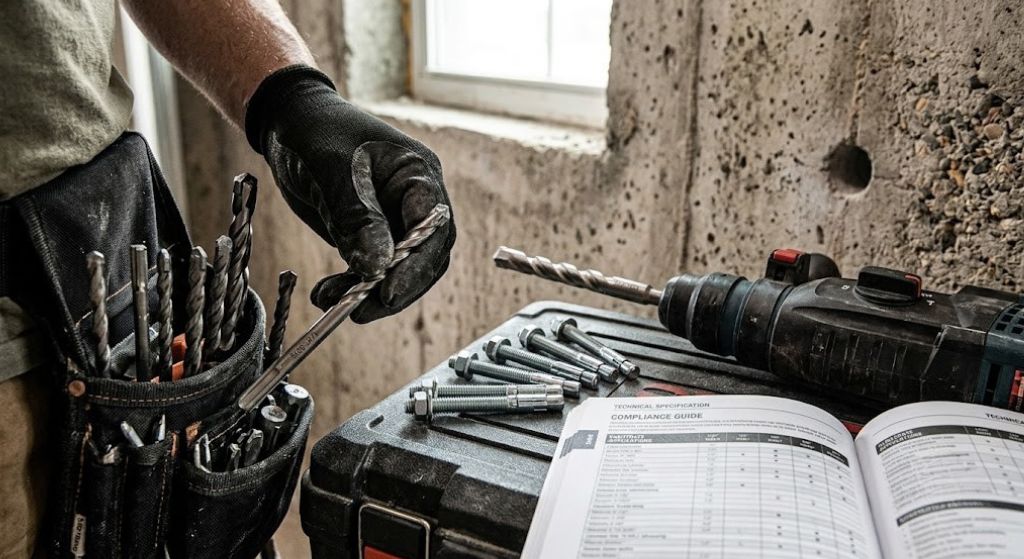
Buying drill bits for masonry anchors looks simple until a hole comes out oversized, dusty, or damaged enough to weaken the anchor. The right drill bits for masonry anchors are not universal, and if you match the bit to the substrate, anchor type, and jobsite conditions, you avoid pullout, rework, and inspection headaches.
How to Choose Drill Bits for Masonry Anchors Installation
Start with the base material, then identify the anchor, then buy the bit that matches the installation spec. That order keeps you out of trouble, because anchor approval and manufacturer instructions always outrank tool preference.
The wrong bit does more than slow down a crew. It changes hole diameter, hole geometry, and the condition of the substrate itself, which directly affects holding power. For commercial work, that means your purchase decision is tied to performance, compliance, and labor cost, not just the price of a box of bits.
The market reflects that shift. Masonry drill bits are one of the fastest-growing categories because construction teams are demanding purpose-built tools instead of generic ones (fastest-growing drill bit type). That makes sense. Masonry anchor installation rewards precision, and precision starts with the bit.
What Makes Masonry Anchor Drilling Different
Masonry is brittle, abrasive, and inconsistent from one wall to the next. You are not just making a hole, you are creating a load path for a fastener that has to hold under tension, shear, vibration, or all three.
That is why hole diameter control matters so much. A hole that is too large reduces expansion or bond strength. A hole that is too small cracks the wall or ruins the anchor during installation. Depth matters too, because dust and debris collect at the bottom of the hole and stop the anchor from seating fully.
Hole quality is just as important as hole size. Research on post-installed fasteners shows that drilling method and drill-bit form affect borehole roughness, and roughness affects pull-out performance. In plain terms, a sloppy hole gives you a sloppy anchor.
The Buyer’s Priority Order: Substrate, Anchor, Then Bit
The correct sequence is simple. Confirm the substrate, confirm the anchor family, then choose the drill bit that the installation method requires.
That matters because the same anchor size does not always use the same bit size. A wedge anchor, sleeve anchor, Tapcon-style screw, and drop-in anchor each follow different hole rules. If you buy bits first and anchors later, you create inventory mismatches and field errors.
For procurement teams, the cleanest process is to tie each approved anchor to a matching bit spec and keep that pairing in the item record. That is how you reduce substitutions on active jobs and keep masonry anchor installation aligned with submittals, not guesses.
Masonry Substrates and the Bit That Fits Each One
Substrate is the first variable that changes the job. Concrete tolerates more impact, brick demands more care, and unreinforced masonry often punishes aggressive hammering.
Concrete
Concrete is where carbide hammer bits earn their keep. For standard anchor drilling, a carbide-tipped hammer drill bit gives you the speed, durability, and hole consistency most commercial crews need.
The big advantage is production. Carbide holds up under abrasive wear better than softer materials, and industry reporting continues to show carbide as the largest material segment in the market because of its hardness and durability. That lines up with field reality, especially on repetitive anchor work in slabs, beams, and structural walls.
Concrete also rewards clean diameter control. For common mechanical anchors, the hole has to match the anchor dimensions exactly or follow the manufacturer’s oversized or undersized spec. A sloppy hole creates a bad fit, and a bad fit creates call-backs.
Brick
Brick is less forgiving than concrete, especially face brick and older soft brick. Excess hammering chips the edges, opens the hole too wide, and starts spalling around the entry point.
Hard brick can tolerate more aggressive drilling, but you still need to protect the surrounding material. Soft brick and face brick demand lower pressure, sharper bits, and a slower approach that preserves hole integrity. If you are working on a facade, that cosmetic damage becomes a quality issue before it becomes a structural one.
This is where better bit selection pays off. A purpose-built masonry bit reduces wandering at the start of the hole and helps you keep the diameter consistent through brittle units. If you are also evaluating anchor type for exposed work, commercial masonry anchors and substrate condition should drive the decision together, not separately.
Unreinforced Masonry
Unreinforced masonry changes the playbook. Hammer drilling can fracture the substrate, so rotation-only methods are often the right answer.
Simpson Strong-Tie’s ET-3G retrofit work on URM is a good example. The approved installation allows either diamond core drilling or carbide drilling in rotation-only mode, but hammer drilling is not allowed because it can damage the masonry (URM retrofit drilling). That is the kind of detail that belongs in your buying decision, not just the field crew’s memory.
For URM, hole quality and substrate protection outrank speed. If the wall cracks, the anchor spec is irrelevant.
Stone and Mixed Masonry
Stone and mixed masonry are variable, which is exactly what makes them annoying. Density changes across the hole path, and that creates wander, uneven wear, and inconsistent cutting behavior.
On these substrates, bit geometry and wear resistance matter more than price. Better flute design helps remove debris, and tougher cutting edges hold alignment longer. Market data backs that shift, with buyers increasingly valuing wear resistance, heat resistance, hole accuracy, and vibration control over unit price alone (total cost of ownership).
If your project includes stone veneer, mixed wythes, or historic materials, keep the anchor and drilling method conservative. That is how you protect the substrate and the schedule at the same time.
Carbide vs. Diamond Core: Which Bit Type Wins for Your Application
This is the main decision most buyers need to get right. Carbide and diamond core bits both have a place, but they solve different problems.
Carbide Masonry Bits
Carbide bits are the workhorse choice for standard masonry anchor drilling. They are cost-effective, widely available, and built for hammer drilling in concrete and many brick applications.
Their advantage is simple: they cut fast and withstand abrasion better than general-purpose steel bits. Newer market reports also point to carbide-tipped designs as a major performance upgrade in demanding construction work, especially where longevity and cutting efficiency matter.
Use carbide when your priority is high-volume fastening, especially in solid concrete, hollow block, and routine masonry maintenance. If you are managing inventory for a maintenance department, carbide bits are the safest standard stock because they cover the broadest range of everyday installations.
Diamond Core Bits
Diamond core bits excel when hole quality, dust control, and speed in specific masonry conditions matter more than raw portability. They produce cleaner holes and, when used wet, keep heat and dust under better control.
That matters in URM and retrofit work. In the Simpson Strong-Tie study, core drilling averaged 1 minute 32 seconds per hole while carbide drilling averaged 4 minutes 42 seconds per hole, so core drilling ran at least three times faster and saved more than 3 minutes per hole (core drilling performance). On a large job, that time difference turns into real labor savings.
Diamond core drilling also helps when hole consistency matters across brittle masonry or angled installations. Installers on that Sacramento jobsite preferred core bits because the carbide rotation-only process at a 22.5 degree angle required substantial physical force. That is not a small comfort issue, it is a production issue.
Rotation-Only vs. Hammer Drilling
Rotation-only drilling protects brittle masonry. Hammer drilling speeds up cutting, but it also increases the risk of cracks, spalling, and borehole damage.
A 2024 masonry study found that rotary-only drilling produced higher pull-out capacities and greater reliability for mechanical screw anchors, while hard hammer drilling created more damage and the least stable results. That is exactly why you do not pick hammer mode by habit. You pick it because the substrate can take it and the approval allows it.
If the anchor spec requires clean walls, minimal damage, or tight tolerances, rotation-only deserves serious attention. If you are standardizing your buying guide for masonry anchors, this is one of the first decision branches to document.
Wet Drilling vs. Dry Drilling
Wet core drilling controls heat and suppresses dust. That improves comfort, cleanliness, and in many cases drill life.
Dry drilling is more practical for fast field work where water management is a problem, but it gives up some of the advantages in smoothness and dust control. On commercial jobs, wet drilling often wins in retrofit and sensitive interior work because cleanup is easier and the borehole stays cooler.
The right call is straightforward. If dust suppression, hole quality, and tool longevity are the priorities, wet core drilling is the better system. If jobsite logistics make water impractical, dry drilling stays on the table, but the trade-off is real.
Drill Bit Specs That Affect Anchor Performance
The headline spec is diameter, but it is not the only spec that matters. Drill depth, flute design, heat resistance, and vibration control all affect the hole you end up with.
Diameter Match and Hole Tolerance
Exact diameter control is non-negotiable for anchor performance. Expansion anchors need the right fit to develop load, and adhesive anchors depend on hole geometry and surface condition for bond strength.
The most common mistake is assuming every 1/2-inch anchor uses a 1/2-inch bit. That is true for many wedge and sleeve anchors, but not for every anchor style. Drop-in anchors, lag shields, and other specialty anchors often call for a larger hole. If you get that wrong, you get spin, looseness, or a fractured wall.
Hole tolerance is not just a lab concern. Research shows that borehole geometry affects fastener behavior in tension and that tight dimensional tolerances matter for hammer drill bits. If you are buying for production work, spec the diameter exactly and keep the tolerance range documented.
Drill Depth and Flute Design
Drill depth should exceed the anchor length enough to leave room for dust. A deeper hole gives the anchor full seating and keeps debris from blocking installation.
Flute design matters because it clears dust. Poor chip evacuation slows drilling and leaves residue in the hole, which reduces friction and weakens the anchor hold. Industry reporting also shows a growing emphasis on optimized flute geometry and wear-resistant coatings because they improve chip removal and drilling efficiency.
Heat Resistance and Bit Life
A bit that runs hot wears out faster, cuts slower, and enlarges holes as the edges degrade. That wear shows up in time, then in quality, then in rework.
On production jobs, bit life is part of the cost equation. The cheapest bit per unit is not the cheapest bit per installed anchor if it needs constant replacement. Buyers are increasingly evaluating total cost of ownership for exactly that reason.
Vibration Control and Substrate Protection
Vibration control matters most on brittle or aging masonry. Less vibration means less cracking, less breakout, and better hole accuracy.
That is especially important on legacy buildings, facade work, and compliance-sensitive retrofits. The same logic applies to workplace safety, because lower vibration improves operator control and reduces fatigue. Good drilling is not just about speed. It is about keeping the structure intact long enough for the anchor to do its job.
Anchor Type Determines the Bit You Buy
You do not choose a bit in isolation. The anchor family determines the hole requirement, and the hole requirement determines the bit.
Sleeve Anchors and Wedge Anchors
These anchors demand precise diameter matching and clean hole walls. For many common sizes, the drill bit matches the anchor diameter, which is why 1/2-inch wedge and sleeve anchors often use a 1/2-inch carbide-tipped hammer drill bit.
That snug fit is what lets the anchor expand correctly. If the hole is oversized, the anchor loses grip. If it is undersized, installation force rises and the substrate can crack.
Adhesive Anchors
Adhesive anchors care about hole cleanliness as much as hole size. Dust acts like a lubricant and weakens the bond, so brushing and blowing out the hole are part of the installation process, not optional cleanup.
For these systems, substrate condition matters more than speed. In cleaner masonry and URM retrofit work, diamond core drilling can create a better borehole for bonding and reduce the cleanup burden. If you are comparing systems, best masonry anchors only means something when the drill process matches the approval.
Tapcon-Style Concrete Screws
Concrete screws demand accurate pilot holes and the right diameter. If the hole is too large, the screw strips or spins. If it is too small, installation torque spikes and the substrate can split.
These fasteners reward consistency. That is why crews doing repetitive installs should standardize on the exact bit size, the exact drilling method, and a wear check before the crew starts. Once the bit wears, the hole changes with it.
Hollow-Wall and Specialty Masonry Anchors
Hollow block and specialty masonry anchors need a careful match between bit spec and anchor geometry. In hollow materials, the goal is often to avoid breakout on the thin face shell while still creating a clean seat for the anchor.
That is where carbide SDS bits designed for hollow block and solid brick drilling earn their place. They give you the flexibility to move between common commercial substrates without switching to a general-purpose bit that slows the crew down. For facilities teams, that pairing is practical because it covers the most common service calls without creating extra SKUs.
When Speed Matters More Than Upfront Cost
If labor is expensive, speed is not optional. A cheaper bit that adds minutes to every hole costs more than a premium bit that keeps production moving.
Core Drilling for Faster Production
The URM test data makes the case clearly. Core drilling cut average drilling time from 4 minutes 42 seconds to 1 minute 32 seconds per hole, which is a major gain when crews are drilling dozens or hundreds of anchors.
That is why production jobs often justify core drilling even when the upfront tool cost is higher. Once the project scale grows, labor eclipses the purchase price of the bit.
Reducing Rework and Broken Anchors
Bad holes create broken anchors, loose anchors, and failed inspections. Every one of those failures costs more than the bit that caused it.
When the hole is clean and on size, anchors seat correctly the first time. That is the difference between an installation crew and a rework crew. If you are responsible for field continuity, that difference matters every day.
Jobsite Efficiency and Labor Cost
Drilling speed is only part of jobsite efficiency. A better bit also reduces dust cleanup, improves consistency, and cuts the time spent checking and correcting holes.
That is why buyers should look at installed cost per anchor, not unit price. The right bit is the one that keeps crews productive and eliminates preventable callbacks. Nothing more, nothing less.
Compliance, Codes, and Manufacturer Instructions
Anchor installation is a specification issue. If the bit, diameter, depth, or drilling method deviates from the approved system, you own the risk.
Why Approval Reports Matter
ICC-ES reports, evaluation data, and product approvals tell you what installation methods are acceptable. That includes drilling method, base material, hole cleaning, and sometimes even angle limitations.
If the approval says rotation-only, hammer mode is off the table. If it says diamond core drilling is acceptable, that becomes a valid procurement option. Compliance starts with the paperwork, not the drill.
Following Anchor Manufacturer Instructions
Manufacturer instructions control the hole size, hole depth, and cleanup steps. Ignore those instructions and you risk reduced capacity, failed inspections, and voided performance claims.
This is where disciplined buying saves money. When you standardize approved bits alongside approved anchors, your crews spend less time improvising and more time installing correctly. That is the point of masonry anchors vs concrete anchors, and it is why the same bit strategy never applies across every substrate.
Documentation for Procurement and QA
Keep the product data, approval reports, and installation instructions attached to the purchase record. That makes submittals cleaner and gives QA a clear reference on site.
For procurement officers, documentation is part of inventory control. If a bit is not linked to a compliant anchor system, it should not be treated as a standard substitute.
Common Buying Mistakes That Cost You Time and Capacity
Most field problems trace back to a handful of buying errors. Avoid these and your install quality improves immediately.
Buying One Bit for Every Substrate
This is the easiest mistake to make and the most expensive to live with. Concrete, brick, URM, and stone do not behave the same way, so one universal bit simply creates compromise everywhere.
A bit that works fine in solid concrete can over-damage brick. A bit that feels gentle in URM can be too slow for production concrete work. Match the tool to the substrate or pay for it in labor.
Ignoring Dust and Debris Removal
Dust at the bottom of the hole weakens the anchor. It lowers friction, blocks seating, and interferes with adhesive bond.
You need a cleaning step in the process. Blow out, brush, then install. If the job uses adhesives or high-load mechanical anchors, cleaning is not a nice extra, it is part of the system.
Overlooking Bit Wear
A worn bit cuts a larger, uglier hole. It also slows the crew down and increases heat, which further shortens tool life.
That is why bit inspection belongs in the daily job routine. Once the edges round off, the hole quality starts dropping long before the bit looks broken.
Choosing Price Over Application Fit
Low-cost bits look good on a PO and bad on a punch list. If the wrong bit causes one failed anchor or one return trip, the savings disappear fast.
Buy on fit, life, and performance. That is the only way to control installed cost.
Recommendations by Job Type and Use Case
Different jobs demand different buying standards. The right bit for production work is not always the right bit for maintenance.
New Commercial Construction
For new construction, standardize around approved carbide hammer bits for concrete and common masonry, then add core drilling capability where the anchor schedule or substrate requires it. Production speed and inventory simplicity matter here.
If the project uses repeat anchor sizes, keep matched diameter sets in bulk. That cuts error risk and keeps the crew moving.
Retrofit and Remediation Work
Retrofit work often means old masonry, unknown substrate conditions, and tighter tolerance for damage. That makes rotation-only drilling, diamond core options, and conservative hole control more valuable.
Older buildings do not forgive aggressive drilling. Choose the bit that preserves the wall first and still meets the anchor spec.
Structural Anchoring and High-Load Installations
High-load work is where hole geometry and compliance matter most. Use the exact approved bit size, verify hole depth, and follow the specified drilling method without deviation.
If the anchor is load-critical, the hole is part of the structural system. Treat it that way.
Maintenance and MRO Crews
Maintenance teams need flexibility, fast access, and durable bits that handle repetitive service calls. Stocking carbide SDS bits for hollow block and solid brick drilling covers a wide range of everyday needs without overcomplicating inventory.
For facilities work, the best strategy is a small approved bit set, clear diameter labeling, and reorder points tied to actual usage. That keeps uptime high and purchasing simple.
How to Buy Drill Bits for Masonry Anchors in Bulk
Bulk buying works best when the bit inventory follows the anchor inventory. That is how you reduce waste and keep the right sizes on the shelf.
Stocking the Right Diameters
Start with the anchor families you use most often, then map the required drill diameters. Common commercial work often centers on a small set of sizes, but specialty anchors and drop-ins create separate requirements.
A clean SKU system keeps this manageable. If the bit size is approved for the anchor family, stock it. If it is not, do not improvise.
Matching Bit Quality to Usage Frequency
High-frequency production work justifies higher-grade bits with better wear life and cleaner cutting. Lower-volume maintenance work can stay on standard-duty options as long as the installation spec is met.
That is a procurement decision, not a field opinion. Put the premium bits where they save labor every day.
Supplier Reliability and Lead Times
A good bit is useless if it is backordered when the crew needs it. Reliable supply matters, especially on commercial work where delays cost more than hardware.
This is where a distributor with deep inventory and technical support keeps projects moving. At Construction & Electrical Products Inc., that means fast access to the sizes and specs that match your anchors, not just whatever is on the shelf.
Bulk Purchase Strategy
Standardize approved bit families, buy by case when the size is repeated often, and keep project-specific sizes separated from maintenance stock. That reduces confusion and keeps reordering clean.
The best bulk strategy is simple: fewer substitutions, fewer surprises, and fewer holes that need to be redrilled.
Quick Selection Checklist Before You Place the Order
Before you buy, lock down the substrate, anchor, and installation method. That is the whole game.
Substrate Confirmed
Verify whether you are drilling concrete, brick, URM, stone, block, or mixed masonry before you choose the bit.
Anchor Type Confirmed
Match the bit to the anchor family and follow the approved installation method, not a habit from a different job.
Hole Diameter and Depth Confirmed
Check the exact spec for diameter and depth, then order to that spec. Guessing here is how anchors fail.
Drilling Method Confirmed
Confirm hammer, rotation-only, wet core, or dry core before the crew starts.
Compliance Documents Confirmed
Keep the approval reports and installation instructions on file so the bit choice matches the system you are actually installing.
Frequently Asked Questions
What is the best bit type for masonry anchors?
For standard concrete and many masonry jobs, carbide hammer bits are the default choice. For cleaner holes, brittle substrates, or faster production in URM retrofit work, diamond core bits are often the better answer.
Can you use the same bit for hollow block and solid brick?
Not as a best practice. Carbide SDS bits can cover both hollow block and solid brick, but the diameter, depth, and drilling pressure still need to match the anchor and the substrate.
Why does hole diameter matter so much?
Because anchor performance depends on fit. Too large and the anchor loosens or spins, too small and the substrate can crack or the anchor can fail during installation.
Do you always need to clean the drilled hole?
Yes. Dust reduces friction and weakens holding power, especially for adhesive anchors and high-load mechanical anchors. Blow out and brush the hole before setting the fastener.
When should you choose core drilling instead of hammer drilling?
Choose core drilling when you need cleaner holes, less dust, better substrate protection, or faster installation in approved masonry applications. It is especially useful in unreinforced masonry and other sensitive retrofit work.
How do you avoid buying the wrong bit size?
Match the bit to the anchor manufacturer’s instructions, not to the anchor name on the box. Confirm the substrate, anchor family, diameter, and hole depth before the order goes in.
Once you understand that the bit is part of the anchor system, the buying decision gets much easier. Match the substrate, match the anchor, and buy the bit that protects both. That is how you keep crews productive, installations compliant, and rework off the schedule.
