
Concrete does not forgive layout mistakes. If you get the steel elevation wrong and the inspector red tags the pour, you are not just eating a few extra chairs. You are eating demo, rework, schedule delay, and a black mark with your client. That is where using the right slab bolster for concrete reinforcement separates clean, profitable work from callback headaches.
If you are placing wide mats, multi layer reinforcement, or precast beds, slab bolsters are the quiet accessory holding your PSI and your reputation together. When you treat them like a commodity, you invite deflection, exposed steel, and premature cracking into the project.
Understand what slab bolsters really do
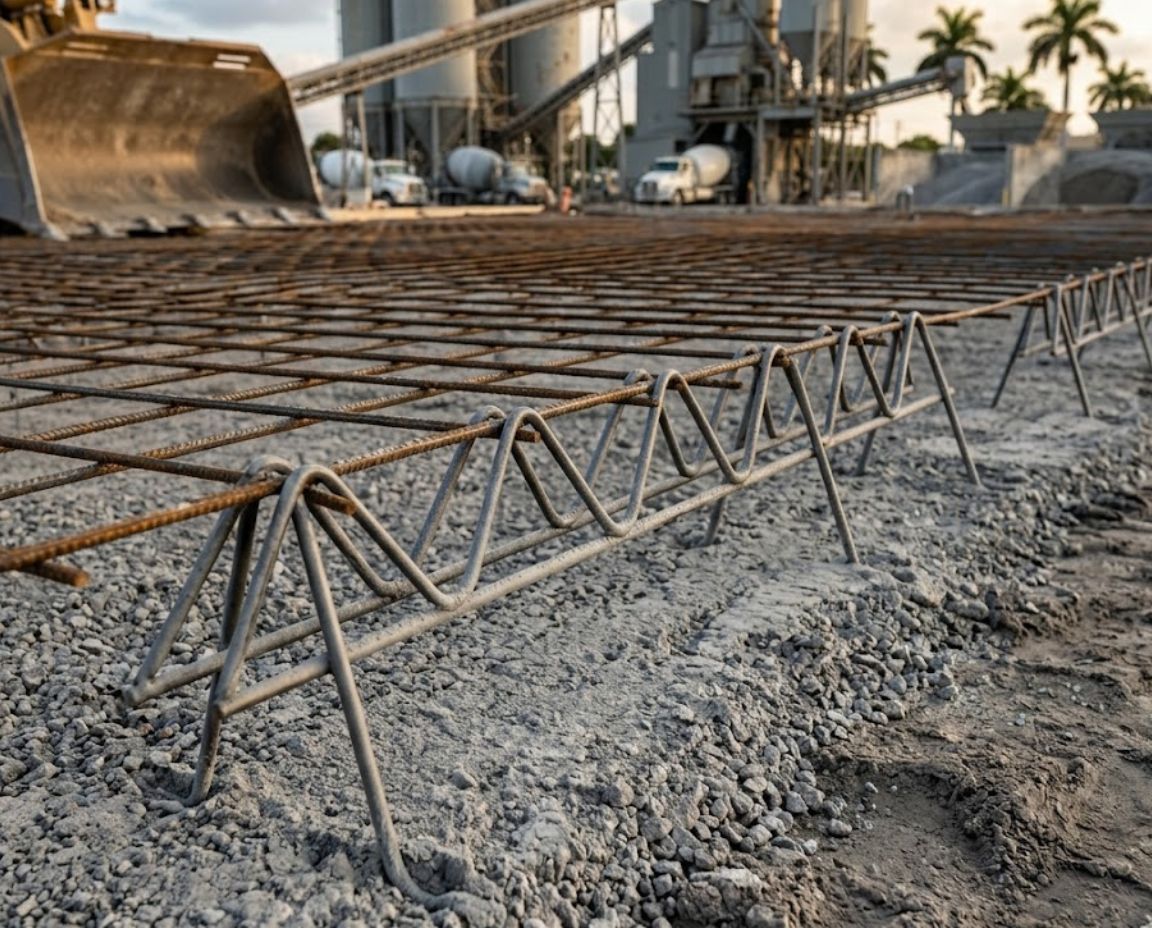
A slab bolster is not just a “long chair.” It is a continuous support system that controls cover and spacing over a large area of slab or deck.
You use slab bolsters to:
- Support rebar or mesh at a specific elevation across flat work
- Maintain the gap between upper and lower mats of steel
- Distribute load so bars do not punch into carton forms, fill, or soft bases
- Keep reinforcement from drifting during pump vibration and foot traffic
Metal slab bolsters, like the continuous supports offered by Grip Rite, are formed in 5 foot lengths with locking ends. This creates a stable track of support instead of a field of isolated point loads. The wide base spreads weight and the protruded top keeps bar placement accurate and consistent across the pour (Grip Rite).
For upper mats or double mats, products such as the SBU Steel Upper Slab Bolster from Dayton Superior are designed to support one layer of steel above another. They lock in the required clear distance so your reinforcement profile matches the engineer’s section, not “close enough” field judgment (Dayton Superior).
Differentiate bolsters from rebar chairs
You might be tempted to treat slab bolsters and individual chairs as interchangeable. They are not.
Chairs shine when you are dealing with:
- Beams
- Narrow footings
- Isolated bars and smaller grids
Slab bolsters, on the other hand, are built for:
- Large, flat slabs and decks
- Precast beds
- Mat foundations
- Wide, multi layer bridge or highway sections
A bolster gives you continuous support under a run of mesh or bars. That continuity is what prevents sagging between supports, which is where you get soft cover and exposed steel in the field. As screwpostanchor.com notes, slab bolsters provide continuous support over large flat surfaces, which is exactly what differentiates them from rebar chairs and makes them essential for slab and foundation work (screwpostanchor.com).
If you are still lining up rows of chairs every couple of feet under a heavy mat, you are paying labor to do a weaker job.
Know the main slab bolster types
Not every slab bolster for concrete reinforcement belongs on every job. If you do not match type to conditions, the problems usually show up after you leave.
Steel slab bolsters
Steel bolsters are the industry standard for strength and stiffness. They handle heavy multi bar mats, high loading, and aggressive finishing with minimal deflection. Many are available in different finishes, such as epoxy coated or tipped, to control corrosion or contact with exposed surfaces (Grip Rite).
The tradeoff is corrosion potential. In wet or chemically harsh environments, bare steel bolsters can rust, which can stain surfaces or compromise long term performance if they are too close to the surface (screwpostanchor.com).
Plastic and composite slab bolsters
Plastic or composite bolsters solve the corrosion issue. They are often used when:
- You have decorative or architectural exposed concrete
- You are dealing with chemically aggressive environments
- Steel marks or rust bleed are unacceptable
The risk is deformation. Under heavy loads or high point loading, plastic supports can deflect or creep, which means your mat drops and your clear cover disappears in the exact zone you needed it most (screwpostanchor.com).
You should not treat plastic bolsters as a direct drop in substitute for steel on heavily loaded commercial or infrastructure slabs without checking capacity.
Upper slab bolsters for double mats
Upper slab bolsters, like Dayton Superior’s SBU, are built to support and space one layer of steel above another. You use them when:
- You have top and bottom mats in a thick slab or mat foundation
- You are stacking cages or multi layer reinforcement in bridge decks or podium slabs
- You need to carry upper steel over carton forms or soft fill that cannot carry concentrated loads (Dayton Superior)
These supports are classified as metal bar supports and rebar supports, and their primary function is maintaining precise spacing and elevation of reinforcement bars so the structure delivers the designed load capacity (Dayton Superior).
Avoid the most expensive slab bolster mistakes
Your material cost on bolsters is small compared to your concrete, rebar, or equipment. The cost of getting them wrong is not.
Mistake 1: Treating cover as “approximate”
If you try to float a mat on loose bricks, scrap, or random chairs, you are gambling with structural cover. Variable cover means:
- Accelerated corrosion in thin cover zones
- Increased cracking where steel is too close to the surface
- Failing inspections on bridges, podium decks, and parking structures
Modern slab bolsters are explicitly designed to lock in height and maintain that during placement and vibration. Jones & Sons notes that their slab bolsters have legs spaced 5 inches on center and spot welded to resist bending, which is exactly how you keep elevation from collapsing under load (Jones & Sons).
If you are working commercial or DOT work, “close” is not acceptable. You need consistent cover.
Mistake 2: Using point supports where you need continuity
If you build a large slab with scattered chairs instead of continuous bolsters, you create long unsupported spans between supports. Under the weight of workers, pump lines, and wet concrete, those bars sag. That sagging turns into a wavy reinforcement profile that makes your structural engineer very nervous.
Metal slab bolsters, with their linear design and 5 foot lengths with locking ends, distribute weight evenly and reduce the risk of settlement, movement, or uneven bar placement across the slab (Grip Rite). That is the difference between a mat that stays on grade and one that drifts during the pour.
Mistake 3: Ignoring the base condition
The wrong bolster on the wrong base is another silent failure mode. If you set heavy mats on narrow leg supports over carton forms, compressible fill, or soft insulation, you will see:
- Bolsters punching into the base
- Loss of elevation and clear cover
- Crushed carton forms and out of tolerance voids
Upper slab bolsters like Dayton Superior’s SBU are explicitly rated to support steel on soft material form surfaces such as carton forms or fill material (Dayton Superior). If you know you are over something that will move, you should choose a support that spreads the load.
Mistake 4: Mixing unknown imports with specified systems
You have already seen what happens when a “black” cable tie turns out to be dye, not UV stabilization. The same logic applies to slab bolsters.
Cheap, non specification bolsters may look similar, but if the wire gauge, leg spacing, or weld quality are inconsistent, you will get:
- Random deflection under mats
- Legs that bend under normal traffic
- Bar movement during vibration that shows up later as cover problems
Dayton Superior is widely recognized in the industry for their rebar support line, including slab bolsters for concrete reinforcement (Dayton Superior). That is the type of supplier you want backing your supports when inspectors and engineers start asking for data sheets.
Choose slab bolsters based on project demands
The right slab bolster is not the cheapest one on the quote. It is the one that will get you through placement, inspection, and service life with no drama.
When you evaluate options, look at:
- Load and bar size. Heavier mats and larger bar sizes lean you toward steel bolsters with tight leg spacing and strong welds.
- Exposure and environment. Wet, deicing salts, or chemically aggressive environments push you toward coatings or noncorrosive supports.
- Base condition. Soft forms, carton voids, or fill need wide base or upper slab bolsters that are designed for soft substrates.
- Inspection requirements. For commercial and infrastructure work, stick with recognized manufacturers whose products are clearly categorized as metal bar supports and rebar supports, and whose data fits your specs.
If you are also sourcing ready mix or aggregates, coordinate with your bulk concrete suppliers in Pompano Beach so your slab bolster selection matches slump, placement method, and sequencing. Heavy pump placement on a very wet mix will punish marginal supports.
Use slab bolsters to speed production, not slow it down
When you deploy the right slab bolster system, you reduce labor instead of adding it.
On a typical deck or mat, continuous bolsters let your crew:
- Roll out mesh or set bars on a defined grid without constant shimming
- Walk and work on steel with fewer “soft spots” underfoot
- Keep elevations consistent so there is less arguing with inspectors and less rework
Large contractors and high rise builders are leaning hard into systematic use of slab bolsters and other supports, and the result has been measurable reductions in rework and faster completion times on big projects (LinkedIn). You can capture the same gain even on mid size commercial slabs simply by standardizing your bolster strategy.
If you are not sure which configuration makes sense for your mix of slab, deck, and precast work, start with a proven, specification grade slab bolster and build your standard details around it.
The cheapest slab bolster is the one you do not have to think about again after the pour.
5 key takeaways
- Slab bolsters are not commodity spacers, they are structural accessories that control cover and bar position over large areas.
- Steel, plastic, and upper slab bolsters each have clear use cases, and using the wrong type is a fast path to failed inspections.
- Continuous support is essential for heavy mats and wide slabs, scattered chairs are not an equivalent solution.
- Base conditions matter. Soft forms, carton voids, and fill require bolsters designed to spread loads without punching through.
- Using specification grade bolsters from recognized manufacturers costs pennies up front and saves you thousands in avoided rework and callbacks.
Frequently asked questions
1. When should you choose a slab bolster over individual chairs?
You should reach for slab bolsters when you are working on wide, flat elements like slabs on grade, elevated decks, mat foundations, or precast beds. Any time you have continuous mesh or a dense rebar mat, a slab bolster for concrete reinforcement provides the continuous support you need to prevent sagging and maintain uniform cover. Chairs still have a place in beams, narrow footings, or isolated bar runs, but they are not a replacement for bolsters on large slab work.
2. Can slab bolsters be used directly on carton forms or soft fill?
Yes, but you need to use bolsters that are designed for that condition. Upper slab bolsters like Dayton Superior’s SBU are specifically engineered to support steel over soft material form surfaces, including carton forms and fill, without punching through or losing elevation (Dayton Superior). Standard narrow leg supports are more likely to penetrate soft bases during placement.
3. Are plastic slab bolsters strong enough for heavy commercial mats?
Plastic and composite bolsters perform well in corrosive or decorative applications, but you need to respect their load limits. Under very heavy mats or concentrated loads, they can deform, which drops your bar elevation and reduces cover (screwpostanchor.com). For high load commercial or infrastructure work, steel bolsters or coated steel bolsters are usually the safer choice.
4. How do you keep bars from moving along the length of a bolster during placement?
Quality metal slab bolsters use a protruded top profile to “nest” the bar so it cannot roll side to side under vibration or foot traffic (Grip Rite). On dense mats, the grid itself also locks the bars in place. If you need more control, you can tie bars to the bolster at intervals, but with the right product and layout, tie points are typically minimal.
5. What is the most common inspection issue related to slab bolsters?
The most common problem inspectors flag is inconsistent or inadequate cover caused by improper supports, not enough bolsters, or the wrong type for the base condition. The cure is straightforward. Use specification grade slab bolsters with documented heights, place them at the spacing recommended by the manufacturer, and match the bolster type to the project environment and base material. That combination keeps your reinforcement where the drawings say it belongs and keeps your jobs moving forward.
