
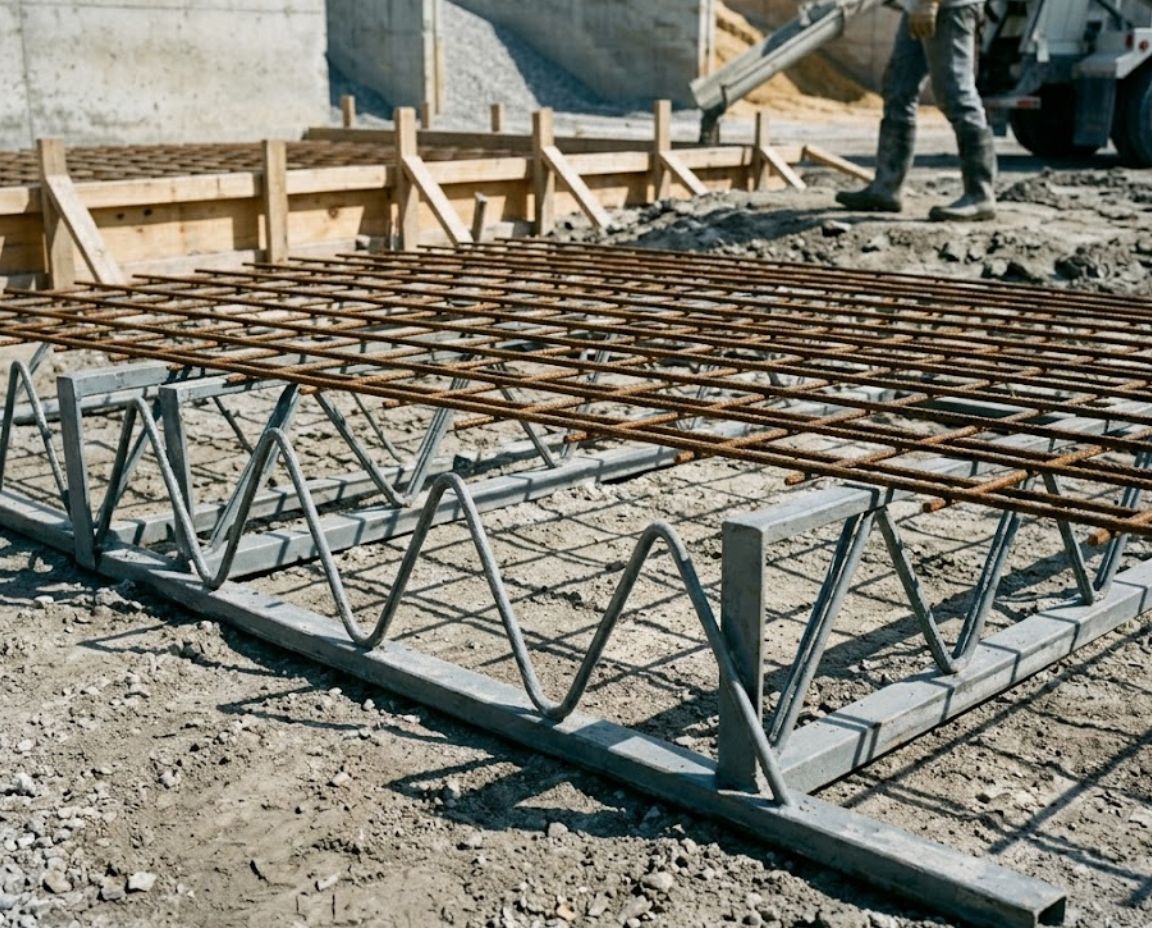
What a slab bolster actually does on your pour
On a drawings set, a slab bolster looks like a small detail. In the field, the wrong slab bolster turns into rejected inspections, cracked decks, and callbacks you do not get paid for.
A slab bolster is a continuous spacer that supports and elevates rebar or mesh in a slab so your steel stays exactly where the engineer put it. It controls cover, keeps the mat from sagging during a heavy pour, and gives inspectors a clean line of support to follow across the deck. In reinforced concrete, that is the difference between a slab that performs for 40 years and one that starts spalling in ten. A slab bolster is not an accessory, it is a structural control tool, and you need to treat it that way.
Slab bolsters are used across residential foundations, post tensioned podium decks, large industrial floors, and bridge and infrastructure projects to maintain correct rebar elevation and spacing in flat work and precast elements (ScrewPostAnchor, Five Star Metals). When you are buying pallet quantities of wholesale concrete and stacking labor on schedule, this is not where you can afford improvisation.
Why precise steel placement matters to you
You do not get paid for concrete, you get paid for meeting spec. Spec is driven by steel placement.
Your slab design assumes a very specific rebar cover. If your bottom mat drops half an inch or your top mat floats, the neutral axis of the section shifts. That reduces capacity, makes the slab more crack prone, and in some cases kicks you out of code compliance. Slab bolsters are how you actually hold that theoretical cover in real job site conditions, during vibration, pumping, and finishing.
Correct cover also protects the bar from corrosion. If your rebar is too close to the surface, chlorides reach the steel faster and you start seeing rust staining and delamination. As Five Star Metals notes, slab bolsters ensure the correct cover depth so the rebar can carry tensile forces as designed and stay protected long term (Five Star Metals).
You are also managing inspection and liability. Inspectors love continuous chairs and bolsters because they can immediately see that the mat is supported, not just tied to a couple of random bricks. When that structure is part of a public bridge, hospital, or precast parking garage, that visible support is your first line of defense if there is ever a question about placement.
Types of slab bolsters you will see on site
Not all slab bolsters behave the same when you put 6 inches of concrete and a crew of finishers on top of them. Understanding the types helps you avoid mixing the wrong product into the wrong environment.
Steel slab bolsters
Steel slab bolsters are the original standard. You see them on heavy commercial and DOT work where load and rigidity matter.
- High compressive strength
- Excellent rigidity for double mats and heavy bar
- Often spot welded with legs at tight spacing to resist bending, for example 5 inches on center as Jones & Sons highlights (Jones & Sons)
The risk is corrosion. Steel bolsters perform extremely well structurally, but in wet or chemically aggressive environments they can corrode and may require additional protective measures (ScrewPostAnchor). In highly corrosive decks, you will coordinate with the engineer and inspector on coatings, plastic tips, or alternative materials.
Plastic slab bolsters
Plastic slab bolsters are lighter and inherently corrosion resistant. They are common in light commercial, residential flatwork, and some precast.
Their advantages are obvious: no rust, quieter walking, easier handling. The trade off is deformation under serious load. If you run a plastic bolster under a tight bar spacing and park a loaded pump truck on the pour, some products will creep and allow your rebar to drop (ScrewPostAnchor). That is where you end up with inconsistent cover and cracked slabs.
Plastic has its place, but you need to match the product to slab thickness, rebar size, and loading. On heavily reinforced podiums and industrial floors, you are generally better served with a spec grade steel bolster.
Continuous chairs versus individual chairs
Chairs and bolsters often get used interchangeably in conversation, but they are not interchangeable in performance.
Individual rebar chairs are point supports. They are great for beams, small footings, and non continuous reinforcement. Slab bolsters are continuous and are specifically designed for large, flat surfaces where you need consistent, uninterrupted support (ScrewPostAnchor). On big pours, that continuity is what keeps the mat from sagging between supports when the crew walks it.
If you try to substitute a row of random chairs for a continuous bolster under a heavy top mat, you end up with a washboard profile in your rebar. That is exactly the kind of thing an experienced inspector will red flag.
Where slab bolsters earn their keep
A reliable slab bolster does two things for you every day: it keeps your rebar where it belongs, and it makes the concrete behave around it.
By elevating the bar, you open up the concrete flow path around the steel, which reduces the risk of honeycombing and voids. Five Star Metals notes that this even flow around bars is critical to avoiding hidden weak spots in the slab (Five Star Metals). That is especially true when you are running a stiff mix or working on thin slabs where vibration is limited.
You also get predictable performance across very different project types:
- Slabs on grade and foundations, where bottom mat cover controls corrosion and long term service life
- Bridge decks and infrastructure, where both bottom and top mats must stay in a tight window through traffic vibrations and temperature swings (ScrewPostAnchor)
- Precast elements, where the rebar cage is fully encapsulated in the form and you only get one shot at getting it right
- Reinforced walls and elevated slabs that depend on exact bar positioning to achieve deflection and crack width limits
On carton forms or soft fill, generic chairs can punch through and drop your cage. Products like Dayton Superior’s SBU Steel Upper Slab Bolster are specifically designed to support one layer of steel above another and also to sit on soft form surfaces such as carton forms and fill material without collapsing (Dayton Superior). That versatility matters when you are switching between structural deck pours and voided slab systems on the same job.
How to choose the right slab bolster
If you run a crew, you know the temptation to buy the cheapest “continuous chair” your supplier has on the shelf. You also know who pays when it fails. You want to match the slab bolster to the job instead.
Match material to environment
For most heavy commercial projects, a steel slab bolster is still the most reliable option. It gives you the stiffness you need under high loads and tight bar spacing. Just be honest about the exposure. In parking decks, wastewater plants, or coastal environments, unprotected steel supports can be a long term corrosion concern (ScrewPostAnchor).
Plastic bolsters avoid corrosion entirely, but they have their own failure mode, deformation. If the slab is thick, the bar is large, or the pour is aggressive, make sure the plastic product has proven load capacity and does not creep under load.
Size and configuration
Slab bolsters are available in a wide range of heights and configurations, so you can use them from thin residential patios to thick industrial floors (Five Star Metals). That adjustability is not optional, it is how you actually hit the specified cover across different slabs without stacking random scraps under your chairs.
Pay attention to:
- Height range and adjustability
- Leg spacing and weld pattern on steel bolsters, legs at closer spacing improve resistance to bending (Jones & Sons)
- Compatibility with your bar size and spacing
- Foot profile, especially if you are on carton forms, membranes, or other sensitive surfaces
Single source supply
If you are already buying masonry supplies wholesale and structural accessories in bulk, there is value in consolidating slab bolsters with a supplier that understands engineering spec. Dayton Superior, for example, positions its SBU Steel Upper Slab Bolster as part of a complete rebar support line aimed at being a single source provider to the concrete industry (Dayton Superior). The benefit to you is straightforward. You lower the risk of mixing incompatible supports into the same pour.
That same logic applies to your own inventory. Standardize on a reliable set of bolsters for your common slab thicknesses and environments, then train your foremen on where each belongs.
Practical tips for using slab bolsters in the field
A spec grade slab bolster will not save a sloppy install. You still need the basics right.
Lay bolsters on consistent spacing along the placement direction of your bars. Do not stretch the spacing to “save a stick” on a big deck. The minute you push spacing too wide, you start to see sag between supports, especially once the crew starts walking the mat.
Tie the bar to the bolster where required, and do not assume weight alone will keep the bar nested during vibration. On double mat systems, upper slab bolsters like the Dayton SBU are designed to hold one layer above another, but placement still matters (Dayton Superior).
On carton forms or soft fill, keep your weight distribution in mind. Use bolsters designed for soft surfaces so they do not punch through. On waterproofed decks, confirm that feet are compatible with the membrane and that you are not introducing punctures that are going to become leaks later.
When in doubt, pull your inspector into the conversation before the pour. Nobody complains when you show them continuous, spec grade slab bolsters under a clean cage.
The cheapest slab bolster you can buy is rarely the least expensive one on a completed project. The inexpensive stick that deforms or corrodes will cost you far more in rework, schedule hits, and long term liability than you saved at the counter.
5 key takeaways
- A slab bolster is not just a spacer, it is a structural control tool that locks in your rebar cover across the entire slab.
- Steel bolsters deliver strength and rigidity for heavy mats, but you must consider corrosion in harsh environments.
- Plastic bolsters solve corrosion issues, yet they can deform under heavy loads and cause your steel to drop.
- Continuous bolsters outperform individual chairs on large flat pours because they prevent sag between supports.
- Standardizing on reliable slab bolsters and matching product to environment reduces failed inspections and callbacks.
Frequently asked questions
1. What is the main purpose of a slab bolster?
A slab bolster supports and elevates rebar or mesh within a concrete slab so your steel stays at the exact height specified on the drawings. By maintaining correct cover and spacing, it protects the bar from corrosion and lets the reinforcement carry tension the way the engineer intended (Five Star Metals).
2. When should you use a slab bolster instead of individual rebar chairs?
You should use a slab bolster any time you are supporting reinforcement over a large, flat area, such as slabs on grade, elevated decks, and precast panels. Unlike individual chairs, slab bolsters provide continuous support, which is better suited for large scale pours and helps prevent sag between points of support (ScrewPostAnchor).
3. How do you choose between steel and plastic slab bolsters?
Choose steel bolsters when you need high strength and stiffness, especially under heavy bar mats or on thick, heavily loaded slabs. Choose plastic when corrosion risk is high and loads are moderate, but verify that the product will not deform under your specific bar spacing and slab thickness (ScrewPostAnchor).
4. Can slab bolsters be used on carton forms or soft fill?
Yes, but you must use bolsters designed for soft surfaces so they distribute load without punching through. For example, steel upper slab bolsters such as Dayton Superior’s SBU are engineered to support steel on soft material form surfaces, including carton forms and fill material (Dayton Superior).
5. Are slab bolsters cost effective on small residential or light commercial jobs?
They are, because the real cost is not the bolster itself. Using proper slab bolsters reduces voids around the rebar, helps ensure correct cover, and lowers the risk of defects that require grinding, patching, or slab replacement later. That makes them a cost effective investment in long term durability even on smaller patios, driveways, and light commercial slabs (Five Star Metals).
