
By the technical team at Construction & Electrical Products Inc. · Pompano Beach, Florida
Epoxy anchor bolts in concrete rarely fail because of the bolt. They fail because the buyer, the yard and the crew used one word for two different parts, and the resin was qualified for only one of them. The purchase order says “epoxy bolts,” the yard sends all-thread, the foreman finds a bundle of rebar offcuts that look close enough, and the steel that goes into the resin is not the steel the evaluation report was written around. The real question is not what to call the steel. It is what the report lets you put in the hole.
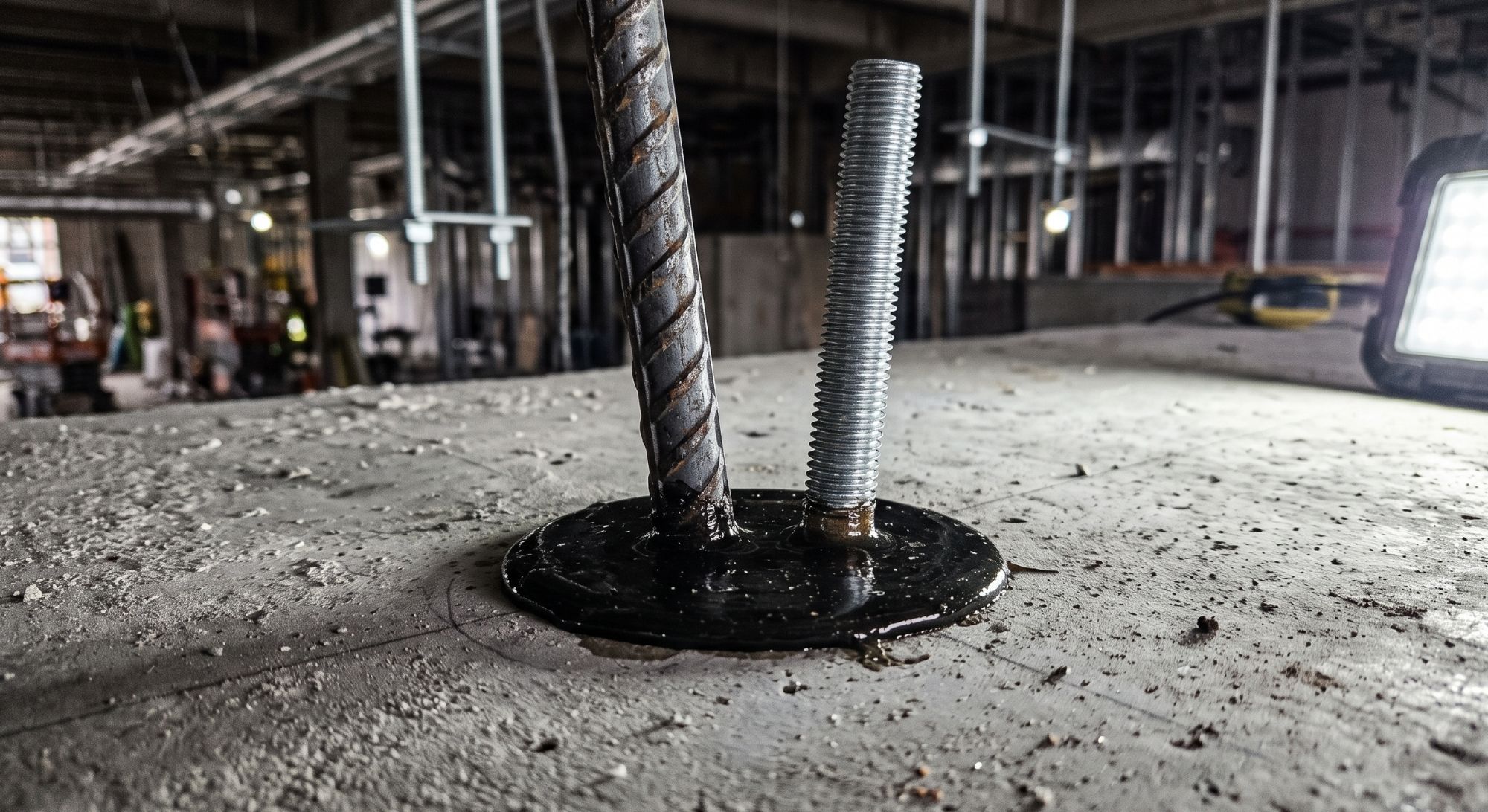
The rule is simple: use threaded rod when the steel has to carry an attachment, use a rebar dowel when the steel has to act as reinforcement, and use only the sizes, grades and finishes the evaluation report lists for the resin in your cartridge. On a real job, a threaded rod is all-thread cut to length and set in resin, with a nut and washer on the exposed end. It carries hanger rods, strut supports, equipment bases and railing posts. A rebar dowel is a deformed reinforcing bar set in resin so that a new slab, curb or pad ties into existing concrete. It does not carry a fixture. It carries continuity.
What Epoxy Anchor Bolts in Concrete Are on a Real Job
Start with the word, because the word is where the trouble starts. A cast-in anchor bolt is placed before the pour. In epoxy, “anchor bolt” is shorthand for something installed afterward, and the shorthand covers at least three parts: all-thread rod, rebar, and a headed bolt or stud. Only the first two are the subject here, because they are the two that get swapped.
Threaded rod is the electrical contractor’s everyday part. It hangs strut and trapeze racks, supports cable tray and conduit runs from a slab above, and holds equipment off a pad. ASTM F1554 is the specification for anchor bolts and rods in carbon, alloy and high-strength low-alloy steel, in headed and headless form, and its scope reaches all-thread rod used for anchoring to concrete. Read the grade before you read the diameter.
A rebar dowel is a different animal. ASTM A615 covers deformed and plain carbon-steel bars for concrete reinforcement, in four yield-strength grades. The deformations, the ribs and lugs on the bar, are what the concrete and the resin grip. Dowels extend a slab, tie a new pad into an old one and connect a new wall to an existing footing. The engineer designs a dowel as reinforcement, with the length it develops into the concrete set on the drawings, not as an anchor with a catalog rating.
How the Resin Holds a Rod and a Bar
Both parts hand load to the concrete through the resin, and they get a grip from the resin in different ways. A threaded rod is held by its threads. A rebar dowel is held by its lugs. Smooth steel gets less from resin than steel with something to key into, which is one reason a smooth pin cut from an offcut is not a substitute for either.
The acceptance criteria say the same thing in their name. ICC-ES AC308 is titled Post-installed Adhesive Anchors and Reinforcing Bars in Concrete Elements, one criteria document covering two products. Evaluation reports written against it list what a product was qualified with, and that list is short on purpose.
What the Evaluation Report Lets You Install
An evaluation report does not say “any steel.” It usually lists threaded rod in stated diameters and grades, reinforcing bar in stated sizes and grades, and sometimes other steel elements. The rod is part of the system the report covers. The resin is not approved alone.
That has three consequences for the order. Commodity all-thread often carries no grade marking, which means nobody can match it to anything, so rod bought for an adhesive anchor needs a known grade and paperwork that ties the lot to it. A No. 4 bar and a 1/2 inch rod share a nominal size and can call for different bit sizes, so the hole chart for the bar is not the chart for the rod. And a coating on the steel, whether galvanizing or an epoxy coat on rebar, changes the surface the resin bonds to, so the report has to cover the finish you are installing.
Construction & Electrical Products Inc. lists both electrical products and epoxy anchoring systems in its catalog, so the anchoring and the electrical side of a job can be quoted in one call, and Certificates of Compliance and Mill Test Reports are provided on request. A mill test report is the document that ties a lot of rod or bar to a grade. If the grade is not on paper, it is not on the job.
Rod Material and the Florida Environment
The buried part of a rod sits in concrete. The exposed end, the nut, the washer and the fixture do not. In South Florida, salt in the air and water that stays on a surface reach those parts first, and dissimilar metals in contact make it worse. Which steel you order decides how the connection looks in the third year.
Carbon steel, zinc-plated, hot-dip galvanized and stainless rod are four different purchases, and “stainless” is not a specification by itself. The grade inside that word decides how the part behaves near the coast, which is what 316 stainless fasteners for coastal Florida goes through in detail. The other half is the order line: specifying fastener grade and finish shows how to write a line that cannot be filled with a lookalike.
Material choice and resin approval are separate questions. A rod that suits the environment but is not listed in the report is not an adhesive anchor. A rod that is listed but wrong for the exposure is an anchor that stains and then corrodes. Commercial buyers who ignore environment always pay twice.
When to Choose Each One
Choose threaded rod when the steel carries an attachment
Pick rod when something is going to hang from it, bolt to it or stand on it: strut, trapeze, tray, a panel base, a railing post. The nut and washer put load on the steel, the steel puts it into the resin, and the report’s rod list tells you what was tested.
Choose a rebar dowel when the steel ties concrete to concrete
Pick a dowel when the job is continuity: a new slab to an old one, a curb to a wall, a pad to a footing. The drawings give the bar size, the spacing and how far it goes into the existing concrete. Those are the engineer’s values.
What decides it
The drawings decide it, and then the evaluation report confirms what the product accepts. If the detail shows a bar, the detail is a reinforcing detail. If it shows a rod with a nut, it is an anchor. Nobody in the field should be choosing between the two to save a trip to the yard.
Mistakes Made With Good Intentions
Every one of these comes from someone trying to keep the job moving, and each has a mechanism worth knowing.
A rebar offcut gets cut and used as a pin because it is on site and obviously strong. It has no thread for a nut and it is not the part the report covers, so strength was never the question. A larger rod goes in “for margin.” The hole size, the resin volume and the embedment were all set for the diameter on the drawing, and a bigger diameter moves every one of them. A rod comes out of the truck bin with no marking and gets installed because the threads look clean. A rod that sat out in a wet season gets set with surface rust and an oily film still on it, and the resin bonds to the film. A nut gets run down tight right after the rod is set, which loads resin that has not finished curing.
Watch for the signals. A rod that spins in the hole when the nut is snugged means the bond never formed. A bar that goes in with no resin showing at the collar means the hole was not filled from the bottom. A cut end with a burr that will not take the nut means the threads were damaged before the resin ever saw them.
The scale makes the habit expensive. Assume a crew sets 600 hanger rods in a week and one in twenty has to be pulled because its grade cannot be matched to the report. That is 30 rods to remove, re-drill, clean and reset, each with a fresh cartridge and nozzle. The fix is not luck, it is procedure.
What to Confirm Before You Order
Check the steel, its grade, its finish, its size and the evaluation report. If those five items are not clear, the order is not ready. Before the purchase order goes out, confirm:
- The drawing shows a rod or a bar, and the order matches it.
- The evaluation report for the exact resin lists that element, size and grade.
- The grade of the steel is known and the paperwork that ties the lot to it is available.
- The finish suits the exposure and is one the report covers.
- The hole size and embedment come from the manufacturer’s instructions and the drawings, not from the crew.
- The order line names grade and finish so that a lookalike cannot be shipped.
- The manufacturer’s instructions for the cartridge in hand are on site, and the technical section documents are kept as reference only.
For the hole itself, epoxy anchor hole size explains why the diameter belongs to the product, and the epoxy anchor installation steps cover everything from drilling to the record. Anchoring systems are listed in the online catalog.
Frequently Asked Questions
What is an epoxy anchor bolt?
Usually it is a threaded rod, or all-thread, set in resin in a drilled hole in concrete. The phrase is also used loosely for rebar dowels and headed bolts, so the order should say which one it means.
Can you use rebar instead of threaded rod in epoxy?
Only when the drawing calls for a bar and the evaluation report lists reinforcing bar for that product. Rebar and rod do different jobs, and one does not stand in for the other.
Can you use any threaded rod with epoxy?
No. Use the rod types, sizes and grades the evaluation report lists for that product. Unmarked all-thread of unknown grade cannot be matched to a report.
Is stainless threaded rod the right choice in coastal Florida?
Not automatically. The grade of stainless matters more than the word, and the rod still has to be one the evaluation report lists.
When can you tighten the nut on an epoxy anchor?
After the cure time in the manufacturer’s instructions for the concrete temperature on the day. Torque values come from the same instructions for the exact product.
Who decides rod diameter and embedment depth?
The engineer of record decides, using the evaluation report and the project design. The crew installs what the drawings and the instructions call for.
About Construction & Electrical Products Inc. Construction & Electrical Products Inc. is an independent distributor of construction, electrical, safety and industrial supplies based in Pompano Beach, Florida, with more than 50 years in the trade and more than 10,000 products in stock, including anchors, fasteners, drill bits, diamond products, saw blades, epoxy anchoring systems, cable ties, wire connectors, terminals, GFCI devices and emergency lighting. Orders ship with no minimum, drop shipment to the job site is available, and Certificates of Compliance and Mill Test Reports are provided on request. Read more about the company and browse the manufacturer documents in the technical section.
This article is general product and procurement information. It is not an engineering opinion, a design recommendation, or a substitute for the project specification. Anchor selection, embedment, spacing, edge distance and design capacity are determined by the engineer of record for the specific project, and the governing values are those published in the manufacturer’s current evaluation report and installation instructions for the exact part number. Construction & Electrical Products Inc. supplies products and manufacturer documentation. It does not design anchorage or perform engineering services.
The installation steps described here are general and may not apply to the product on your job. Always follow the manufacturer’s current printed instructions for the specific part number, diameter and base material, and follow all applicable OSHA requirements for drilling, silica dust control and personal protective equipment.
Get a Quote
Call 954-972-9787 or toll free 1-888-744-0442 and a salesperson will help you match the product to the job.
Construction & Electrical Products Inc. 1800 NW 15th Ave #155 Pompano Beach, FL 33069 Phone: 954-972-9787 · Toll free: 1-888-744-0442 Email: sales@constructionandelectrical.com Hours: Monday through Friday, 8:30 a.m. to 4:00 p.m. Closed Saturday and Sunday. No minimum order. Same-day shipping on most items. Drop shipment to the job site available. Certificates of Compliance and Mill Test Reports on request.
